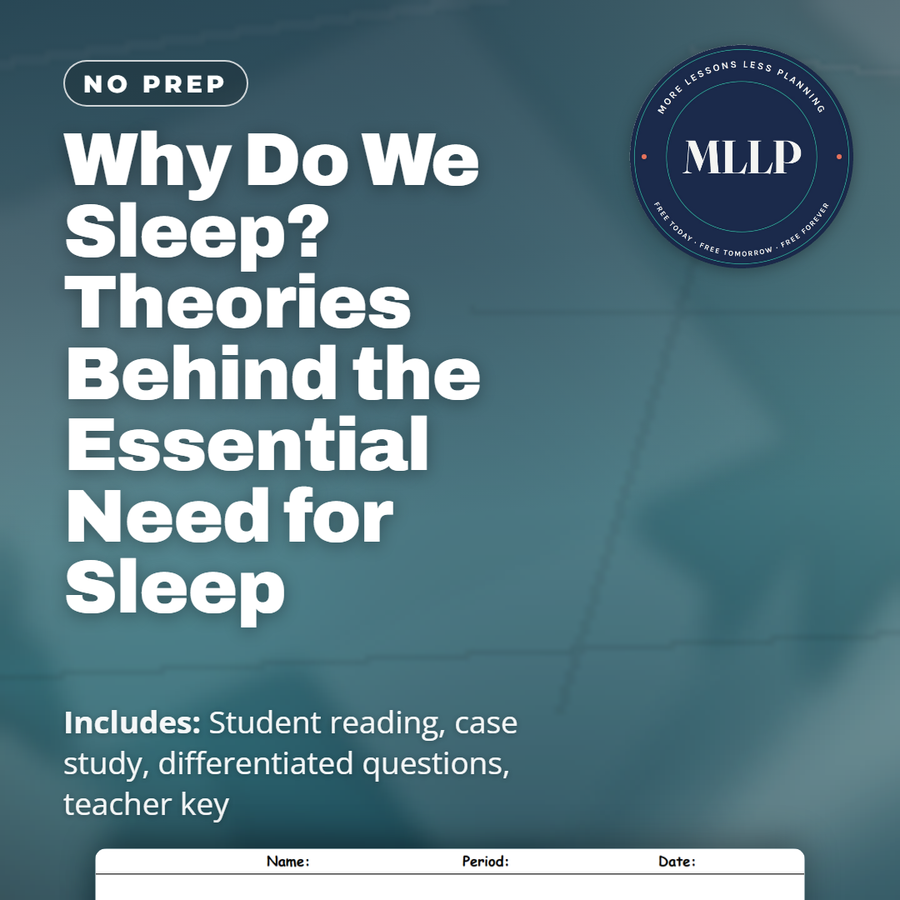
Why Do We Sleep? Theories Behind the Essential Need for Sleep
Quality reviewed September 2026
Facts verified September 10, 2026
- Subject
- Social Studies
- Grades
- Grades 9-12
- Length
- 7-page student worksheet
- Time
- About one 50-minute class period
- Great for
- Sub plans and independent work
- Includes
- Reading passage, comprehension questions + full answer key
- Format
- Print-and-go PDF
What students do
- Match terms like restorative theory, evolutionary theory, and brain plasticity theory to their correct definitions
- Fill in the blank sentences on memory consolidation, the evolutionary theory, and the restorative theory
- Answer multiple choice questions on avoiding predators, REM sleep and memory, and the student memory case study
- Write short answers on the brain plasticity theory, evidence from the athletes' case study, and REM deprivation's effect on emotional health
What it covers
- The restorative theory, evolutionary theory, and brain plasticity theory of why we sleep
- How sleep supports physical recovery, memory consolidation, and emotional regulation
- Two case studies, one on athletes and extended sleep and one on students, sleep, and memory retention
Start reading this worksheet
Introduction to Sleep: An Essential Biological Function
Sleep is a universal need across all animal species, serving as a critical part of health and survival. For humans, sleep is essential for both physical and mental well-being. But why do we sleep? Scientists have explored this question through various theories, each proposing different explanations for the purpose of sleep. The most well-known theories include the restorative theory, which suggests that sleep allows the body to repair and recover, and the evolutionary theory, which proposes that sleep evolved as a survival mechanism. By examining these theories, we can better understand why sleep is not only essential but also highly complex.
The Restorative Theory of Sleep
The restorative theory posits that sleep allows the body to repair itself and rejuvenate. During sleep, particularly during the deep stages of Non-Rapid Eye Movement (NREM) sleep, several vital processes occur. Tissues grow and repair, the immune system strengthens, and the brain clears out waste products, including those that could lead to neurodegenerative diseases over time. This theory is supported by findings that show a clear connection between sleep and physical recovery. For instance, growth hormones—which play a major role in tissue growth and repair—are primarily released during sleep. Similarly, the immune system becomes more active during sleep, fighting off infections and ensuring we stay healthy. The restorative theory helps explain why people who experience long periods of sleep deprivation often suffer from weakened immune systems, poor physical performance, and cognitive decline.
The Evolutionary Theory of Sleep
The evolutionary, or adaptive, theory of sleep proposes that sleep developed as a survival mechanism. According to this theory, animals (including humans) evolved to sleep at times when they were less likely to encounter predators or other dangers. By sleeping during the night, humans and other animals can avoid potential threats and conserve energy. While we may not think about this on a daily basis, humans are biologically programmed to be less active at night due to poor night vision compared to other species. Our ancestors may have found it safer to stay inactive and hidden during the hours of darkness. This theory also explains why certain animals, such as nocturnal creatures, sleep during the day and are active at night. Their sleep patterns evolved to align with their needs and vulnerabilities in their respective environments.
Like what you read? The full reading, the case study, and every question set are in the free download below, along with the answer key.
Why this matters
Ask why we sleep and most students give one answer: to rest. This reading offers three competing theories instead, restorative, evolutionary, and brain plasticity, backed by two case studies: athletes who extended their sleep and students whose memory retention tracked their sleep.
Setting the two case studies side by side teaches something a list of theories cannot. Once students weigh what extended sleep meant for the athletes against what sleep meant for memory retention in the other group, they have actual evidence to reason from when asked what REM deprivation does to emotional health, not just a guess.
From one teacher to another
I use this reading to open the sleep unit because it lays out three competing theories, restorative, evolutionary, and brain plasticity, instead of just telling students sleep is important. The athlete case study on extended sleep and the student memory retention case study give them two different angles to work through in the questions, and both come up again in the short answer section. The matching and fill-in-the-blank parts keep the three theories separate before students have to explain REM deprivation and emotional health in their own words.
What you get
Download
Where should I send the next one?
Everything here is free and it stays that way. Leave your email and I'll send you the new lessons as they go up. You can unsubscribe from any one of them.
Related resources
Classical Conditioning Explained: Pavlov and Beyond
False Memories: How Our Minds Create Misinformation
How We Remember: An Overview of Memory Processes
Operant Conditioning Basics: Reinforcement, Punishment, and Behavior
Sleep Disorders and Their Impact on Health: Insomnia to Narcolepsy
Stages of Sleep: NREM, REM, and Their Effects on Health
Every lesson on this site is free to download and use. If one of them saved you a prep period, you can chip in a few bucks toward my three kids' daycare fund. That's genuinely where tips go.