Why Do We Pay Taxes - Where Your Money Goes
Quality reviewed September 2026
- Grades
- Grades 9-12
- Time
- About two 50-minute class periods
- Includes
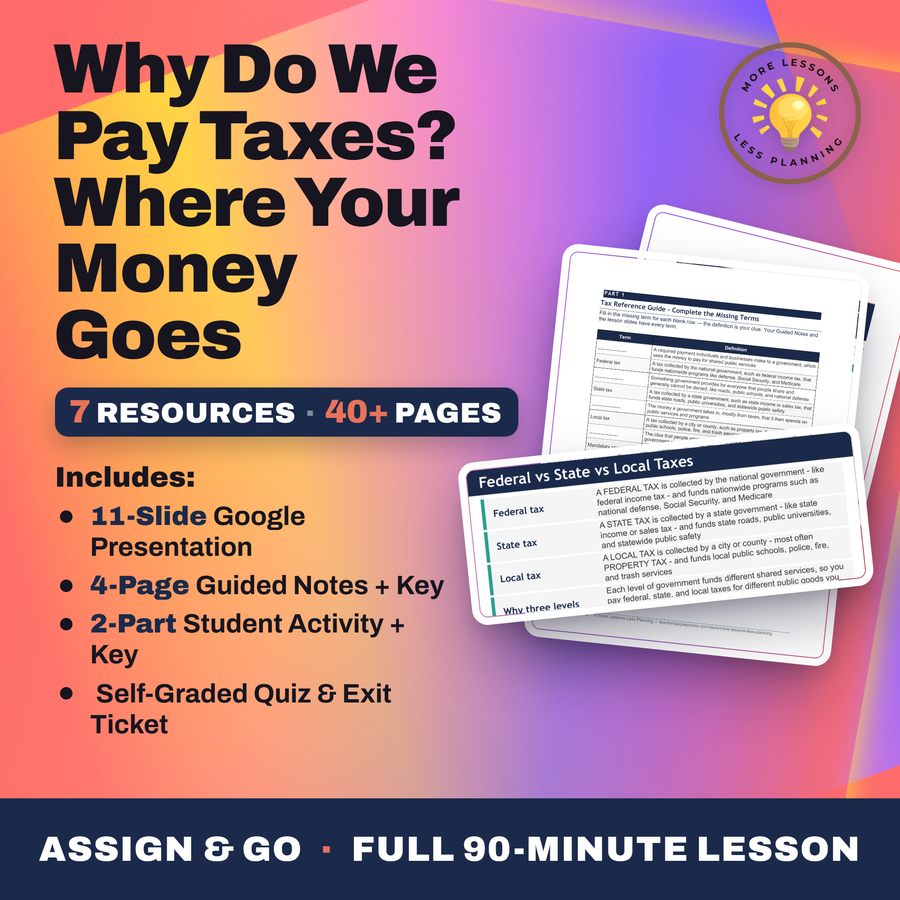
- 11 ready-to-teach files
- Format
- Word (.docx) · PowerPoint (.pptx)
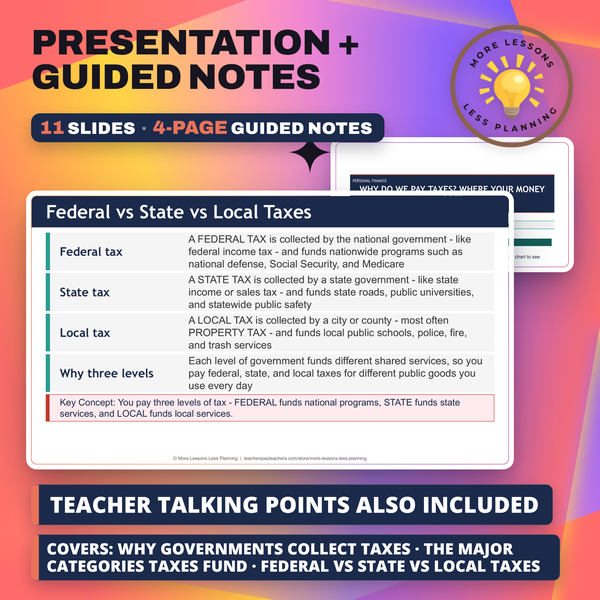
- Slide deck
- Guided notes
- Guided notes teacher key
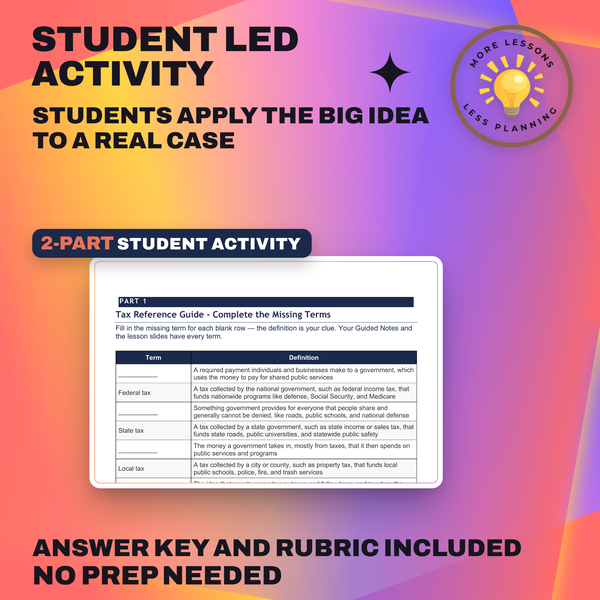
- Activity + answer key
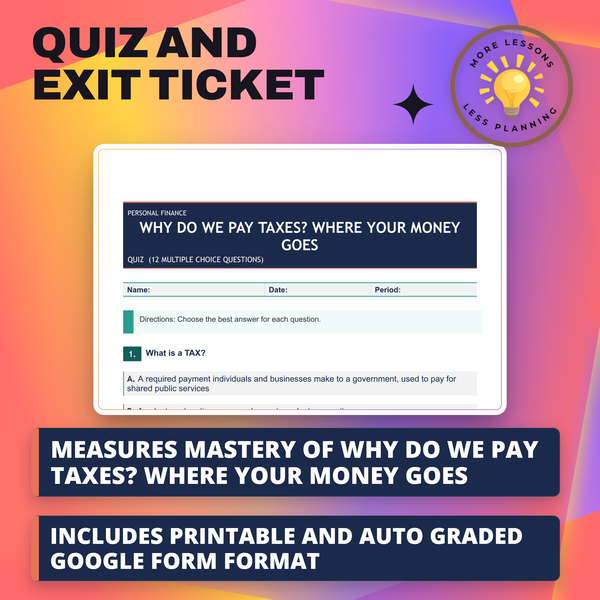
- Quiz + answer key
- Exit ticket + answer key
- Teacher guide
- Teacher presentation notes
What students do
- Read a "where each $100 goes" pie chart to find the largest slice and the two largest single program areas
- Calculate combined shares, like health programs plus Social Security, to see how much of every federal dollar they consume together
- Distinguish federal, state, and local taxes by naming which level funds roads, schools, and public safety
- Write a recommendation to a town council naming two funding priorities and explaining the trade-off with limited revenue
What it covers
- The free-rider problem, and why it makes taxes required instead of voluntary
- A "where each $100 goes" federal-spending pie chart, separating the largest catch-all slice from the two largest programs
- The difference between federal, state, and local taxes, tied to who actually funds a school versus an interstate
- Advising a fictional town council on two funding priorities under genuinely limited revenue
Learning targets
- Explain WHY governments collect taxes and what a public good is
- Describe the major categories taxes FUND, using the federal-spending pie chart to see where each $100 goes
- Distinguish FEDERAL vs STATE vs LOCAL taxes and what each level of government funds
- Explain the SOCIAL CONTRACT idea and what would happen to shared services WITHOUT taxes
Peek inside
✔
Taxes pay for shared services
A TAX is a required payment to a government, which uses the REVENUE to pay for services everyone shares
✔
They fund public goods
Taxes Pay for Shared Services
A TAX is a required payment to a government, which uses the REVENUE to pay for services everyone .
A PUBLIC GOOD is something government provides for everyone - roads, public schools, national - that people share.
No One Person Would Pay Alone
You would never build a highway or an army by yourself; taxes let a whole community POOL money for things too big for one .
Because everyone benefits from public goods, taxes are REQUIRED, not .
1. A required payment individuals and businesses make to a government, which uses the money to pay for shared public services, is a .
Why this matters
If paying for the fire department were optional, the truck still shows up when a neighbor's house burns, so why would anyone pay? That free-rider problem is why taxes are required. Students read a spending pie chart and separate one catch-all slice, $28, from the two real programs behind it, health at $24 and Social Security at $22.
Students lump federal, state, and local taxes into one idea, so I make them trace which level funds their school versus the interstate near their house. The lesson ends with them advising a town council on two priorities under limited revenue, naming a trade-off, since one dollar can't fund both.
From one teacher to another
I anchor this lesson on the free-rider question, because it's the real reason taxes have to be required instead of optional: if paying for the fire department were voluntary, the truck still shows up when your neighbor calls, so why would anyone actually pay. From there students read an actual federal-spending pie chart framed as "where each $100 goes," and I make them separate the largest single slice, the $28 interest-and-everything-else catch-all, from the two largest actual programs, health at $24 and Social Security at $22, because those two get conflated constantly. They do real addition with the numbers too, confirming that all five categories sum to exactly $100 and calculating for themselves just how much of every federal dollar health and Social Security consume together. The federal-versus-state-versus-local piece gets grounded in their own lives, tracing which level of government actually pays for their school versus the interstate near their house. Everything closes with a scenario where they advise a fictional town council with genuinely limited revenue, and I require they name two real priorities and explain the trade-off honestly, since every dollar spent on one thing is a dollar not spent on another.
Every file in this toolkit
-
Activity (Student)
The brand-new town of Riverbend has to fund roads, a school, police, and fire, so Sam Rivera has students read a pie chart of federal spending, add all five slices to $100, then rank services against limited revenue.
-
Activity (Answer Key)
Health programs and Social Security together claim $46 of every $100 in federal spending on this chart, with defense and income security tied at $13 each and the catch-all interest-and-everything-else slice topping them all at $28.
-
Exit Ticket (Student)
Why governments collect money at all starts the quiz, then a $24 health slice and a $22 Social Security slice from a federal spending chart get named before the social contract itself gets defined. Tax, public good, and social contract belong in the closing paragraph.
-
Exit Ticket (Answer Key)
Naming tax, public good, and social contract correctly earns full credit here, since the sample response ties a fire department's funding to the free-rider problem that taxes solve.
-
Guided Notes (Student)
Twenty-four dollars of every $100 in federal spending goes to health programs and $22 to Social Security, and those two slices build toward the free-rider problem and three tax definitions.
-
Guided Notes (Teacher Key)
$28 out of every $100 is the largest single slice on the completed spending pie, next to health at $24, Social Security at $22, and the federal, state, and local tax definitions.
-
Quiz (Student)
Defining a public good is one of several questions, next to a $24-and-$22 federal spending chart and what a federal, state, or local tax actually funds at each level of government.
-
Quiz (Answer Key)
$13 apiece for national defense and income security are marked correct, alongside the $24-and-$22 program pair, property tax funding local schools and fire service, and the social contract definition.
-
Slides
Every $100 of federal spending splits into about $24 for health programs and $22 for Social Security on this deck's pie chart, before it separates what federal, state, and local taxes each fund and closes on the free rider problem.
-
Teacher Guide
Health programs and Social Security together claim $46 of every $100 the federal government spends, the split this guide's pie chart opens with. Extensions design a personal $100 budget, trace one real tax a family actually pays, and rank funding priorities in a Riverbend town-council debate.
-
Teacher Presentation Notes
Of every $100 the federal government spends, $24 goes to health and $22 to Social Security, the two biggest slices ahead of defining the social contract and what disappears without tax revenue to fund it.
Download
Where should I send the next one?
Everything here is free and it stays that way. Leave your email and I'll send you the new lessons as they go up. You can unsubscribe from any one of them.
Related resources
Self-Employment Taxes: The Gig Worker's Surprise
Tax Refunds: Why a Big One Isn't a Win
Banking Basics: Checking, Savings, and Debit Cards Explained

Big Purchase Planning: Save for Gadgets & More
Bonds - Lending to Governments and Companies
Budgeting Apps - Mint, YNAB and Your Phone
Every lesson on this site is free to download and use. If one of them saved you a prep period, you can chip in a few bucks toward my three kids' daycare fund. That's genuinely where tips go.