Self-Employment Taxes: The Gig Worker's Surprise
- Slide deck
- Guided notes
- Guided notes teacher key
- Activity + answer key
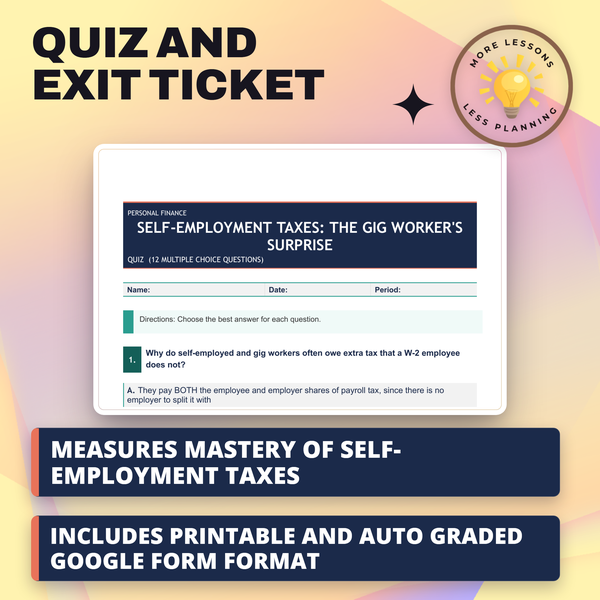
- Quiz + answer key
- Exit ticket + answer key
- Teacher guide
- Teacher presentation notes
Where should I send the next one?
Everything here is free and it stays that way. Leave your email and I'll send you the new lessons as they go up. You can unsubscribe from any one of them.
Every file in this toolkit
Related resources
Tax Refunds: Why a Big One Isn't a Win
Bonds - Lending to Governments and Companies
Financial Goals - Short, Medium and Long Term
Health Insurance - The Most Confusing Bill You'll Get
Hourly vs Salary: Which Job Actually Pays More?

Impulse Buying - How Stores Trick You
What students do
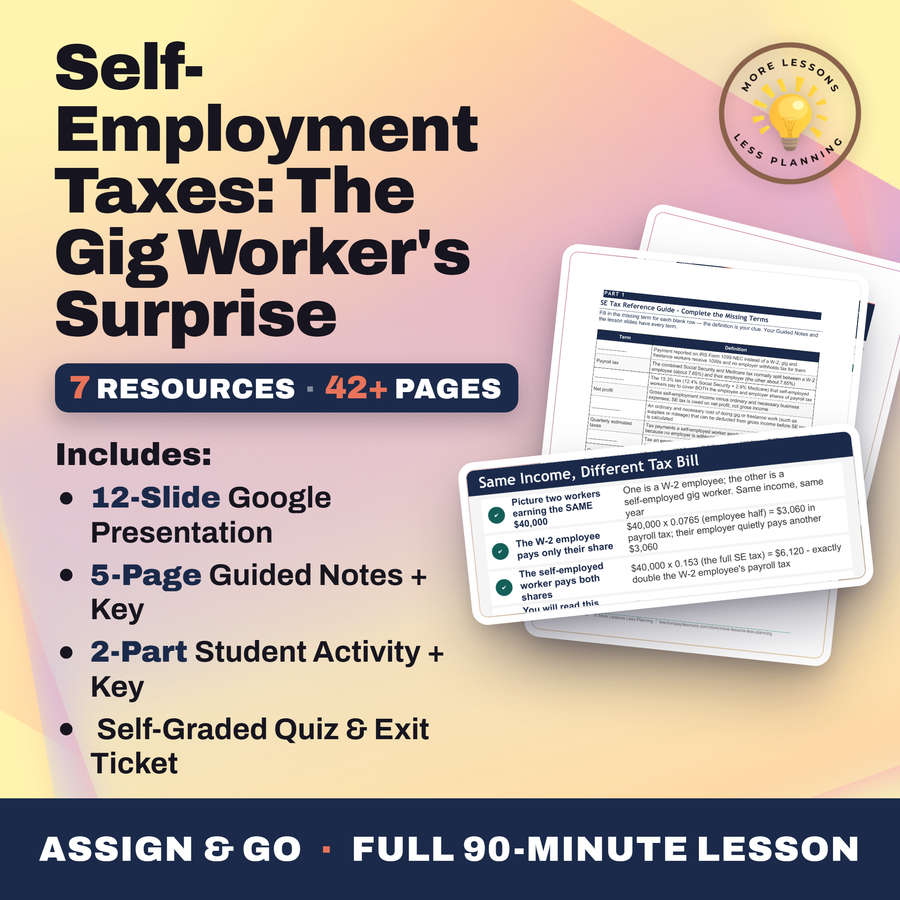
- Calculate self-employment tax on net profit using the 15.3% labeled model
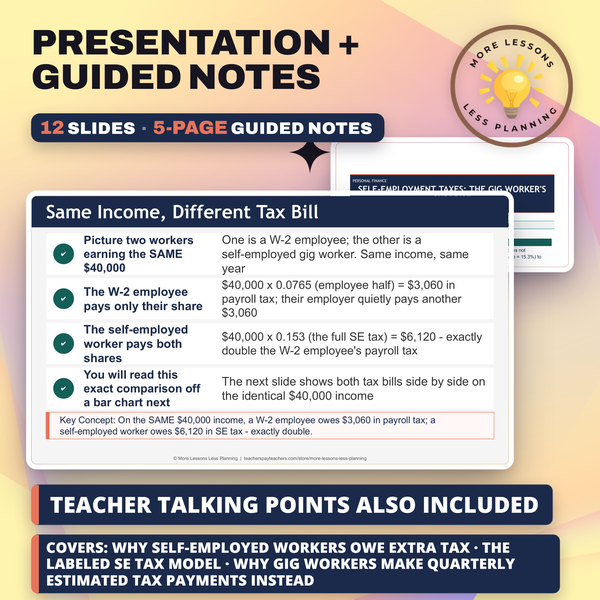
- Compare tax owed by a W-2 employee versus a self-employed worker on identical income
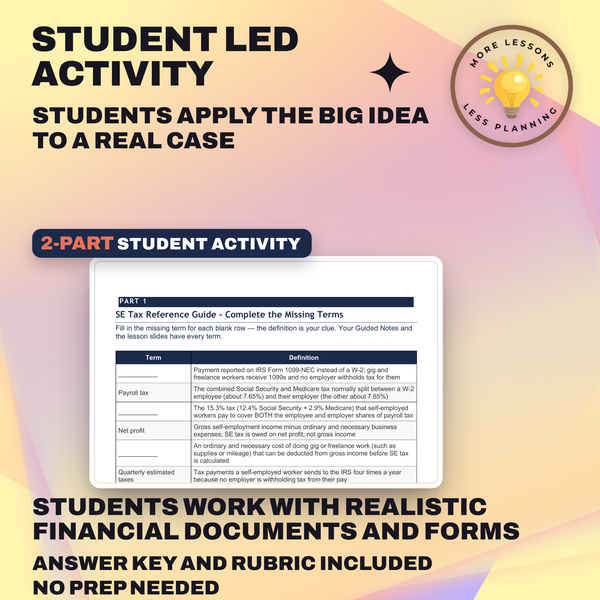
- Deduct real business expenses from gross income to find the net profit SE tax applies to
- Split a full-year tax bill into four quarterly estimated payments
What it covers
- Why 1099 income has no withholding, unlike a W-2 paycheck
- How the 15.3% SE tax breaks into a 12.4% Social Security and 2.9% Medicare share
- Why the self-employed pay both the employee and employer halves of payroll tax
- The 25 to 30 percent set-aside rule for taxes on every gig payment
Learning targets
- Explain why self-employed workers owe extra tax that a W-2 employee does not
- Apply the LABELED SE tax model (12.4% Social Security + 2.9% Medicare = 15.3%) to calculate SE tax on gig income
- Explain why gig workers make quarterly estimated tax payments instead of having tax withheld
- Calculate how deducting ordinary and necessary business expenses lowers SE tax owed on NET profit
From one teacher to another
I don't let the surprise stay a surprise here, so instead of a vague warning the lesson opens on Casey's actual numbers, a full year of 1099 pay with nothing withheld, followed by a tax bill that lands exactly double what a W-2 friend owes on identical income. As peer mentor Jordan Reyes, students work that 15.3% split into its Social Security and Medicare pieces and see for themselves why it lands twice as hard. The habit I build the ending around is simple, set aside a quarter of every payment right away, since that's the fix nobody hands gig workers before their first paycheck.
Every lesson on this site is free to download and use. If one of them saved you a prep period, you can chip in a few bucks toward my three kids' daycare fund. That's genuinely where tips go.