Why Do We Love Horror?
Quality reviewed September 2026
Facts verified September 9, 2026
- Subject
- Social Studies
- Grades
- Grades 9-12
- Length
- 6-page student worksheet
- Time
- About one 50-minute class period
- Great for
- Sub plans and independent work
- Includes
- Reading passage, comprehension questions + full answer key
- Format
- Print-and-go PDF
What students do
- Explain the fight-or-flight response and how it activates during horror experiences
- Analyze the Little Albert study and how fear can be conditioned through association
- Compare dopamine release in thrill-seekers versus those who avoid horror
- Evaluate social and cultural reasons people seek out scary entertainment
What it covers
- Psychology of fear and the fight-or-flight response
- Fear conditioning and learned behavior
- Brain chemistry and cultural factors in thrill-seeking
Start reading this worksheet
The Psychology of Fear
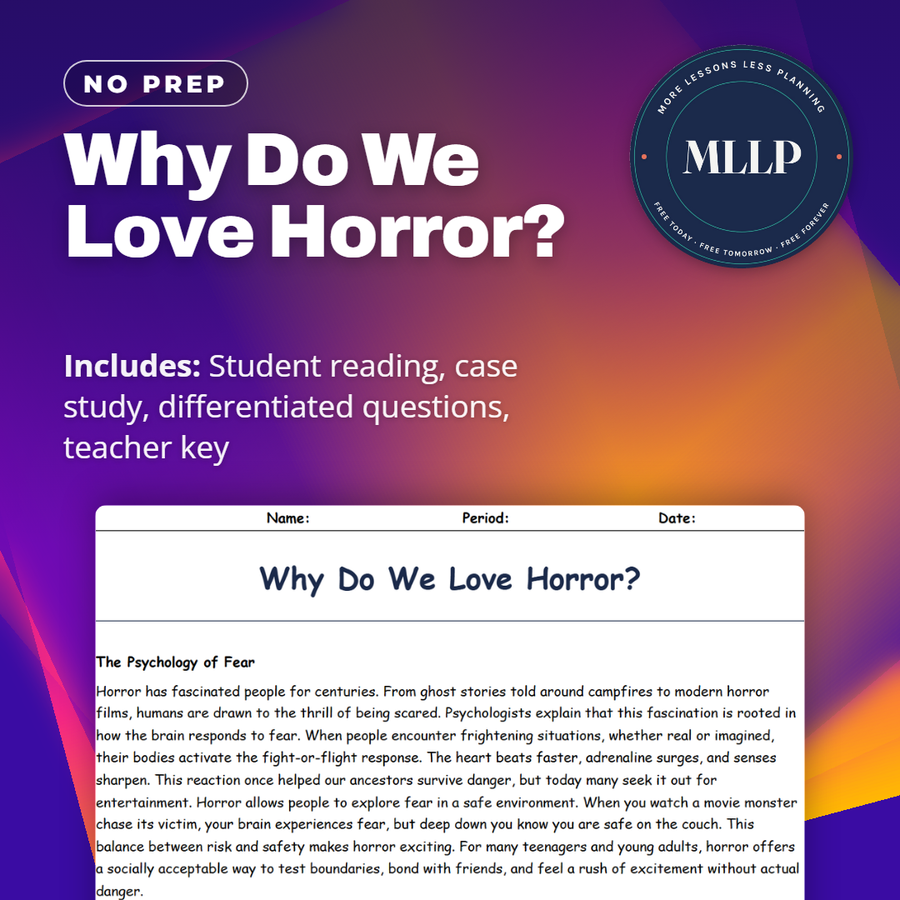
Horror has fascinated people for centuries. From ghost stories told around campfires to modern horror films, humans are drawn to the thrill of being scared. Psychologists explain that this fascination is rooted in how the brain responds to fear. When people encounter frightening situations, whether real or imagined, their bodies activate the fight-or-flight response. The heart beats faster, adrenaline surges, and senses sharpen. This reaction once helped our ancestors survive danger, but today many seek it out for entertainment. Horror allows people to explore fear in a safe environment. When you watch a movie monster chase its victim, your brain experiences fear, but deep down you know you are safe on the couch. This balance between risk and safety makes horror exciting. For many teenagers and young adults, horror offers a socially acceptable way to test boundaries, bond with friends, and feel a rush of excitement without actual danger.
Thrill-Seeking and the Brain
Not everyone enjoys horror equally. Studies suggest that some people are more likely to seek out thrilling experiences, including roller coasters, extreme sports, and horror films. These individuals may have brains that release more dopamine, a chemical linked to pleasure and reward, when facing fear. In other words, what terrifies one person may thrill another. Cultural factors also play a role. In societies that value bravery and toughness, enjoying horror may be seen as a sign of strength. For others, horror provides a safe way to confront social anxieties or hidden fears. Movies and haunted houses allow people to “practice” handling fear, which may make them more resilient in stressful real-life situations.
Like what you read? The full reading, the case study, and every question set are in the free download below, along with the answer key.
Why this matters
Two students can watch the same slasher movie and walk out with opposite reactions, one wanting to go again, one never wanting to see it again. The difference is not courage, it is chemistry: fear triggers a bigger dopamine release in some brains than others.
A student once told me they finally understood why their best friend loves haunted houses while they refuse to go near one. The Little Albert study shows how fear gets attached to ordinary objects through association, which is why one person's scary is another person's boring. The explanation moves from character to biology.
From one teacher to another
Students are always surprised to learn that enjoying horror isn't a personality quirk. It's neuroscience. Some brains release more dopamine during fear, and that feels good. The Little Albert experiment gets them thinking about how fear gets built into everyday objects through association. I've had students say they finally understand why their friend loves haunted houses while they don't. It takes the judgment out of it and puts the explanation squarely on biology and experience.
What you get
Download
Where should I send the next one?
Everything here is free and it stays that way. Leave your email and I'll send you the new lessons as they go up. You can unsubscribe from any one of them.
Related resources
Every lesson on this site is free to download and use. If one of them saved you a prep period, you can chip in a few bucks toward my three kids' daycare fund. That's genuinely where tips go.