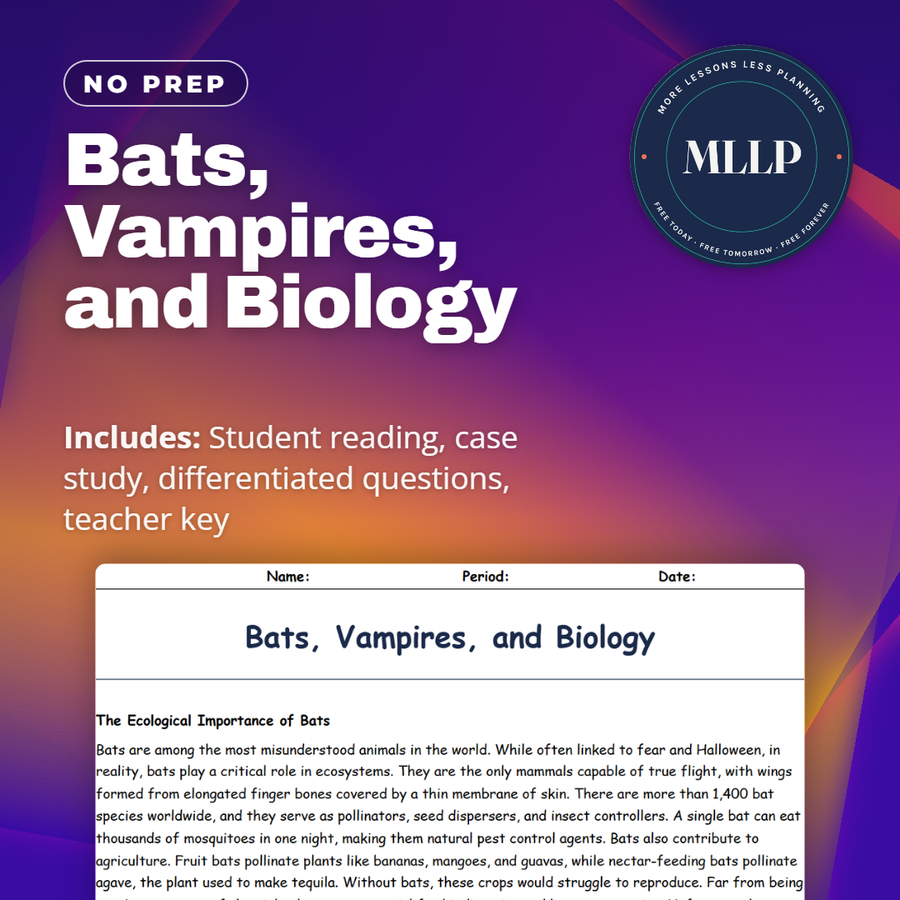
Bats, Vampires, and Biology
Quality reviewed September 2026
Facts verified September 9, 2026
- Subject
- Science
- Grades
- Grades 9-12
- Length
- 6-page student worksheet
- Time
- About one 50-minute class period
- Great for
- Sub plans and independent work
- Includes
- Reading passage, comprehension questions + full answer key
- Format
- Print-and-go PDF
What students do
- Distinguish vampire myths from real bat behavior based on scientific evidence
- Analyze how fear of disease exaggerated the danger posed by vampire bats to livestock
- Evaluate ranching solutions that balance livestock protection with ecosystem health
- Explain how vampire bat saliva has unexpected medical applications for human health
What it covers
- Bat ecology and pollination services
- Vampire bat behavior versus folklore
- Evolution of myths versus scientific understanding
Start reading this worksheet
The Ecological Importance of Bats
Bats are among the most misunderstood animals in the world. While often linked to fear and Halloween, in reality, bats play a critical role in ecosystems. They are the only mammals capable of true flight, with wings formed from elongated finger bones covered by a thin membrane of skin. There are more than 1,400 bat species worldwide, and they serve as pollinators, seed dispersers, and insect controllers. A single bat can eat thousands of mosquitoes in one night, making them natural pest control agents. Bats also contribute to agriculture. Fruit bats pollinate plants like bananas, mangoes, and guavas, while nectar-feeding bats pollinate agave, the plant used to make tequila. Without bats, these crops would struggle to reproduce. Far from being spooky creatures of the night, bats are essential for biodiversity and human economies. Unfortunately, habitat destruction and human fears have caused many bat populations to decline, threatening both ecosystems and agriculture.
The Myth of Vampire Bats
The association between bats and vampires comes from folklore. Stories of blood-drinking creatures spread in Europe long before people discovered real vampire bats in Central and South America. Out of all bat species, only three feed on blood: the common vampire bat, the hairy-legged vampire bat, and the white-winged vampire bat. These bats usually feed on livestock, making small cuts with their sharp teeth and licking the blood. They do not suck blood like the vampires in stories, and their saliva contains chemicals that prevent blood clotting. While the idea of bats as bloodsuckers fuels myths and horror stories, scientists have found valuable medical uses in vampire bat saliva. The anticoagulant proteins have been studied for treating strokes and blood clots. This shows how even the most feared species can have surprising benefits when studied scientifically.
Like what you read? The full reading, the case study, and every question set are in the free download below, along with the answer key.
Why this matters
Only three of more than 1,400 bat species feed on blood, but folklore treats every bat like a monster. A single bat eats thousands of mosquitoes a night, so when a rabies scare pushed ranchers to kill bats on sight, farms lost the pest control and pollination those bats provided for free.
Once my students see vampire bat saliva turning up in real medical research for stroke treatment, the myth versus science divide stops feeling abstract. They start asking what other folk fears might be covering for an animal doing more good than harm.
From one teacher to another
Bats terrify people, but they're essential to ecosystems. A single bat eats thousands of mosquitoes every night, and only three out of 1,400+ species feed on blood, yet folklore treats all bats as monsters. The real kicker is when students learn how fear drove ranchers to kill bats during a rabies scare, which actually harmed farms by removing pest control and pollination. That shift from myth to science is what makes this worksheet stick.
What you get
Download
Where should I send the next one?
Everything here is free and it stays that way. Leave your email and I'll send you the new lessons as they go up. You can unsubscribe from any one of them.
Related resources
Every lesson on this site is free to download and use. If one of them saved you a prep period, you can chip in a few bucks toward my three kids' daycare fund. That's genuinely where tips go.