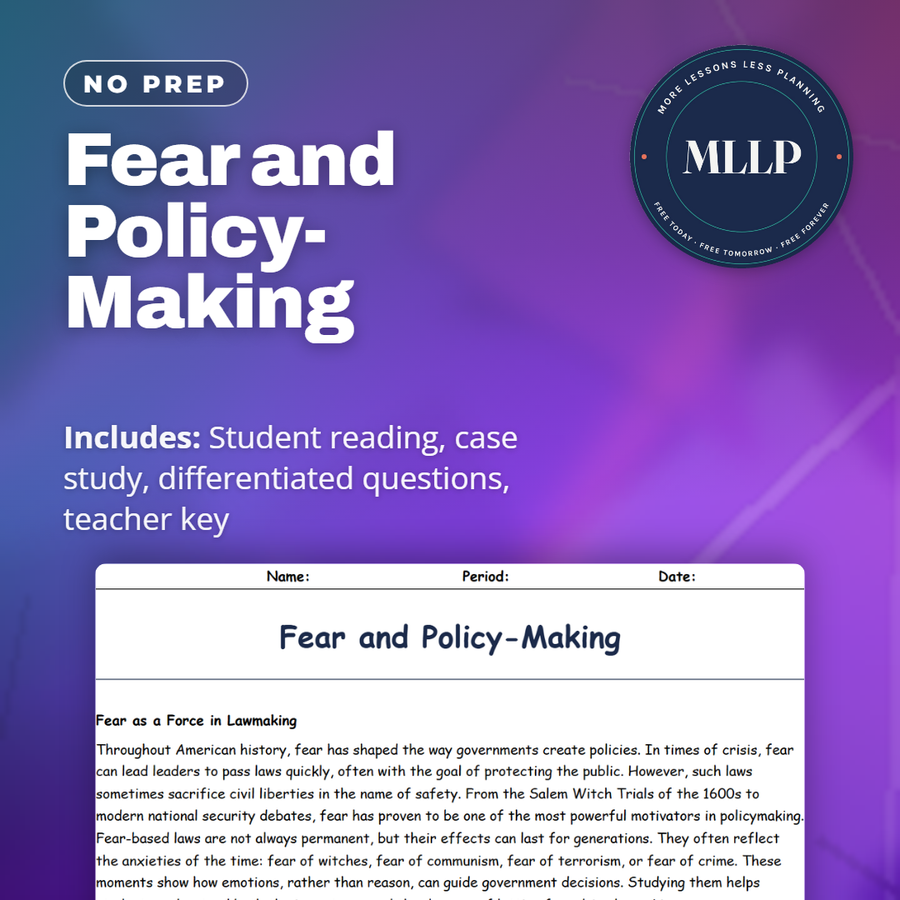
Fear and Policy-Making
Quality reviewed September 2026
Facts verified September 9, 2026
- Subject
- Social Studies
- Grades
- Grades 9-12
- Length
- 6-page student worksheet
- Time
- About one 50-minute class period
- Great for
- Sub plans and independent work
- Includes
- Reading passage, comprehension questions + full answer key
- Format
- Print-and-go PDF
What students do
- Trace how fear of different threats shaped American laws across centuries and contexts
- Analyze the Salem Witch Trials, Red Scare, and post-9/11 policies for patterns of emotion over evidence
- Evaluate trade-offs between national security and civil liberties in fear-based legislation
- Explain why fear-driven laws often seem justified in the moment but controversial in retrospect
What it covers
- Historical examples of fear-based legislation
- Impact of fear on civil liberties and freedom of speech
- Balance between security and constitutional rights
Start reading this worksheet
Fear as a Force in Lawmaking
Throughout American history, fear has shaped the way governments create policies. In times of crisis, fear can lead leaders to pass laws quickly, often with the goal of protecting the public. However, such laws sometimes sacrifice civil liberties in the name of safety. From the Salem Witch Trials of the 1600s to modern national security debates, fear has proven to be one of the most powerful motivators in policymaking. Fear-based laws are not always permanent, but their effects can last for generations. They often reflect the anxieties of the time: fear of witches, fear of communism, fear of terrorism, or fear of crime. These moments show how emotions, rather than reason, can guide government decisions. Studying them helps students understand both the importance and the dangers of letting fear drive lawmaking.
Historical Examples of Fear-Based Laws
One of the earliest examples comes from the Salem Witch Trials in 1692. In the face of panic about witchcraft, colonial courts accepted spectral evidence—dreams and visions—as proof of guilt. This undermined fair trials and led to wrongful executions. Fear of the supernatural outweighed reason and justice. Centuries later, fear influenced policy again during the Red Scare of the 1950s. In an effort to fight communism, Congress held hearings to expose suspected communists in government, schools, and Hollywood. Many innocent people were blacklisted, losing their jobs and reputations without real evidence. In this case, fear of a political ideology drove laws and investigations that limited freedom of speech and association. A more recent example comes from the aftermath of September 11, 2001, when Congress passed the USA PATRIOT Act. The law expanded surveillance powers to prevent terrorism, but critics argued it reduced privacy rights. While fear of terrorism justified the law at the time, its long-term effects on civil liberties are still debated today.
Like what you read? The full reading, the case study, and every question set are in the free download below, along with the answer key.
Why this matters
Salem's courts convicted people using dreams entered as spectral evidence. Decades later the Red Scare ended careers on suspicion alone, and after September 11 the PATRIOT Act expanded government power while fear of terrorism was still raw. Laid end to end, three centuries produce the same pattern with a different threat attached.
Treated separately, each of these looks like an isolated mistake made by people who should have known better. Lined up together, they show something harder to guard against: a law passed in panic can feel justified in the moment and only look reckless once the fear passes. That pattern is what students end up hunting for in the news.
From one teacher to another
Understanding fear's role in lawmaking is critical in democracy, and history shows why. Salem courts accepted dreams as spectral evidence. The Red Scare destroyed careers based on suspicion alone. The PATRIOT Act followed terrorism fears. Each time, people suffered for laws written in panic. When students trace this pattern across centuries, they start asking whether fear is driving laws today. That critical lens is what this worksheet builds.
What you get
Download
Where should I send the next one?
Everything here is free and it stays that way. Leave your email and I'll send you the new lessons as they go up. You can unsubscribe from any one of them.
Related resources
Every lesson on this site is free to download and use. If one of them saved you a prep period, you can chip in a few bucks toward my three kids' daycare fund. That's genuinely where tips go.