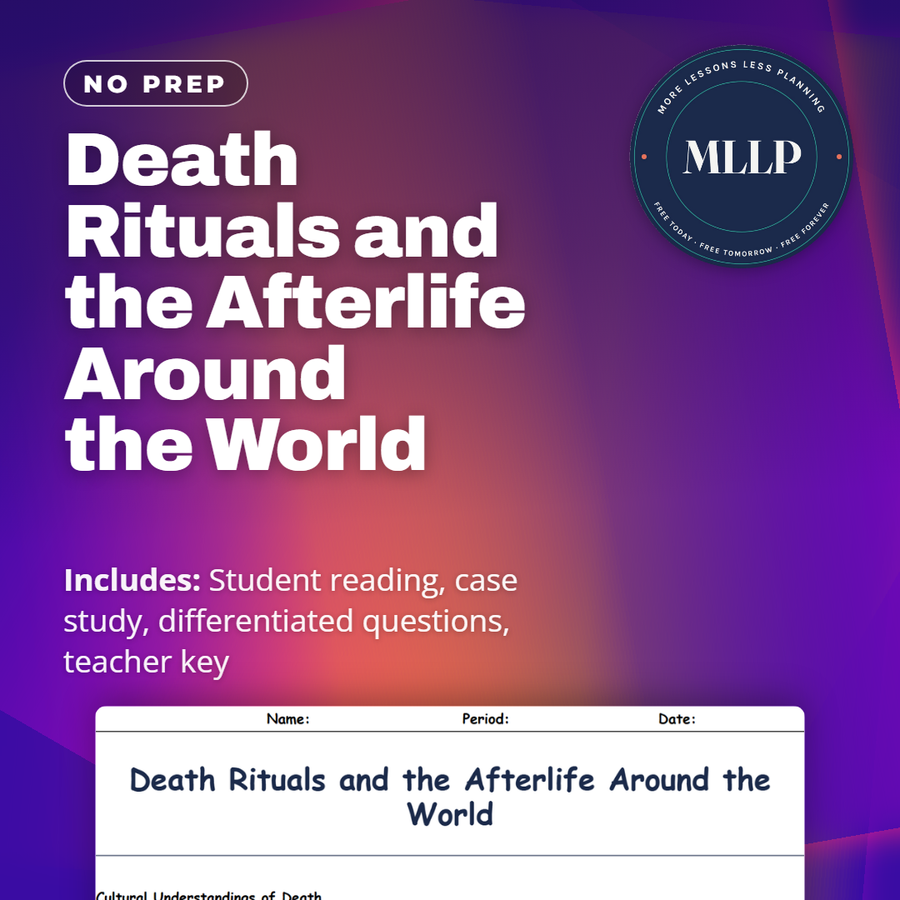
Death Rituals and the Afterlife Around the World
Quality reviewed September 2026
Facts verified September 9, 2026
- Subject
- Social Studies
- Grades
- Grades 9-12
- Length
- 7-page student worksheet
- Time
- About one 50-minute class period
- Great for
- Sub plans and independent work
- Includes
- Reading passage, comprehension questions + full answer key
- Format
- Print-and-go PDF
What students do
- Compare how different cultures honor the dead through rituals, festivals, and beliefs
- Analyze the connection between Día de los Muertos celebrations and Egyptian burial practices
- Examine how cultural values and beliefs shape approaches to death and remembrance
- Evaluate the role of festivals in helping communities process grief and maintain bonds with ancestors
What it covers
- Global death rituals and funeral practices
- Cultural and religious beliefs about the afterlife
- Festivals celebrating ancestors and the dead
Start reading this worksheet
Cultural Understandings of Death
Every society has developed unique ways of understanding and honoring death. While death is a universal human experience, the beliefs, rituals, and symbols surrounding it vary widely. Some cultures view death as the end of existence, while others see it as a transition to another realm or even a rebirth. These interpretations shape funeral practices, mourning traditions, and holidays devoted to remembering the dead. By examining these rituals, we can learn how cultures find meaning in loss and preserve connections with those who have passed away. For example, in ancient Egypt, belief in the afterlife shaped nearly every aspect of society. Egyptians mummified their dead, built pyramids and tombs, and placed treasures beside bodies for use in the next world. In contrast, cultures influenced by Eastern religions—such as Hinduism and Buddhism—view death through the lens of reincarnation. Instead of being an ending, death is part of a cycle of rebirth, with rituals designed to ensure a better next life. These examples reveal how diverse human societies have created rituals to face mortality and express their deepest spiritual values.
Festivals of the Dead Across Cultures
Death is not only marked by private funerals but also by public festivals that bring communities together. In Mexico, Día de los Muertos (Day of the Dead) blends Catholic and Indigenous traditions to celebrate deceased loved ones. Families build altars decorated with food, flowers, and photographs, welcoming spirits back for a joyful reunion. In China, the Qingming Festival encourages families to clean graves and offer symbolic items like paper money. Meanwhile, in Japan, the Obon Festival invites ancestors’ spirits home through lanterns and dances. These celebrations show how remembrance can be both solemn and joyful, emphasizing family ties across generations. Even in pre-Christian Europe, people honored the dead through festivals. The ancient Celtic festival of Samhain marked the end of harvest and the beginning of winter, a time when people believed spirits could cross into the human world. Bonfires, costumes, and offerings were used to protect communities and honor ancestors. These traditions eventually influenced Christian practices like All Saints’ Day and, later, Halloween. Across cultures, festivals of the dead allow societies to confront mortality collectively, turning fear into ritualized meaning.
Like what you read? The full reading, the case study, and every question set are in the free download below, along with the answer key.
Why this matters
American students often assume mourning is supposed to be quiet and private. Dia de los Muertos breaks that fast: families build altars with sugar skulls and marigolds, treating the day as color rather than silence. Egyptians filling tombs with treasures for an afterlife, and the Obon festival lighting lanterns for spirits, make the same point from opposite corners of the world.
Students read these differences as a curiosity at first, a list of customs from other places. What shifts by the end is realizing no ritual here is random. Each grows out of a culture's actual beliefs about death and what people owe the dead, turning a comparison of festivals into a conversation about grief itself.
From one teacher to another
Death is the one universal human experience, yet cultures approach it in shockingly different ways. Día de los Muertos families build altars with sugar skulls and marigolds, celebrating joy rather than silence, completely opposite to how we typically mourn in the U.S. when students see Egyptians filling tombs with treasures for the afterlife or the Obon festival welcoming spirits through lanterns, they grasp that rituals aren't random but reflect deep cultural values. This worksheet opens conversations about grief, meaning, and identity that stay with them.
What you get
Download
Where should I send the next one?
Everything here is free and it stays that way. Leave your email and I'll send you the new lessons as they go up. You can unsubscribe from any one of them.
Related resources
Every lesson on this site is free to download and use. If one of them saved you a prep period, you can chip in a few bucks toward my three kids' daycare fund. That's genuinely where tips go.