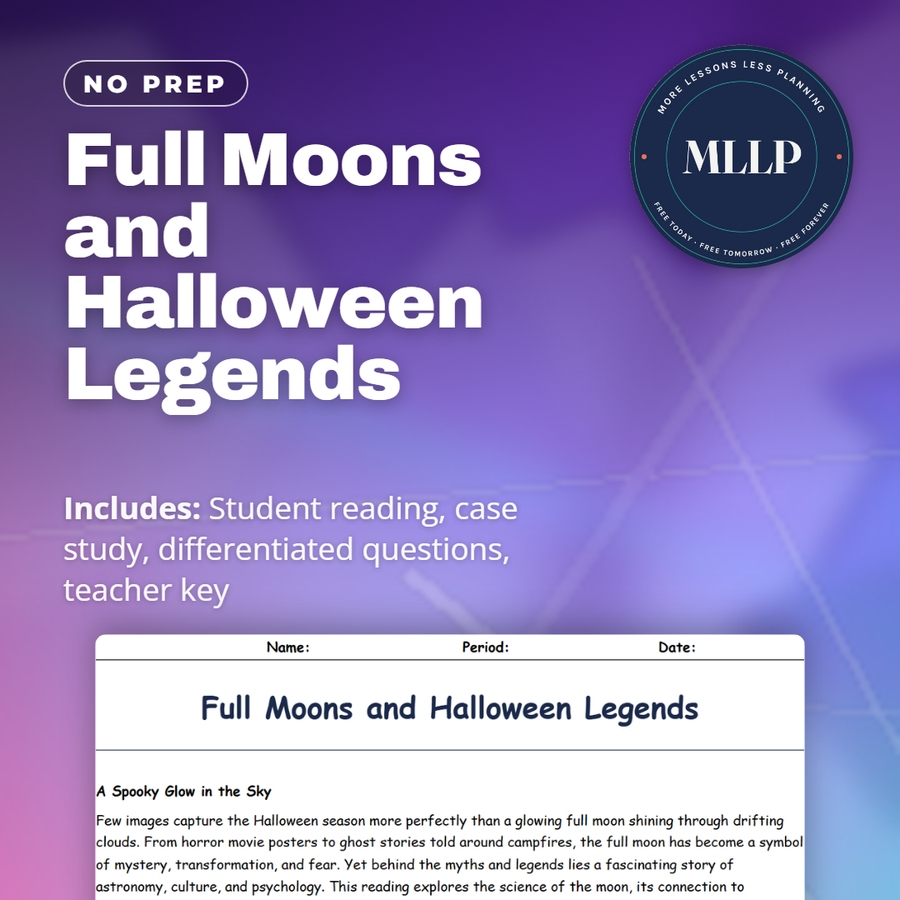
Full Moons and Halloween Legends
Quality reviewed September 2026
Facts verified September 9, 2026
- Subject
- ELA
- Grades
- Grades 9-12
- Length
- 7-page student worksheet
- Time
- About one 50-minute class period
- Great for
- Sub plans and independent work
- Includes
- Reading passage, comprehension questions + full answer key
- Format
- Print-and-go PDF
What students do
- Distinguish between scientific facts and cultural myths about full moon effects on human behavior
- Analyze how cultural beliefs across different societies shaped lunar mythology and traditions
- Examine why a full moon on Halloween is astronomically rare and culturally significant
- Evaluate the connection between lunar brightness and folklore about werewolves and witches
What it covers
- Lunar phases and basic astronomy
- Full moon myths and superstitions across cultures
- Cultural significance of celestial events
Start reading this worksheet
A Spooky Glow in the Sky
Few images capture the Halloween season more perfectly than a glowing full moon shining through drifting clouds. From horror movie posters to ghost stories told around campfires, the full moon has become a symbol of mystery, transformation, and fear. Yet behind the myths and legends lies a fascinating story of astronomy, culture, and psychology. This reading explores the science of the moon, its connection to Halloween traditions, and why a simple lunar cycle continues to inspire awe and superstition.
The Science of the Full Moon
A full moon occurs when Earth is directly between the sun and the moon. This alignment allows sunlight to illuminate the entire side of the moon that faces Earth, making it appear completely round and bright. A full lunar cycle takes about 29.5 days, which means a full moon happens roughly once a month. The moon itself does not produce any light. Instead, it reflects sunlight, acting like a giant mirror in space. Depending on Earth’s position, we see different fractions of the moon’s lit side, which creates the familiar lunar phases—crescent, half, gibbous, and full. During a full moon, the moon rises at sunset and stays visible all night, setting at sunrise. The rarity of a full moon on Halloween makes it particularly intriguing. While full moons happen monthly, the alignment of Halloween night with a full moon occurs only once every 18 to 19 years on average. Even rarer is the phenomenon of a Blue Moon, when two full moons occur in a single calendar month. This rarity fuels both fascination and superstition.
Myths and Legends of the Full Moon
The brightness of the full moon has inspired countless myths across cultures. Ancient peoples often associated the moon with gods, monsters, or supernatural powers. In European folklore, the full moon was linked to werewolves, witches, and spirits wandering the earth. In many traditions, moonlight was believed to weaken boundaries between the living and the dead, echoing Halloween’s own themes of spirits and the afterlife. The werewolf legend is perhaps the most famous lunar myth. According to folktales, a person cursed or bitten by a werewolf would transform during a full moon. While there is no scientific evidence to support these transformations, the myth persists in movies and literature. Other cultures used the full moon more positively. In Chinese tradition, the harvest moon was celebrated with the Mid-Autumn Festival, a time for family gatherings and giving thanks for crops. Native American tribes named full moons according to seasonal changes, such as the “Hunter’s Moon” in October, which signaled the time for preparing food for winter. These cultural stories show how one natural phenomenon—the full moon—could spark both fear and celebration depending on the context.
Like what you read? The full reading, the case study, and every question set are in the free download below, along with the answer key.
Why this matters
Ask a room of students whether a full moon makes people act strangely and most will say yes without hesitation, confirmation bias doing exactly what it does best. The actual astronomy is far less dramatic: a full moon happens roughly once a month, and its landing on Halloween happens only every eighteen to nineteen years. It last happened in 2020, the first time since 1944.
The werewolf and witch folklore built around moonlight is not connected to anything the moon actually does to the body, and that is the harder pill to swallow than the astronomy itself. Walking through how rarely the event occurs forces a separation between a pattern that feels true and one that is measurable.
From one teacher to another
Students arrive convinced that full moons cause crime, accidents, and madness; confirmation bias is powerful. Yet the science is clear: full moons happen roughly once a month, and their alignment with Halloween occurs only every 18 to 19 years. When the 2020 Blue Moon fell on October 31st, the first time since 1944, it sparked global wonder but also exposed how much folklore outweighs evidence in our heads. This worksheet teaches them to question those assumptions and trust data instead.
What you get
Download
Where should I send the next one?
Everything here is free and it stays that way. Leave your email and I'll send you the new lessons as they go up. You can unsubscribe from any one of them.
Related resources
Every lesson on this site is free to download and use. If one of them saved you a prep period, you can chip in a few bucks toward my three kids' daycare fund. That's genuinely where tips go.