Budgeting for Halloween
Quality reviewed September 2026
Facts verified September 9, 2026
- Subject
- Career & Life Skills
- Grades
- Grades 9-12
- Length
- 6-page student worksheet
- Time
- About one 50-minute class period
- Great for
- Sub plans and independent work
- Includes
- Reading passage, comprehension questions + full answer key
- Format
- Print-and-go PDF
What students do
- Create and manage a realistic holiday spending plan using the 50/30/20 budgeting rule
- Evaluate how prioritizing spending goals affects purchasing decisions and saves money
- Analyze how sharing costs and reusing items stretch a budget without cutting the celebration
- Apply bulk-buying and DIY strategies to reduce expenses for costumes and candy
What it covers
- Holiday spending and financial responsibility
- Budget planning and the 50/30/20 rule
- Money management strategies for real situations
Start reading this worksheet
Spending During the Holiday Season
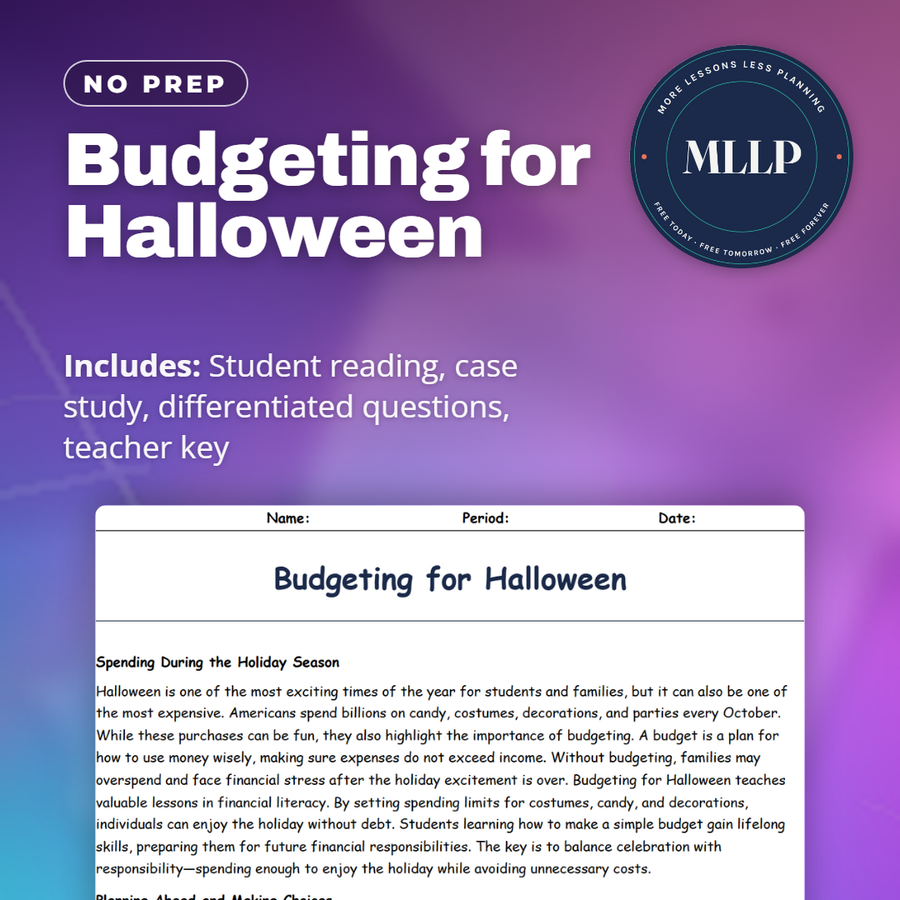
Halloween is one of the most exciting times of the year for students and families, but it can also be one of the most expensive. Americans spend billions on candy, costumes, decorations, and parties every October. While these purchases can be fun, they also highlight the importance of budgeting. A budget is a plan for how to use money wisely, making sure expenses do not exceed income. Without budgeting, families may overspend and face financial stress after the holiday excitement is over. Budgeting for Halloween teaches valuable lessons in financial literacy. By setting spending limits for costumes, candy, and decorations, individuals can enjoy the holiday without debt. Students learning how to make a simple budget gain lifelong skills, preparing them for future financial responsibilities. The key is to balance celebration with responsibility: spending enough to enjoy the holiday while avoiding unnecessary costs.
Planning Ahead and Making Choices
Creating a Halloween budget begins with planning. Families often estimate how many trick-or-treaters will visit, which helps them decide how much candy to buy. Others may choose between buying a new costume or reusing or making one at home. Parties and decorations add more decisions. By prioritizing what matters most, households can enjoy Halloween without overspending. A good strategy is the 50/30/20 rule, which suggests dividing income into categories: 50% for needs, 30% for wants, and 20% for savings. While Halloween spending falls under "wants," it can be planned without harming financial stability. Simple decisions (like buying candy in bulk, sharing party costs with friends, or reusing decorations) help make budgets stretch further.
Like what you read? The full reading, the case study, and every question set are in the free download below, along with the answer key.
Why this matters
Maya set a $100 ceiling for her Halloween party and still pulled it off, not by spending less on everything but by deciding what mattered: she swapped costumes with friends and made treats instead of buying them. One fixed number forced better decisions than an unlimited budget would have.
Budgeting stays abstract until a real number like Maya's hundred dollars gives my students something to allocate under the 50/30/20 rule. Watching her prioritize flips the lesson: a tight budget spent on purpose, not a bigger one, is what actually makes the creativity happen.
From one teacher to another
Budgeting gets abstract fast, but throw a real-world scenario like a $100 Halloween party and suddenly students are engaged. We follow Maya's example. She threw her party by swapping costumes with friends and making DIY treats instead of buying everything new. The breakthrough moment is when they realize that constraints force creativity, not the other way around. This worksheet makes financial literacy concrete and memorable for high schoolers.
What you get
Download
Where should I send the next one?
Everything here is free and it stays that way. Leave your email and I'll send you the new lessons as they go up. You can unsubscribe from any one of them.
Related resources
Every lesson on this site is free to download and use. If one of them saved you a prep period, you can chip in a few bucks toward my three kids' daycare fund. That's genuinely where tips go.