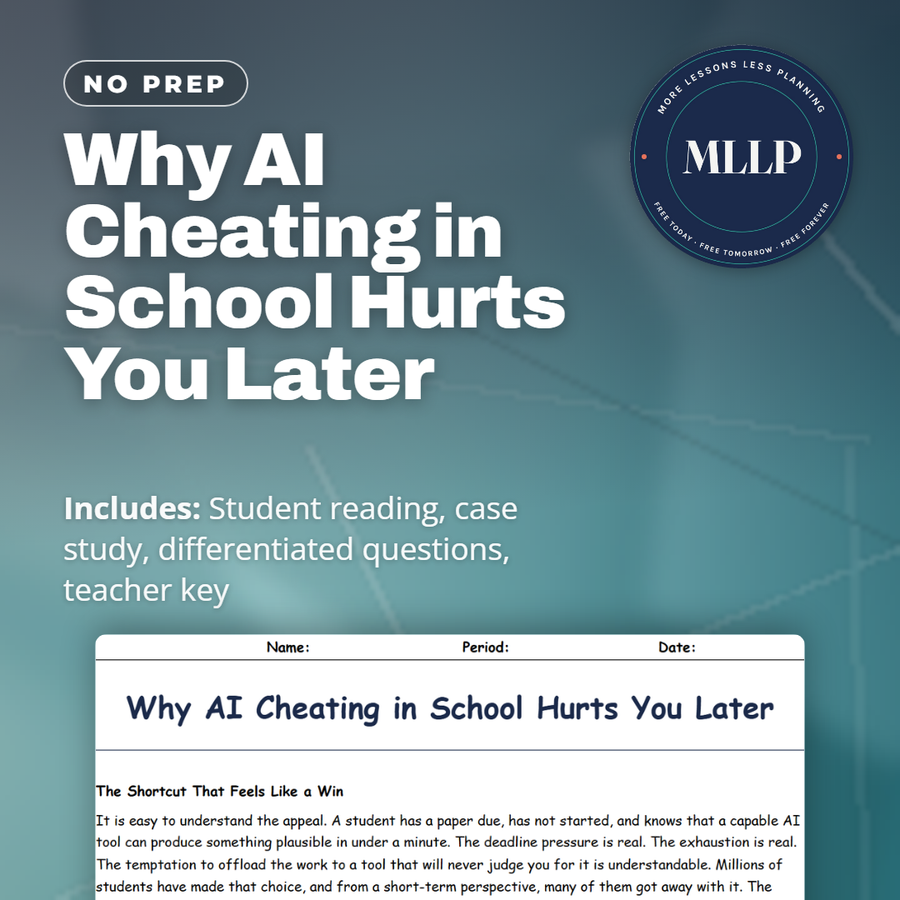
Why AI Cheating in School Hurts You Later
Quality reviewed September 2026
Facts verified September 20, 2026
- Subject
- Career & Life Skills
- Grades
- Grades 9-12
- Length
- 9-page student worksheet
- Time
- About one 50-minute class period
- Great for
- Sub plans and independent work
- Includes
- Reading passage, comprehension questions + full answer key
- Format
- Print-and-go PDF
What students do
- Five terms, including information literacy and deferred cost, get matched to their definitions
- Fill in three blanks pulled from the reading's sections on writing, research, and hiring
- Jordan's case study, a freshman who freezes in a locked-browser exam after years of AI-written essays, gets read and analyzed
- Explain in short answer form the difference between using AI to assist your thinking and using it to replace your thinking
What it covers
- Why the reading calls the cost of AI cheating "deferred, not zero"
- How employers actually catch the gap, through interviews and no-AI skills tests
- A case study on a freshman who cannot write under exam conditions after years of AI help
Start reading this worksheet
The Shortcut That Feels Like a Win
It is easy to understand the appeal. A student has a paper due, has not started, and knows that a capable AI tool can produce something plausible in under a minute. The deadline pressure is real. The exhaustion is real. The temptation to offload the work to a tool that will never judge you for it is understandable. Millions of students have made that choice, and from a short-term perspective, many of them got away with it. The paper was submitted, the grade was recorded, the class was passed. The immediate cost was zero. The problem is that the cost is not zero. It is deferred. What a student trades away when they use AI to bypass genuine intellectual work is not a few hours of effort. They trade away the actual learning that the assignment was designed to produce. That learning, the struggle with unclear ideas, the process of building an argument, the discipline of finding evidence and making it support a claim, is the mechanism by which academic work develops the brain. Skip the mechanism and the development does not happen. This is not a moral argument about honesty, though that argument exists and matters. It is a practical argument about preparation. The skills that rigorous academic work is supposed to build are the same skills that employers in nearly every professional field will expect when that student enters the workforce. Using AI to avoid developing those skills now means arriving at the workforce without them later, at exactly the point when the consequences of that gap become most costly.
What Writing Actually Teaches
Most students think of a writing assignment as a test of whether they can produce acceptable sentences about a topic. That framing misses the point. Writing is a technology for thinking. The process of having to construct an argument in writing forces the writer to discover what they actually know, identify what they do not know, confront contradictions in their own thinking, and organize ideas in a way that can withstand scrutiny. Students who genuinely work through that process come out of it knowing something they did not know going in, even if the knowledge is just a clearer understanding of their own position. AI writing tools skip that process entirely. The tool does not need to think through the argument because it is predicting plausible text, not working out a genuine position. The student who reads the output and submits it has not engaged with the reasoning process at all. They have consumed a product. What they have not done is practice the intellectual work that the assignment was designed to build. The brain adapts to what it practices. If the practice is offloaded, the adaptation does not occur. Professional environments that value writing, which includes law, journalism, medicine, policy, research, consulting, and management, expect employees to communicate complex ideas in writing as a core job function. The attorney who cannot draft a clear brief, the consultant who cannot write a coherent recommendation memo, the manager who cannot write a performance review that actually communicates something useful, are all at a significant disadvantage. These are not advanced skills that require special talent. They are baseline competencies built through repeated practice, and the primary venue for building that practice is school.
The Problem With Borrowed Research
Research assignments have a similar dynamic. When a student asks an AI tool to summarize a topic and submits the summary as their own work, they skip several processes that academic research is designed to develop. Evaluating source quality is one of them. A student who has to find, read, and assess actual sources learns to distinguish between peer-reviewed research and speculative content, between primary sources and secondary interpretations, and between evidence-based claims and opinion. An AI summary presents synthesized conclusions without the intellectual scaffolding that makes a person capable of evaluating similar claims in the future. Information literacy, the ability to find, evaluate, and use information effectively, has been identified by employers and researchers as one of the most significant skill gaps in the current workforce. Studies conducted by research libraries and corporate training departments consistently find that recent graduates struggle to evaluate source credibility, conduct efficient searches of complex databases, and synthesize conflicting evidence into coherent conclusions. These are not innate abilities. They are skills that have to be built through repeated, effortful practice. Bypassing research assignments short-circuits the primary school-based mechanism for building them. There is an additional problem specific to AI-generated content: it is frequently wrong. AI tools trained on large text datasets confidently produce inaccurate information, fabricate citations, and present outdated data as current. A student who has not developed the research and fact-checking skills to verify AI output is in a particularly dangerous position, because they cannot tell what is accurate and what is fabricated. Using AI as a research replacement does not just prevent skill development. It actively introduces false information into the student's understanding.
Like what you read? The full reading, the case study, and every question set are in the free download below, along with the answer key.
Why this matters
This is probably the most direct reading in the unit for a student currently deciding whether to paste a prompt into AI tonight, so I lean on Jordan's story rather than a rules lecture. It matters because the reading's real argument is not about honesty, it is that the cost of skipping the thinking now shows up later, in a timed exam, a job interview, or a work assessment, at a point where there is no AI to bail you out and catching up costs real time and money. Jordan says it plainly near the end: the shortcut did not remove the hard part, it just moved it later and made it more expensive.
From one teacher to another
Jordan cheated his way through high school writing with AI, always editing the output enough to sound like his own voice, and he never got caught. This reading is not really about the getting-caught part. It is about what happened next: a locked-browser college exam with no AI access, where Jordan stared at the prompt for twelve minutes and turned in a C-minus after years of B-plus grades. The reading backs his story with the reasoning behind it, that writing and research assignments are how the brain builds thinking skills, and that skipping the assignment skips the development, whether or not anyone ever finds out.
What you get
Download
Where should I send the next one?
Everything here is free and it stays that way. Leave your email and I'll send you the new lessons as they go up. You can unsubscribe from any one of them.
Related resources
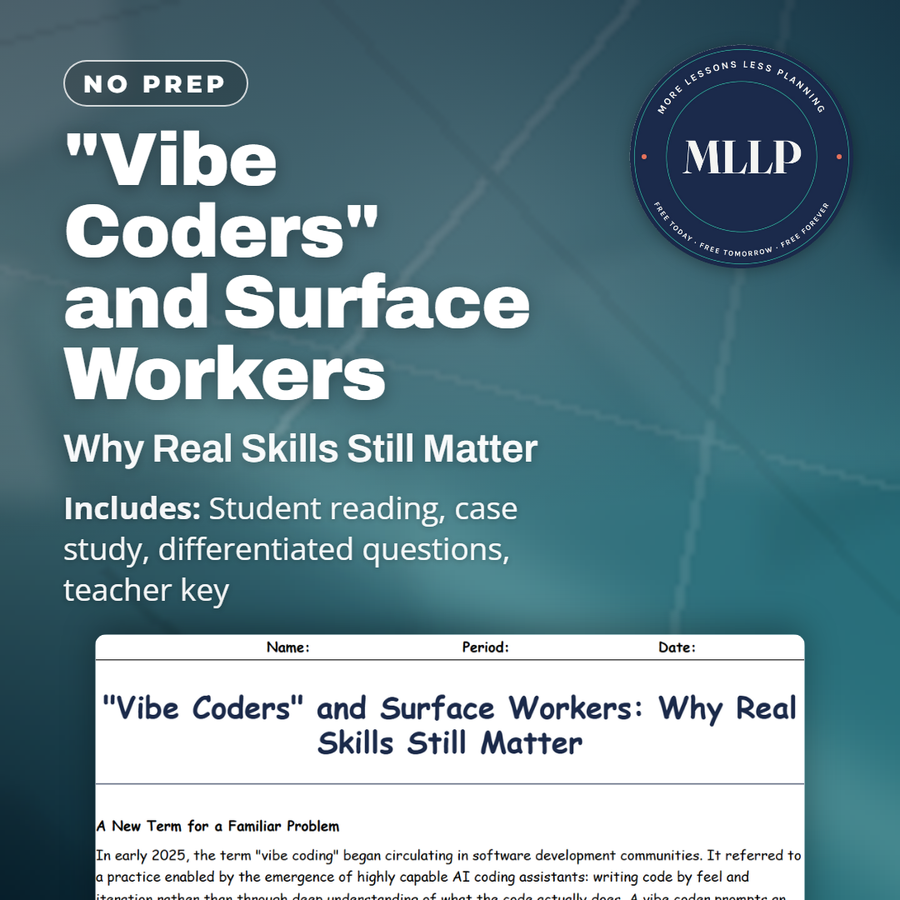
"Vibe Coders" and Surface Workers: Why Real Skills Still Matter
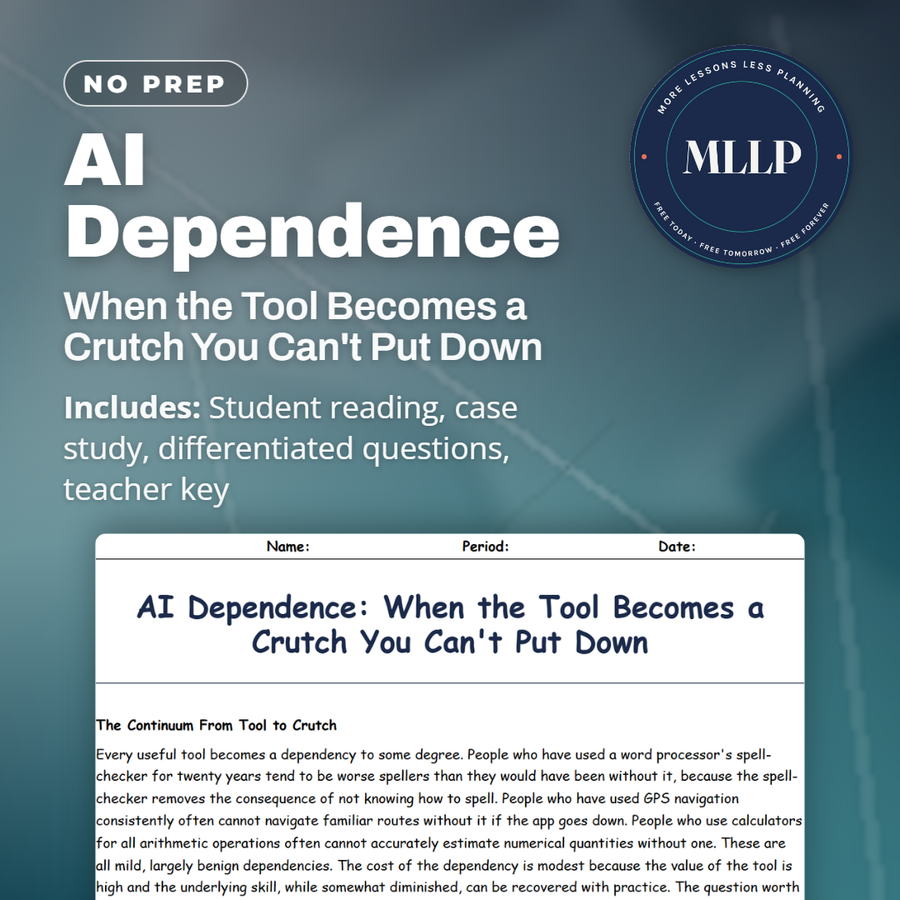
AI Dependence: When the Tool Becomes a Crutch You Can't Put Down
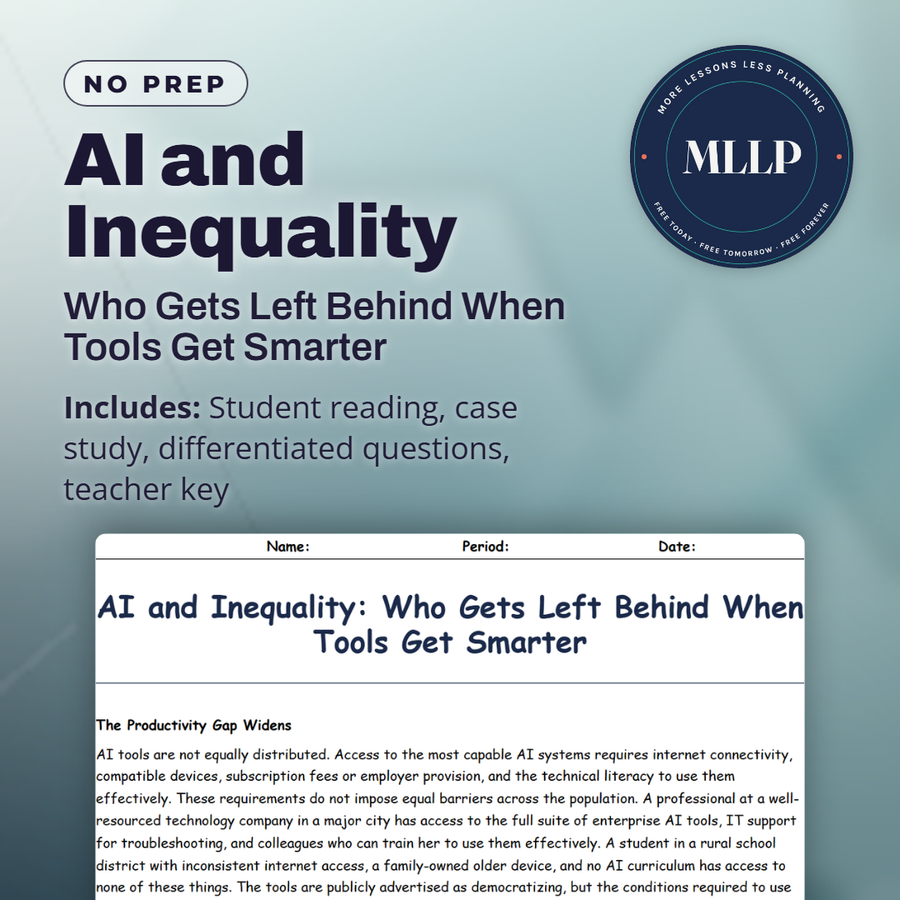
AI and Inequality: Who Gets Left Behind When Tools Get Smarter
Cognitive Offloading: When You Stop Thinking for Yourself
Skill Atrophy in Real Life: Stories From College and the Workplace
The "Junior Employee Crisis": How Will Anyone Learn the Job?
Every lesson on this site is free to download and use. If one of them saved you a prep period, you can chip in a few bucks toward my three kids' daycare fund. That's genuinely where tips go.