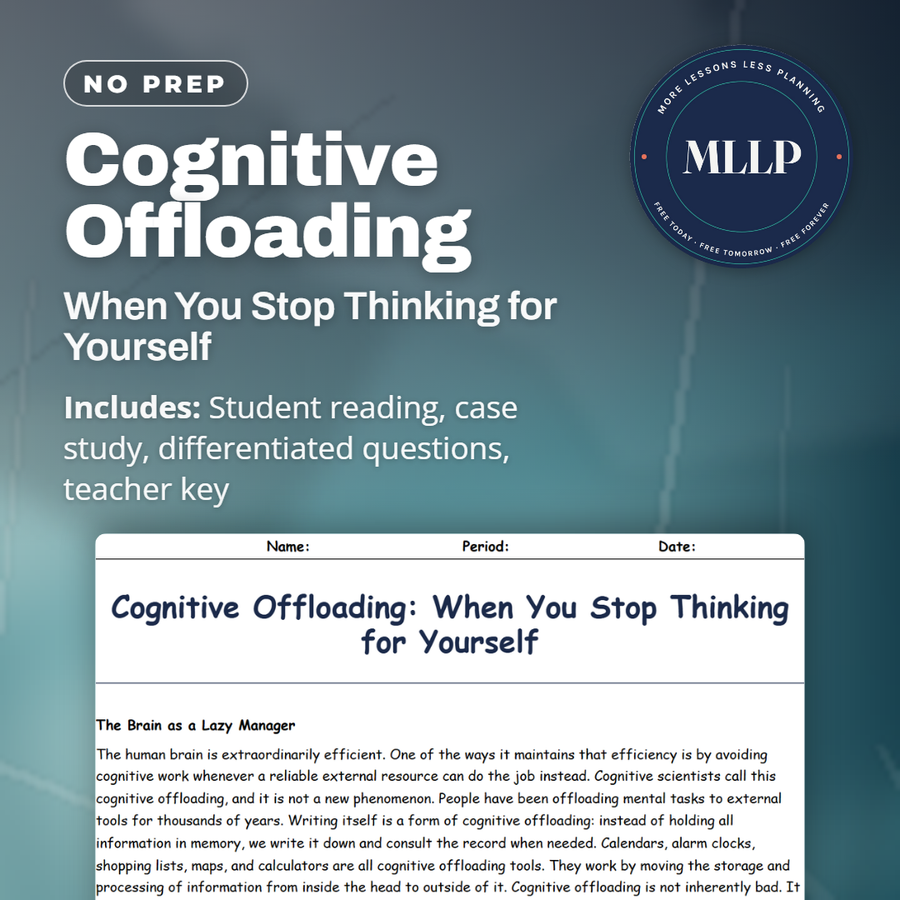
Cognitive Offloading: When You Stop Thinking for Yourself
Quality reviewed September 2026
Facts verified September 20, 2026
- Subject
- Career & Life Skills
- Grades
- Grades 9-12
- Length
- 10-page student worksheet
- Time
- About one 50-minute class period
- Great for
- Sub plans and independent work
- Includes
- Reading passage, comprehension questions + full answer key
- Format
- Print-and-go PDF
What students do
- Five terms, including cognitive offloading and neuroplasticity, get matched to their real definitions
- Trace how the London taxi driver study and a 2020 GPS navigation study tie practice to brain structure
- Destiny's case study, a new hire who freezes without AI access while writing a recommendation memo, gets read and picked apart
- Answer short answer questions on why the reading calls offloading "not inherently bad" and what tips the balance toward harm
What it covers
- The neuroscience of neuroplasticity and why practiced skills strengthen while unused ones fade
- The London taxi driver and 2020 GPS studies as real-world evidence of skill atrophy
- A case study on a recent graduate whose analytical reasoning stalls without AI to lean on
Start reading this worksheet
The Brain as a Lazy Manager
The human brain is extraordinarily efficient. One of the ways it maintains that efficiency is by avoiding cognitive work whenever a reliable external resource can do the job instead. Cognitive scientists call this cognitive offloading, and it is not a new phenomenon. People have been offloading mental tasks to external tools for thousands of years. Writing itself is a form of cognitive offloading: instead of holding all information in memory, we write it down and consult the record when needed. Calendars, alarm clocks, shopping lists, maps, and calculators are all cognitive offloading tools. They work by moving the storage and processing of information from inside the head to outside of it. Cognitive offloading is not inherently bad. It has allowed humans to extend their effective cognitive capacity far beyond what biological memory and processing alone could support. The question is what happens when offloading becomes so complete and so habitual that the underlying biological capacity atrophies from disuse. If you stop doing mental arithmetic entirely because a calculator is always available, you may find that your ability to estimate, check for obvious errors, and reason numerically has weakened. The tool has not just supplemented your ability. It has begun to replace it. AI tools represent a significant expansion in the scope of tasks that can be offloaded. Where previous tools handled specific, narrow categories (arithmetic, storage, navigation), AI systems can handle reasoning, writing, research, analysis, and decision support. The breadth of offloading they enable is qualitatively different from what came before. A person who offloads all of those cognitive functions to AI is not just using a calculator for math. They are delegating most of their intellectual work to an external system.
What Neuroscience Says About Practice and Atrophy
The brain changes physically in response to what it practices. This is a well-established finding in neuroscience. Neural pathways that are used regularly become stronger and faster. Pathways that are not used weaken over time. The process applies to cognitive skills the same way it applies to physical ones. A person who practices spatial reasoning regularly develops stronger neural pathways for spatial reasoning. A person who never uses spatial reasoning finds those pathways becoming less efficient. This principle, known as neuroplasticity, has been studied extensively since the 1990s and its implications for skill maintenance are well understood. The classic example is the London taxi driver study. Researchers examining the brains of experienced London cab drivers, who are required to memorize a complex map of 25,000 streets without GPS assistance, found that the hippocampus, a region associated with spatial memory and navigation, was physically larger and denser in experienced drivers than in control subjects. They also found that when those drivers retired and stopped navigating, the hippocampal advantage diminished. The practice was doing structural work on the brain, and the absence of practice undid it. Applying this research to AI offloading suggests a practical concern. If an individual habitually uses AI for all analytical writing, their neural pathways for analytical reasoning may weaken over time. If they habitually use AI for decision-making, their capacity for evaluating tradeoffs and tolerating the discomfort of uncertain decisions may diminish. Cognitive capacity is not a fixed trait. It is a property of systems that are maintained through use. Disuse does not preserve capacity. It erodes it.
The Navigation Example: What GPS Did to Spatial Memory
GPS navigation is a well-studied case of cognitive offloading at scale because it was adopted broadly by a large population over a relatively short period, allowing researchers to track its effects. Studies conducted after widespread GPS adoption showed measurable declines in self-reported spatial navigation confidence among regular GPS users compared to those who continued to navigate without it. More significantly, studies using tasks that required participants to navigate in unfamiliar environments without GPS showed performance differences between heavy GPS users and non-users. A 2020 study published in Nature Communications found that reliance on GPS navigation was associated with reduced hippocampal engagement during travel, and that people who relied on GPS showed less accurate mental mapping of routes they had traveled many times compared to people who navigated without it. The tool was not just handling the task for them. It was preventing the brain from doing the work that builds spatial knowledge as a side effect of navigation. Every time a GPS user turned off their brain and followed the arrow, they missed a navigation practice repetition. This example matters because it is a controlled, measurable case that illustrates the general principle. GPS is a relatively benign cognitive offload, and even it shows measurable effects on spatial cognition over time. The cognitive functions being offloaded to AI systems are far more central to professional and academic performance than turn-by-turn navigation. The potential for skill erosion is correspondingly larger.
Like what you read? The full reading, the case study, and every question set are in the free download below, along with the answer key.
Why this matters
Most of my students already use AI for homework and do not think much about what it costs them. This reading gives them actual brain science, not a lecture, for why relying on AI for absolutely everything can leave their own thinking weaker exactly when they need it most: a cold-open assignment, a job interview, a moment with no tool in reach. Destiny's story lands because it is not a warning about some distant future. She is 22, she has a real job and a real supervisor, and it already happened to her.
From one teacher to another
This reading traces cognitive offloading from ordinary tools like calendars and calculators to the much wider scope AI now covers: reasoning, writing, research, and decision-making. It leans on real neuroscience, the London taxi driver study and a 2020 Nature Communications study on GPS use, to show that skills fade with disuse the same way muscles do. The case study follows Destiny, a recent graduate who breezed through college with AI help and then froze on her first solo work assignment. I use this one to get students thinking about which mental habits they are quietly handing off, before they end up in Destiny's position.
What you get
Download
Where should I send the next one?
Everything here is free and it stays that way. Leave your email and I'll send you the new lessons as they go up. You can unsubscribe from any one of them.
Related resources
"Vibe Coders" and Surface Workers: Why Real Skills Still Matter
AI Dependence: When the Tool Becomes a Crutch You Can't Put Down
AI and Inequality: Who Gets Left Behind When Tools Get Smarter
Skill Atrophy in Real Life: Stories From College and the Workplace
The "Junior Employee Crisis": How Will Anyone Learn the Job?
The Jobs Already Disappearing: AI Automation in 2025-2026
Every lesson on this site is free to download and use. If one of them saved you a prep period, you can chip in a few bucks toward my three kids' daycare fund. That's genuinely where tips go.