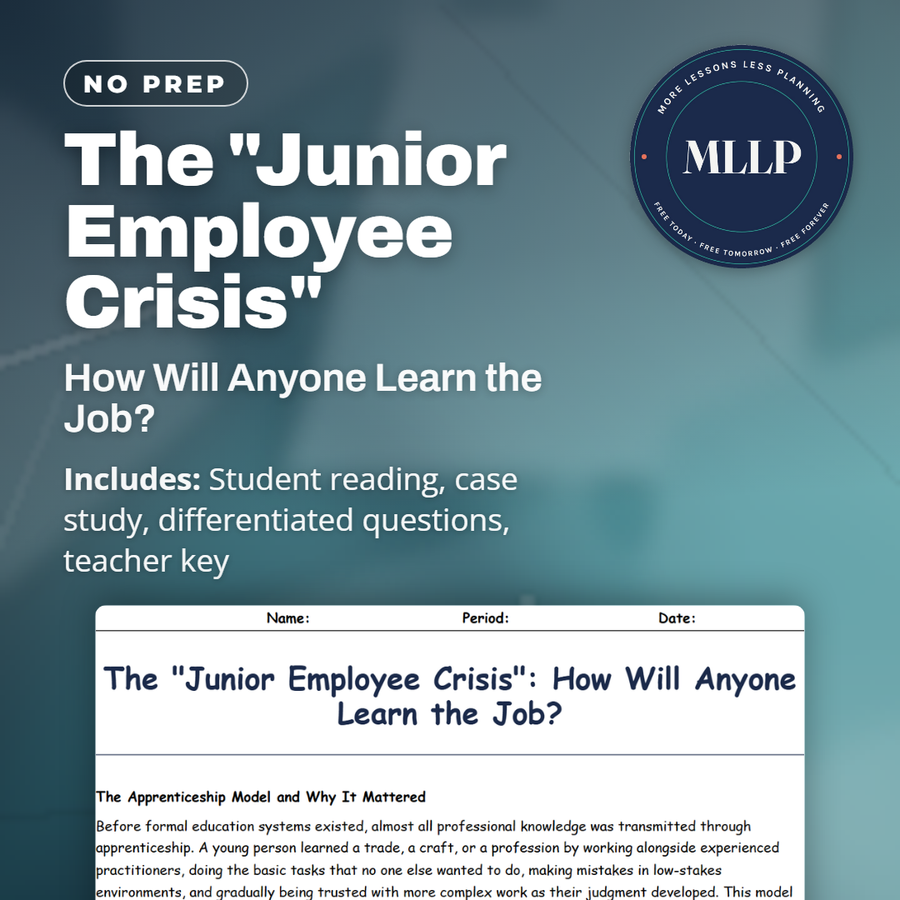
The "Junior Employee Crisis": How Will Anyone Learn the Job?
Quality reviewed September 2026
Facts verified September 20, 2026
- Subject
- Career & Life Skills
- Grades
- Grades 9-12
- Length
- 10-page student worksheet
- Time
- About one 50-minute class period
- Great for
- Sub plans and independent work
- Includes
- Reading passage, comprehension questions + full answer key
- Format
- Print-and-go PDF
What students do
- Five terms, including apprenticeship, professional judgment, and brittle expertise, get matched to their definitions
- Trace how document review, financial modeling, and fact-checking disappeared from entry-level jobs first
- Tara's case study, a third-year associate who realizes she has not read a full contract in two years, gets read and analyzed
- Write short answers explaining why supervising AI output may not build the same judgment as doing the work directly
What it covers
- The apprenticeship model and how junior tasks used to build professional judgment
- Real 2024 cases from law firms, investment banks, and consulting firms cutting junior hiring
- A case study on a young associate who cannot navigate a contract without an AI platform
Start reading this worksheet
The Apprenticeship Model and Why It Mattered
Before formal education systems existed, almost all professional knowledge was transmitted through apprenticeship. A young person learned a trade, a craft, or a profession by working alongside experienced practitioners, doing the basic tasks that no one else wanted to do, making mistakes in low-stakes environments, and gradually being trusted with more complex work as their judgment developed. This model was not just a labor arrangement. It was a knowledge transmission system. The apprentice learned not only the technical skills of the trade but also the professional judgment, the ethical norms, the situational awareness, and the relational skills that could not be written down in any textbook. Modern professions retained versions of this model. A junior attorney reviews documents, assists senior attorneys, and observes courtroom proceedings before being trusted to handle matters independently. A junior journalist fact-checks stories, assists on investigations, and gradually takes on smaller beats before managing complex ones. A junior consultant collects data, builds models under supervision, and sits in on client meetings as a note-taker before being allowed to present. A junior software developer fixes bugs and implements small features before being trusted to design system architecture. In each case, the junior role is simultaneously contributing value and accumulating the judgment that will make the person capable of the senior role. This model depends on the existence of junior work. If AI tools eliminate the tasks that junior employees perform, the model breaks. The senior professionals of the next decade would need to have acquired their judgment somewhere, but the pathway through which that judgment has historically been developed would no longer exist.
Which Junior Tasks Are Disappearing First
The tasks most vulnerable to AI replacement in knowledge professions share certain characteristics: they are well-defined, they involve processing large amounts of structured information, they have clear standards for what constitutes correct output, and they do not require ongoing client relationships or ethical judgment in ambiguous situations. Document review in law fits this description. Entry-level financial modeling in finance fits it. Basic data collection and report generation in consulting fits it. Proofreading and fact-checking in journalism fits it. These are precisely the tasks that fill the first two or three years of a professional career in each of these fields. By 2024, multiple large law firms had reduced their associate hiring by measurable percentages and attributed the reduction in part to AI-assisted document review. Investment banks including Goldman Sachs and Morgan Stanley had deployed AI tools that automated portions of the financial analysis work previously done by first-year analysts. Major consulting firms were using AI to generate initial analytical frameworks and data summaries that associates would previously have spent weeks creating. The pattern was consistent across industries: the work that juniors do is being absorbed by AI, and the headcount that work supported is contracting. The problem is compounded by economics. Junior positions have always been costly for firms relative to the immediate value they produce. A first-year associate at a law firm bills less per hour than a senior partner but costs nearly as much to employ when salaries, benefits, training, and supervision time are factored in. When AI can produce much of the first-year work product at a fraction of that cost, the business case for maintaining large junior cohorts becomes difficult to defend. Some firms have begun reducing cohort sizes while maintaining the expectation that the remaining junior employees will be more immediately productive, which creates its own contradiction.
What Experience Actually Teaches That Cannot Be Compressed
Professional judgment is not a collection of rules. It is a pattern-recognition capacity developed through repeated exposure to varied situations, including situations where the rules did not apply cleanly, where competing considerations had to be weighed, and where the outcome of a decision taught the decision-maker something about the gap between their model and reality. This kind of judgment cannot be acquired by reading about it. It cannot be acquired by watching AI handle the situations. It is built through personal engagement with the complexity, including the failures and recoveries that are the most instructive experiences of any professional development arc. Senior professionals in law, medicine, finance, and consulting consistently describe the same phenomenon when asked what made them good at their jobs: they describe a body of cases, clients, situations, and mistakes that shaped their intuitions over time. The first-year document review that seemed mindless at the time trained the eye for what mattered in a contract. The first failed model that a finance director built as an analyst taught them which assumptions were load-bearing. The first story that came apart during fact-checking taught a journalist where sources lie to protect themselves. These experiences cannot be downloaded. They accumulate through doing. Compressing the junior experience does not just reduce headcount. It produces senior professionals who skipped the crucible. A manager who never did the basic work does not understand the constraints of the people she supervises. An attorney who never did document review does not know intuitively what a red-flag clause looks like in a contract. A financial analyst who never built a model from scratch does not have the debugging intuition to find errors in complex spreadsheets. These gaps may not be immediately visible, but they accumulate as organizations fill senior roles with people whose judgment was built on an abbreviated foundation.
Like what you read? The full reading, the case study, and every question set are in the free download below, along with the answer key.
Why this matters
A lot of my students assume that if AI takes over the boring entry-level tasks, that is a win, one less tedious job to do. This reading complicates that by showing what those boring tasks were actually for: they built the judgment that senior professionals rely on for the rest of their careers. It matters for my students specifically because most of them are headed toward exactly those entry-level roles first, so understanding what got removed, and what firms are experimenting with instead, gives them a clearer sense of what their own first years on a job might look like.
From one teacher to another
The apprenticeship model explains why junior jobs mattered beyond a paycheck: a first-year associate's document review or a junior analyst's first spreadsheet model was never just labor, it was how professional judgment got built. This reading traces that model breaking down as law firms, investment banks, and consulting firms shrink their junior cohorts because AI can now do the entry-level version of the work for a fraction of the cost. The case study follows Tara, a third-year associate who realizes during a system outage that she has reviewed thousands of AI summaries but has not actually read a contract from start to finish in two years. It ends on an open question the reading does not resolve: whether supervising AI output can teach the same judgment as doing the work firsthand.
What you get
Download
Where should I send the next one?
Everything here is free and it stays that way. Leave your email and I'll send you the new lessons as they go up. You can unsubscribe from any one of them.
Related resources
"Vibe Coders" and Surface Workers: Why Real Skills Still Matter
AI Dependence: When the Tool Becomes a Crutch You Can't Put Down
AI and Inequality: Who Gets Left Behind When Tools Get Smarter
Cognitive Offloading: When You Stop Thinking for Yourself
Skill Atrophy in Real Life: Stories From College and the Workplace
The Jobs Already Disappearing: AI Automation in 2025-2026
Every lesson on this site is free to download and use. If one of them saved you a prep period, you can chip in a few bucks toward my three kids' daycare fund. That's genuinely where tips go.