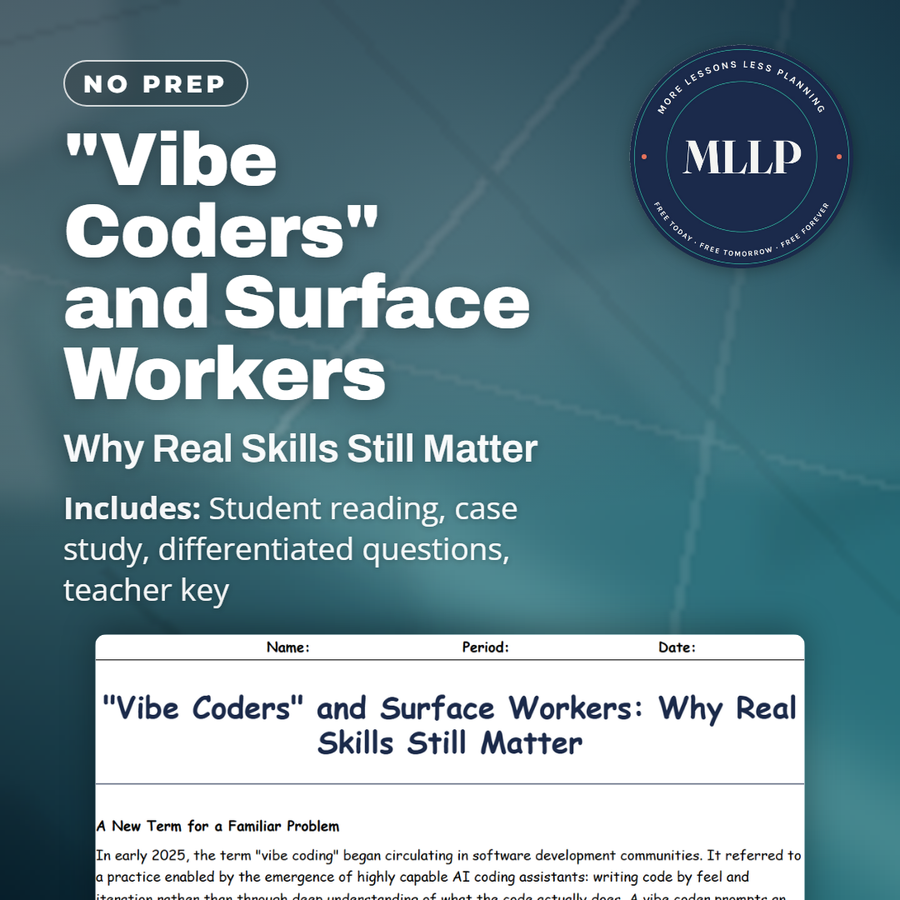
"Vibe Coders" and Surface Workers: Why Real Skills Still Matter
Quality reviewed September 2026
Facts verified September 20, 2026
- Subject
- Career & Life Skills
- Grades
- Grades 9-12
- Length
- 11-page student worksheet
- Time
- About one 50-minute class period
- Great for
- Sub plans and independent work
- Includes
- Reading passage, comprehension questions + full answer key
- Format
- Print-and-go PDF
What students do
- Five terms, including vibe coding, technical debt, and SQL injection, get matched to their definitions
- Trace the three situations where surface work breaks down, diagnosis, novel problems, and accountability
- Dev's case study, a junior developer who cannot debug his own vibe-coded feature during an outage, gets read and unpacked
- Write short answers on why AI amplifies genuine skill but only simulates skill that is not there yet
What it covers
- What "vibe coding" means and why it spread beyond software into writing, research, and finance
- Real 2024 security research on vulnerabilities AI-generated code introduces
- A case study on a junior developer who cannot fix a bug in code he never understood
Start reading this worksheet
A New Term for a Familiar Problem
In early 2025, the term "vibe coding" began circulating in software development communities. It referred to a practice enabled by the emergence of highly capable AI coding assistants: writing code by feel and iteration rather than through deep understanding of what the code actually does. A vibe coder prompts an AI tool to generate a function, tests whether it seems to work in obvious cases, and ships it without understanding the underlying logic, edge cases, or failure modes. The term was initially used with affectionate irony by experienced developers who found AI tools dramatically accelerating their work. It quickly became a more serious concern when it became clear that many of the people doing this were not experienced developers using AI to go faster, but beginners using AI to skip the learning that would have made them developers at all. The concept translates beyond coding. A "surface worker" is someone who can produce outputs that look like the result of skilled work, because AI tools handle the underlying complexity, but who has not developed the foundational understanding that would allow them to evaluate, modify, troubleshoot, or defend what they have produced. A surface writer produces polished prose without having developed an argument. A surface analyst produces formatted reports without understanding the statistical methods used. A surface lawyer produces formatted legal briefs without understanding the case law being cited. The output looks professional. The capability that would make the person a genuine professional is absent. The emergence of surface work is a natural consequence of tool capability outrunning skill development. When tools can produce the visible output of skilled work without the underlying skill, there is a persistent temptation to produce the output and present it as evidence of skill. In the short term, this often works. Grades improve. Initial impressions are positive. But surface work is fragile in ways that genuine skilled work is not. It holds up in familiar, routine situations and fails unpredictably when the situation requires genuine understanding.
What Breaks When You Cannot Go Deeper
The fragility of surface work becomes visible in several predictable situations. The first is when something goes wrong and the practitioner must diagnose the problem. A developer who vibe-coded a feature and did not understand what they wrote cannot debug a failure in that feature without starting over from the AI. A paralegal who submitted an AI-generated research memo cannot defend the citations if a senior attorney questions one. A student who submitted an AI-generated analysis cannot answer follow-up questions about the methodology they supposedly used. In each case, the surface of the work provided no protection against the scrutiny that the situation required. The second is when the situation is novel. AI tools perform best on problems that resemble their training data. When a vibe coder encounters an unusual architecture constraint, an undocumented API, or a system interaction that AI tools have not seen modeled before, they have no resources beyond prompting the AI and hoping it knows. When it does not know, the developer has no analytical foundation to fall back on. This is the 'brittleness in novel situations' that the reading on junior employees discussed. Surface work survives routine situations and collapses in exactly the situations where resilience matters most. The third is when the stakes require accountability. In professional contexts, practitioners are not just expected to produce work. They are expected to stand behind it. An attorney who signs a brief is responsible for the legal reasoning it contains. A financial analyst who submits a valuation is responsible for the methodology. A doctor who orders a treatment is responsible for the clinical reasoning that supports it. AI tools generate output, but they do not provide accountability. The practitioner who submits that output is accountable for understanding it, which means they need to actually understand it. Surface work and professional accountability are fundamentally incompatible.
The Vibe Coding Case in Detail
Software development is worth examining in more detail because it is both an early and a well-documented case of AI tool capability creating surface worker dynamics. Between 2023 and 2025, the percentage of professional code written with significant AI assistance increased dramatically. GitHub Copilot, ChatGPT, and purpose-built coding assistants became standard tools in development environments, and developer productivity by certain metrics increased substantially. Companies reported faster shipping times, higher code coverage, and reduced time-to-feature for many development tasks. The problems began emerging in code review and in production failures. Senior developers reviewing AI-assisted code found repeated patterns: code that handled the specified requirements but failed to account for edge cases, security vulnerabilities that an understanding developer would have caught, and architectural decisions that worked for the immediate use case but created costly technical debt for the future. The AI had solved the stated problem without the system-level understanding that would have identified the adjacent problems the solution created. A senior developer who understood the system could catch these issues. A vibe coder who did not understand what they had written could not. Several prominent security researchers published analyses in 2024 documenting AI-generated code security patterns in production systems. They found that AI coding assistants consistently generated code with certain categories of vulnerabilities, including SQL injection vulnerabilities, buffer overflow risks, and authentication bypass patterns, at rates that security-conscious manual coding would have avoided. The vulnerabilities were not the AI's fault in any meaningful sense: the AI generated what it was asked to generate. The fault was in deployment by practitioners who lacked the foundational knowledge to evaluate what they were shipping. Vibe coding in security-sensitive applications is not just suboptimal. It is actively dangerous.
Like what you read? The full reading, the case study, and every question set are in the free download below, along with the answer key.
Why this matters
A lot of my students already use AI to build things, whether it is code, a design, or a project, and the finished product looks impressive regardless of whether they understand how it works. This reading gives that gap a name and shows exactly where it becomes a problem, not in the easy, familiar situation, but the moment something breaks and there is no AI answer ready to hand. It matters because the reading is honest that AI tools are not the villain here. Dev's CTO tells him directly that the AI can help him build fast, it just cannot debug for him under pressure or care about what breaks, which is the line I want students sitting with.
From one teacher to another
In early 2025 the term "vibe coding" started spreading through developer communities to describe writing code by feel, prompting an AI tool and shipping whatever it produces without understanding the logic underneath. This reading follows that idea past software into writing, research, and finance, calling anyone who produces polished output without the foundation behind it a surface worker. It backs the concept with real 2024 security research showing that AI-generated code carried specific vulnerability patterns at rates a knowledgeable developer would have avoided. Dev's case study makes the risk concrete: a production bug takes down a feature for six hours, and Dev cannot fix code he built entirely by prompting AI, because he never understood what it did in the first place.
What you get
Download
Where should I send the next one?
Everything here is free and it stays that way. Leave your email and I'll send you the new lessons as they go up. You can unsubscribe from any one of them.
Related resources
AI Dependence: When the Tool Becomes a Crutch You Can't Put Down
AI and Inequality: Who Gets Left Behind When Tools Get Smarter

Cognitive Offloading: When You Stop Thinking for Yourself
Skill Atrophy in Real Life: Stories From College and the Workplace
The "Junior Employee Crisis": How Will Anyone Learn the Job?
The Jobs Already Disappearing: AI Automation in 2025-2026
Every lesson on this site is free to download and use. If one of them saved you a prep period, you can chip in a few bucks toward my three kids' daycare fund. That's genuinely where tips go.