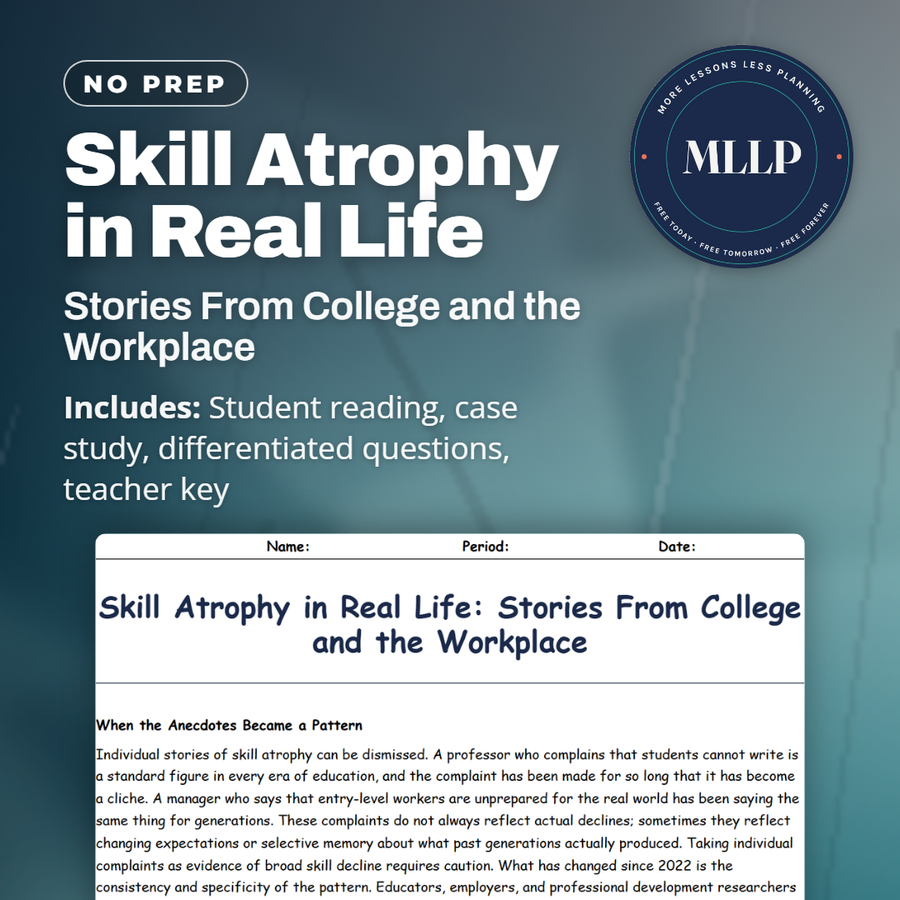
Skill Atrophy in Real Life: Stories From College and the Workplace
Quality reviewed September 2026
Facts verified September 20, 2026
- Subject
- Career & Life Skills
- Grades
- Grades 9-12
- Length
- 11-page student worksheet
- Time
- About one 50-minute class period
- Great for
- Sub plans and independent work
- Includes
- Reading passage, comprehension questions + full answer key
- Format
- Print-and-go PDF
What students do
- Five terms, including differential diagnosis and pattern library, get matched to their definitions
- Fill in three blanks pulled from documented cases in law, medicine, and writing centers
- Nathaniel's case study, a first-year resident who cannot explain his own differential diagnosis, gets read and analyzed
- Explain in short answer form why the skill gaps reported since 2022 differ from the decades-old complaint that students are unprepared
What it covers
- Documented skill atrophy cases from college writing centers, law firms, finance, and medical residencies
- A key info table tracking the observed pattern, cause, and response for each sector
- A case study on a medical resident who cannot explain his own diagnostic reasoning
Start reading this worksheet
When the Anecdotes Became a Pattern
Individual stories of skill atrophy can be dismissed. A professor who complains that students cannot write is a standard figure in every era of education, and the complaint has been made for so long that it has become a cliche. A manager who says that entry-level workers are unprepared for the real world has been saying the same thing for generations. These complaints do not always reflect actual declines; sometimes they reflect changing expectations or selective memory about what past generations actually produced. Taking individual complaints as evidence of broad skill decline requires caution. What has changed since 2022 is the consistency and specificity of the pattern. Educators, employers, and professional development researchers across a wide range of fields are describing the same phenomenon in the same terms: students and entry-level workers who have strong academic records, reasonable intelligence, and genuine motivation are exhibiting unexpected gaps in foundational skills that are difficult to explain without reference to AI over-reliance. The gaps are not in exotic or specialized knowledge. They are in the basic intellectual mechanics that higher education has historically been expected to produce: writing, analysis, research, quantitative reasoning, and independent problem-solving. This reading examines several documented cases and patterns from actual educational and workplace environments, with the intention of making the abstract concern about skill atrophy concrete and understandable. The examples are drawn from accounts published by educators, professional associations, and business media between 2023 and 2025. They are not intended as horror stories but as useful data points for anyone thinking seriously about how to navigate the current AI transition.
The College Writing Center Surge
Writing centers at colleges and universities have traditionally served as supplemental resources for students who struggled with writing: those for whom English was a second language, those with learning differences, and those who arrived with weaker preparation. They were not designed to serve the general student population as a remediation resource. Since 2023, writing center directors at multiple institutions have reported dramatic increases in demand from students who cannot complete writing assignments without substantial assistance, including students who appear otherwise academically capable. The pattern reported by multiple writing center directors is consistent: students arrive with an AI-generated draft, a vague sense of the topic, and limited ability to explain the argument they are supposedly making. When asked to speak about their own claim, they cannot. When asked to identify which part of the essay is the strongest evidence for their thesis, they struggle. The challenge is not grammar or sentence structure, which the AI handled. The challenge is that the student is not the author of the ideas and has not done the thinking that would allow them to engage with those ideas independently. Several writing center directors have noted that they are effectively teaching students from scratch how to generate their own ideas and construct their own arguments, a process that was supposed to happen during years of K-12 schooling. The remediation cost at the college level is high: writing center appointments are limited, skilled tutors are scarce, and students competing for appointments face multi-week waitlists while their courses continue. Some institutions have begun restructuring their general education writing requirements to include more in-class, AI-restricted writing practice specifically in response to this pattern.
The Workplace Research Gap
Employers in research-dependent fields have begun documenting a specific failure pattern in entry-level hires since 2023: the inability to conduct effective independent research without AI tools. The pattern shows up in several ways. New hires may be unable to construct effective database search queries because they have relied on AI to synthesize information without ever learning how to navigate primary sources. They may be unable to evaluate source credibility because they have always received pre-synthesized summaries. And they may be unable to identify what they do not know, the meta-cognitive skill of recognizing gaps in one's understanding, because AI systems fill in the gaps silently rather than flagging them. A particularly well-documented case came from a mid-sized legal research firm that published an account of its training process adaptations in 2024. The firm found that a significant percentage of recent hires required remedial instruction in basic legal research methods, including how to use legal databases, how to trace the history of a legal argument through case citations, and how to identify when a case had been overturned. These are foundational skills that law school curricula had historically assumed students would develop through repeated practice. The firm attributed the gap directly to AI legal research tools that had removed the practice repetitions from student workflows during law school. The financial sector has reported analogous patterns in quantitative analysis. Investment firms, banks, and corporate finance departments have noted that entry-level hires who relied heavily on AI financial modeling tools during their education often cannot identify errors in simple spreadsheet models, cannot explain the logic of a valuation methodology, and cannot adapt a standard model to an unusual situation. The AI handled the modeling, and the student learned to interpret results without developing the underlying quantitative reasoning that would allow them to catch errors or handle edge cases.
Like what you read? The full reading, the case study, and every question set are in the free download below, along with the answer key.
Why this matters
Students hear "you'll lose skills if you rely on AI too much" as a vague scolding line, so this reading swaps the lecture for documented cases from real writing centers, law firms, and hospitals. It matters because the pattern shows up fastest in the people who looked most prepared on paper, strong grades, solid board scores, good writing samples, and only cracked when the AI was taken away. That is the exact position most of my students are heading toward, so watching it happen to Nathaniel and to real writing center students makes the stakes concrete instead of abstract.
From one teacher to another
Five real-world accounts open this reading: college writing centers seeing a surge in students who cannot explain their own arguments, a legal research firm training new hires from scratch, finance departments that cannot catch spreadsheet errors, and a medical residency program worried about diagnostic reasoning. The case study follows Nathaniel, a new resident whose confident board scores did not translate into being able to explain his own differential diagnosis to his attending. What makes this one useful in class is that it is not speculation. Every example comes from an account an educator, employer, or professional association actually published between 2023 and 2025.
What you get
Download
Where should I send the next one?
Everything here is free and it stays that way. Leave your email and I'll send you the new lessons as they go up. You can unsubscribe from any one of them.
Related resources
"Vibe Coders" and Surface Workers: Why Real Skills Still Matter
AI Dependence: When the Tool Becomes a Crutch You Can't Put Down
AI and Inequality: Who Gets Left Behind When Tools Get Smarter
Cognitive Offloading: When You Stop Thinking for Yourself
The "Junior Employee Crisis": How Will Anyone Learn the Job?
The Jobs Already Disappearing: AI Automation in 2025-2026
Every lesson on this site is free to download and use. If one of them saved you a prep period, you can chip in a few bucks toward my three kids' daycare fund. That's genuinely where tips go.