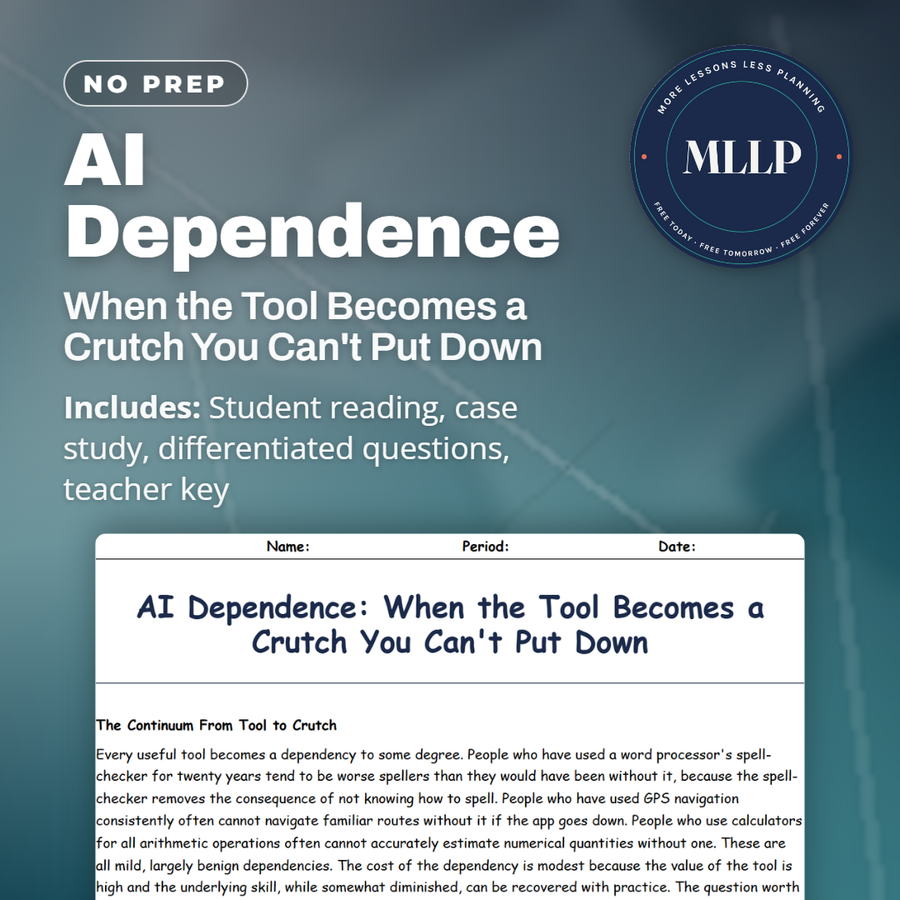
AI Dependence: When the Tool Becomes a Crutch You Can't Put Down
Quality reviewed September 2026
Facts verified September 20, 2026
- Subject
- Career & Life Skills
- Grades
- Grades 9-12
- Length
- 10-page student worksheet
- Time
- About one 50-minute class period
- Great for
- Sub plans and independent work
- Includes
- Reading passage, comprehension questions + full answer key
- Format
- Print-and-go PDF
What students do
- Amara's four-draft, three-week attempt to write without AI gets traced stage by stage
- Match key terms, from learned helplessness to the feedback loop, to their definitions
- Three key-term blanks get filled using facts on classroom calculator research and AI anxiety surveys
- Short answer questions explain why the printing press was a benign trade-off and AI dependence may not be
What it covers
- Four reading passages on AI dependence, learned helplessness, and the self-reinforcing feedback loop
- A case study following a senior who struggles to write her college essay without AI
- Learned helplessness and feedback loops, with number sense and the memory palace as the historical parallels
Start reading this worksheet
The Continuum From Tool to Crutch
Every useful tool becomes a dependency to some degree. People who have used a word processor's spell-checker for twenty years tend to be worse spellers than they would have been without it, because the spell-checker removes the consequence of not knowing how to spell. People who have used GPS navigation consistently often cannot navigate familiar routes without it if the app goes down. People who use calculators for all arithmetic operations often cannot accurately estimate numerical quantities without one. These are all mild, largely benign dependencies. The cost of the dependency is modest because the value of the tool is high and the underlying skill, while somewhat diminished, can be recovered with practice. The question worth asking about AI tools is whether the dependencies they create are in the same benign category or whether they are qualitatively different. Several indicators suggest the risks are larger than the spell-checker analogy implies. The cognitive functions being offloaded to AI, reasoning, analysis, writing, decision support, research, are more central to professional and intellectual performance than spelling. The breadth of offloading is wider, meaning more functions are affected simultaneously. And the pace of adoption is faster, meaning the dependencies are forming before there has been time to study their effects at scale. The concept of a crutch captures something important that the word dependency does not. A crutch is a support that enables movement but that also prevents the recovery and strengthening of the underlying capability it is substituting for. Using a crutch indefinitely after an injury heals keeps the person mobile but prevents the muscle development that would make the crutch unnecessary. AI tools used in place of developing cognitive capability have a similar structure: they enable performance while preventing the development of the underlying skill. The result is continued dependence on the tool rather than growing independence from it.
When Anxiety Replaces Confidence
One of the more concerning patterns that researchers and educators have begun documenting is the relationship between AI dependence and anxiety. Students and workers who have developed habits of relying on AI for cognitive tasks often report significant anxiety when those tools are unavailable. This is not simply inconvenience. The anxiety reflects a genuine perception of incapacity: the individual has come to believe that they cannot perform adequately without the AI's assistance. Whether or not that belief is accurate, it shapes behavior in ways that are themselves costly. A 2023 survey of college students conducted by an academic research group found that a significant percentage of respondents reported feeling unable to begin writing assignments without first consulting an AI tool, even when they had adequate knowledge of the topic. A separate survey of professionals in knowledge-work roles found that a meaningful fraction reported feeling less confident in their own judgment when AI tools were unavailable. The pattern is consistent with what behavioral researchers call learned helplessness: a state in which repeated experiences of having an external resource handle a challenge reduces a person's belief in their own ability to handle similar challenges independently. Anxiety has direct performance costs. A student or professional who is anxious about their own capability without AI will avoid practicing the underlying skills, further deepening the dependency. They will be less likely to take intellectual risks, less willing to commit to positions without AI validation, and less able to perform under time pressure when deliberate consultation with AI tools is not an option. The crutch does not just substitute for the skill. It actively undermines the confidence that would be required to build the skill back.
The Feedback Loop of Over-Reliance
Dependencies tend to self-reinforce. A person who relies on AI for writing produces better-looking written output than they would without it. The better output is rewarded with positive feedback, whether a good grade, an employer's approval, or a colleague's compliment. That positive feedback confirms the behavior: AI assistance is working, so the person uses it more. The more they use it, the less they practice independent writing. The less they practice, the worse they would perform without AI. The worse they would perform without AI, the more dependent they feel on having it available. The cycle tightens over time. This feedback loop is difficult to interrupt because all of the visible signals point in the direction of continued AI use. The work looks good. The grades are acceptable. The employer is satisfied. The discomfort of attempting the task without AI is avoided. What is invisible is the skill development that is not happening, the capability that is not being built, and the future cost that is being accumulated. The cycle does not reveal its downside until the person is in a situation where AI is unavailable, inappropriate, or where the stakes are high enough that AI error is unacceptable. Breaking the feedback loop requires deliberate, sustained effort that runs against the grain of immediate incentive structures. A student who stops using AI for writing will initially produce worse written work than they did with AI assistance. Their grade may drop in the short term. Their teacher may not understand what is happening. The discomfort of the process, the struggle with ideas that used to be effortlessly handled by AI, is real and uncomfortable. Breaking the cycle is an investment in future capability that costs something in the present. Understanding that cost structure clearly is essential for making intentional choices about it.
Like what you read? The full reading, the case study, and every question set are in the free download below, along with the answer key.
Why this matters
Every student using AI for schoolwork right now is running the exact experiment this reading describes, and most won't find out whether they built a skill or lost one until a moment like Amara's, a blank page, a deadline, and no AI available, forces the question. The reading's calculator research is a useful warning sign precedent: a widely used tool quietly eroded a specific skill for a generation of students before anyone measured it carefully enough to notice. Naming the anxiety that shows up when AI isn't available, the specific feeling Amara describes of not knowing how to sound like herself anymore, gives students language for something many of them are already experiencing without a name for it. Reading this now, before college essays, job applications, and timed exams without AI access, gives students a chance to notice the pattern while it is still reversible.
From one teacher to another
Amara opened her AI tool out of habit to start her college essay, the same way she had for nearly every assignment since sophomore year, then stopped herself. She realized she no longer knew what she actually thought about the prompt, and it took her four drafts and three weeks to write 650 words in her own voice. This worksheet uses her story to walk students through what the reading calls a crutch, a tool that keeps someone functioning while quietly preventing the skill underneath it from ever getting stronger. Students trace the feedback loop the reading describes: AI-assisted work looks better, gets rewarded with good grades or approval, and that reward pushes the person toward using AI more and practicing less, until the underlying skill has quietly eroded. The reading compares this to two older technology shifts, calculators in 1970s math classrooms and the printing press replacing memorized texts, and asks whether AI's effect on reasoning and writing will turn out to be as harmless as one or as costly as the other.
What you get
Download
Where should I send the next one?
Everything here is free and it stays that way. Leave your email and I'll send you the new lessons as they go up. You can unsubscribe from any one of them.
Related resources
"Vibe Coders" and Surface Workers: Why Real Skills Still Matter
AI and Inequality: Who Gets Left Behind When Tools Get Smarter
Cognitive Offloading: When You Stop Thinking for Yourself
Skill Atrophy in Real Life: Stories From College and the Workplace
The "Junior Employee Crisis": How Will Anyone Learn the Job?
The Jobs Already Disappearing: AI Automation in 2025-2026
Every lesson on this site is free to download and use. If one of them saved you a prep period, you can chip in a few bucks toward my three kids' daycare fund. That's genuinely where tips go.