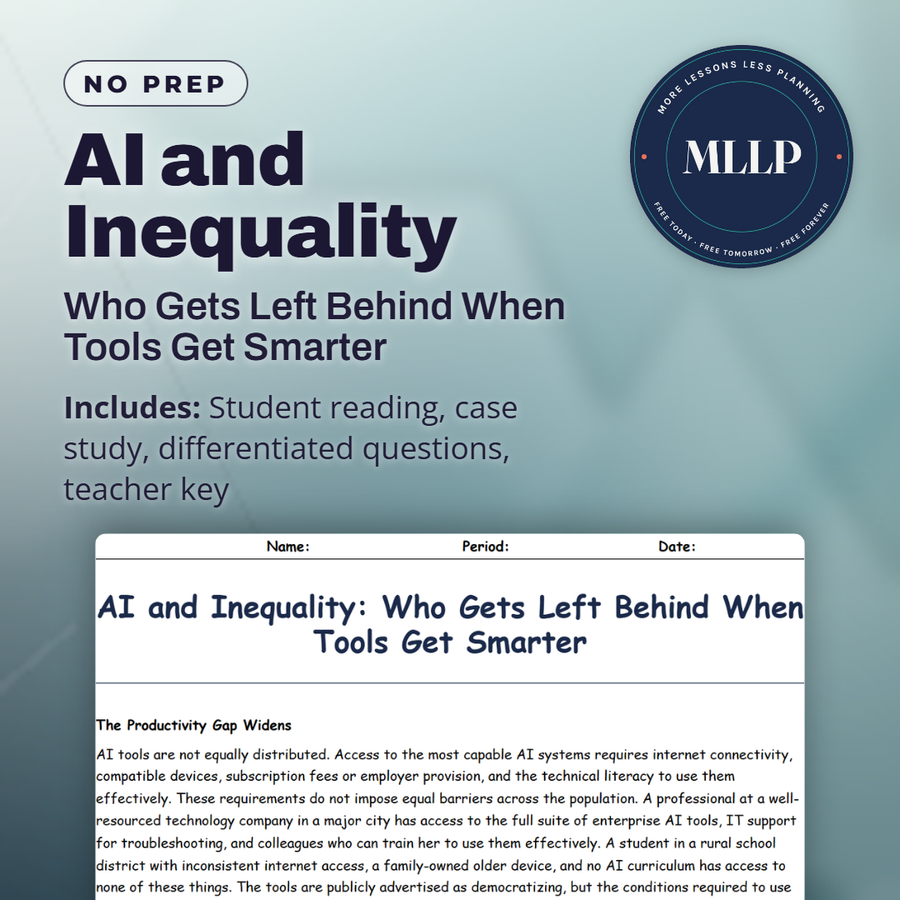
AI and Inequality: Who Gets Left Behind When Tools Get Smarter
Quality reviewed September 2026
Facts verified September 20, 2026
- Subject
- Career & Life Skills
- Grades
- Grades 9-12
- Length
- 9-page student worksheet
- Time
- About one 50-minute class period
- Great for
- Sub plans and independent work
- Includes
- Reading passage, comprehension questions + full answer key
- Format
- Print-and-go PDF
What students do
- Two schools given the same AI writing prompt get compared side by side in the case study
- Match key terms, from digital divide to credential gap, to their definitions
- Three key-term blanks get filled using facts on subscription costs and job displacement patterns
- Short answer questions ask why calling AI tools 'democratizing' can be misleading
What it covers
- Four reading passages on the AI divide, job displacement, and education inequality
- A case study comparing two schools given the same AI-assisted writing prompt
- A key info table on the digital divide, AI literacy, and the credential gap facing Title I schools
Start reading this worksheet
The Productivity Gap Widens
AI tools are not equally distributed. Access to the most capable AI systems requires internet connectivity, compatible devices, subscription fees or employer provision, and the technical literacy to use them effectively. These requirements do not impose equal barriers across the population. A professional at a well-resourced technology company in a major city has access to the full suite of enterprise AI tools, IT support for troubleshooting, and colleagues who can train her to use them effectively. A student in a rural school district with inconsistent internet access, a family-owned older device, and no AI curriculum has access to none of these things. The tools are publicly advertised as democratizing, but the conditions required to use them effectively are not equally distributed. This matters for inequality because productivity differences translate into earnings differences over time. A worker who can leverage AI to produce the output of three workers will command salary premiums over workers who cannot. An entrepreneur who can use AI tools to replace several expensive professional services will outcompete an entrepreneur who cannot afford those tools at all. A student who learns to use AI effectively as an academic amplifier will develop capabilities that a student without AI access cannot match. The short-term convenience gap, the difference in what a task takes with versus without AI, compounds into a long-term capability and earning gap over careers and educational trajectories. The concern about AI and inequality is not a hypothetical. Research on productivity-enhancing technology has consistently found that such technology is adopted first by more affluent individuals and organizations, that the productivity gains accrue primarily to early adopters before prices fall, and that by the time wider access materializes, the early adopters have used their productivity advantage to further consolidate their economic position. The pattern has played out with computer ownership, broadband internet, and smartphone adoption. There is no reason to expect AI adoption to follow a different pattern.
The Digital Divide Takes a New Form
The concept of the digital divide, the gap between populations with and without access to digital technology, has been discussed in education and policy circles since the 1990s. Significant progress was made during the 2000s and 2010s: broadband subsidies expanded, device costs fell, and school technology programs brought computers and internet to communities that previously had neither. By 2020, the most basic forms of digital access had been largely extended to most of the U.S. population, though significant gaps remained in rural and low-income communities. The arrival of capable AI tools has reset this progress in a meaningful sense, creating a new tier of advantage that basic internet access does not automatically provide. The new AI divide has several distinct dimensions. The capability dimension is the most obvious: the most capable AI systems, those with real-time web access, advanced reasoning, multimodal capabilities, and integration with professional tools, are available at subscription prices that range from $20 to $30 per month for consumer versions and significantly more for enterprise versions. For a student in a low-income household, $20 per month may represent a meaningful financial barrier. For a large corporation, the same amount is trivial. The result is that the students and small businesses with the most to gain from AI productivity enhancements often have the least access to them. The literacy dimension is equally important and receives less attention. Even where AI tools are technically accessible, using them effectively requires prompting skill, critical evaluation of AI output, and the ability to identify when AI is confidently wrong. These skills are not uniformly distributed. Students who attend well-resourced schools with AI-literate teachers and formal AI curricula will develop these skills. Students in under-resourced schools are being asked to navigate increasingly AI-saturated information environments without formal guidance. The gap is not just about access to the tool. It is about access to the understanding of how to use it critically.
Who Loses Jobs and Who Gains Jobs
The labor market effects of AI automation are not neutral across demographic groups. The jobs most aggressively targeted by current AI automation, customer service, data entry, document processing, basic content creation, and administrative coordination, are disproportionately held by workers without college degrees, workers in lower income brackets, and in many cases workers from demographic groups that have historically faced barriers to the higher-credential positions that AI is less immediately affecting. The pattern of job loss is concentrating in the economic tier least able to absorb it. The jobs being created by AI development and deployment are clustered at the opposite end of the credential and income spectrum. AI engineers, machine learning researchers, data scientists, prompt engineers, and AI safety researchers are all high-credential, high-income roles. The workers being displaced and the workers being recruited for new positions are separated by multiple years of specialized education and significant investment in credentials. The workers most affected by displacement have neither the time nor the resources to bridge that gap quickly. Policy responses including retraining programs have historically been slow, underfunded, and less effective at mid-career than at early career stages. Geographic concentration compounds the inequality. AI development and the best-paying AI-adjacent jobs are concentrated in a small number of metropolitan areas: San Francisco, Seattle, New York, Boston, and Austin being the most prominent. The communities most affected by AI-driven automation of factory and service work are often geographically distant from those centers. Workers in manufacturing towns in the Midwest, in agricultural communities, or in rural service economies do not have straightforward paths to AI-sector employment even if they acquire the requisite credentials, because the jobs are not where they live.
Like what you read? The full reading, the case study, and every question set are in the free download below, along with the answer key.
Why this matters
The reading's own evidence points at these exact students: whether their school has an AI license and a trained teacher, or whether they're left to use free-tier tools on a personal phone with no instruction, is already shaping how well they write, research, and eventually compete for the same jobs and colleges as the other students in the case study. The jobs the reading says are most exposed to AI automation, customer service, data entry, basic content creation, are common first jobs and family income sources for many students in this exact demographic, while the AI-sector jobs replacing them are concentrated in a handful of expensive coastal cities most of these students will never live in. Understanding that the gap is generational, meaning it compounds into the next household's disadvantage rather than resetting each year, is the reason this reading treats AI inequality as an urgent classroom topic rather than a distant economic abstraction.
From one teacher to another
Two students got the exact same writing prompt in a 2025 research project, one from a well-resourced suburban school with a licensed AI platform and a semester of AI literacy instruction, and one from a Title I school where students had only free-tier apps on their own phones and no formal training. This worksheet uses that comparison to walk students through what the reading calls the AI divide: a capability gap driven by subscription costs of $20 to $30 a month, and a literacy gap in knowing how to evaluate what AI produces rather than simply accepting it. The reading also traces who is losing jobs to AI automation, customer service and data entry workers without college degrees, and who is gaining them, AI engineers and data scientists clustered in a handful of expensive cities far from where the displaced workers live. Students read the project director's own conclusion: the gap between the two schools wasn't about intelligence, it was about who got taught to use the tool and who was left to figure it out alone.
What you get
Download
Where should I send the next one?
Everything here is free and it stays that way. Leave your email and I'll send you the new lessons as they go up. You can unsubscribe from any one of them.
Related resources
"Vibe Coders" and Surface Workers: Why Real Skills Still Matter
AI Dependence: When the Tool Becomes a Crutch You Can't Put Down

Cognitive Offloading: When You Stop Thinking for Yourself
Skill Atrophy in Real Life: Stories From College and the Workplace
The "Junior Employee Crisis": How Will Anyone Learn the Job?
The Jobs Already Disappearing: AI Automation in 2025-2026
Every lesson on this site is free to download and use. If one of them saved you a prep period, you can chip in a few bucks toward my three kids' daycare fund. That's genuinely where tips go.