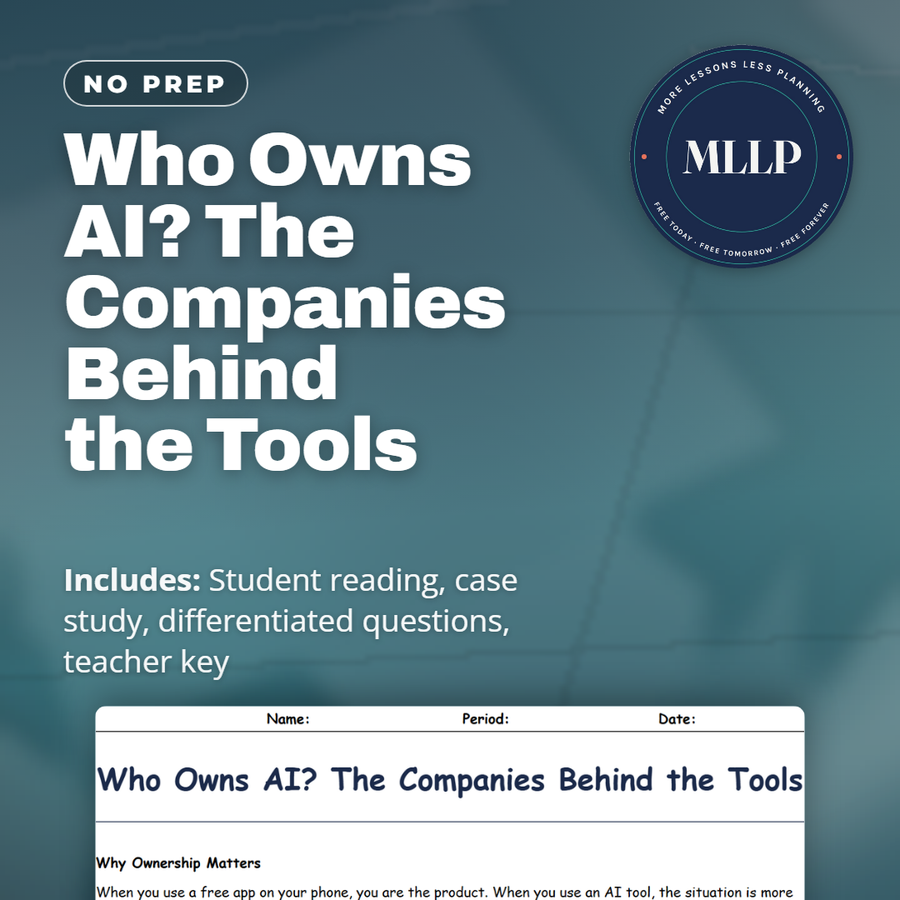
Who Owns AI? The Companies Behind the Tools
Quality reviewed September 2026
Facts verified September 20, 2026
- Subject
- Career & Life Skills
- Grades
- Grades 9-12
- Length
- 9-page student worksheet
- Time
- About one 50-minute class period
- Great for
- Sub plans and independent work
- Includes
- Reading passage, comprehension questions + full answer key
- Format
- Print-and-go PDF
What students do
- Five AI companies, from OpenAI to Meta, get matched to the investor, business model, or safety commitment named in the reading
- Trace how a $13 billion Microsoft investment and an $80 billion infrastructure commitment show the scale of money flowing into AI
- Explain why Google is described as both the most capable and the most conflicted company in the AI industry
- Weigh in on Mr. Okonkwo's case study over whether student homework questions can become a company's training data
What it covers
- The business models, investors, and founding stories behind OpenAI, Google, Anthropic, and Meta
- How free-tier AI services use conversation data, and the open source versus closed source debate
- Mr. Okonkwo's case study on whether a school tutoring contract lets a company train on student data
Start reading this worksheet
Why Ownership Matters
When you use a free app on your phone, you are the product. When you use an AI tool, the situation is more complicated, and more consequential. Understanding who owns the AI tools you use, what business model supports them, who funds the companies behind them, and what happens to the data you generate by using them is not optional background knowledge. It is essential for making informed decisions about when to use these tools, what information to share with them, and how much to trust their outputs. Power in the AI industry is concentrated in a very small number of companies, and that concentration has implications for everyone who uses these tools, which is now most of the world. This reading examines the major players in the AI industry, how they make money (or plan to), the role of investors and governments, and what questions you should ask about any AI tool before trusting it with your data or your decisions. This is not an argument that all AI companies are bad actors. It is an argument that informed use requires understanding whose interests are served by the tools you are using.
The Big Players and Their Business Models
OpenAI, maker of ChatGPT, began as a nonprofit research organization in 2015 with the stated mission of ensuring that artificial general intelligence benefits all of humanity. In 2019, it restructured into a 'capped profit' hybrid, allowing it to accept commercial investment while theoretically limiting profit extraction. This structure was controversial from the start, and by 2024 and 2025, OpenAI was in the process of converting to a more conventional for-profit structure. Its revenue comes primarily from ChatGPT subscriptions, enterprise licensing, and API access for developers. Microsoft has invested approximately $13 billion in the company and integrates its models into products used by hundreds of millions of people. Google, through its DeepMind research lab and the teams building Gemini, is both one of the world's leading AI research organizations and a company with a specific business vulnerability: its search advertising business, which generates most of its revenue, could be disrupted by AI tools that answer questions directly rather than sending users to websites where they see ads. Google is therefore simultaneously one of the most capable AI organizations in the world and one of the most conflicted: it benefits from advancing AI and is threatened by the same advances. This tension has shaped Google's cautious public-facing AI rollout strategy. Anthropic, the maker of Claude, was founded with explicit AI safety commitments. It is structured as a public benefit corporation, a legal form that requires it to consider its social mission alongside profit. Anthropic has received significant investment from Amazon (over $4 billion as of 2024) as well as from Google. The company publishes safety research and has committed to not racing ahead of what it believes can be deployed safely. Meta, which makes open-source AI models including the Llama family, has a different model: it releases its AI systems publicly, making them available to any developer. This approach has competitive benefits for Meta (it commoditizes AI, reducing OpenAI's advantage) but also raises safety concerns because open-source models are harder to restrict once released.
Where the Money Comes From, and What It Expects
The amount of capital flowing into AI is difficult to comprehend. OpenAI raised a $10 billion funding round in 2023. Anthropic raised over $7 billion by 2024. Microsoft committed $80 billion to AI infrastructure in 2025 alone. The scale of this investment means these companies have investors who expect returns (large, outsized returns), and that expectation shapes every product, research, and safety decision. Companies that accept billions in venture capital and corporate investment are not free to conclude that their technology should be deployed more slowly or that certain applications should not be pursued. The financial structure matters. Most AI companies are currently spending more money than they earn: they are not profitable. OpenAI was reported to be losing approximately $5 billion per year in 2024, even with substantial revenue, because the cost of training and running large models is enormous. These companies are betting that future capabilities will create dominant market positions worth trillions of dollars. This is similar to how Amazon spent years losing money to build the infrastructure that eventually generated extraordinary returns. Whether this bet pays off, and who benefits when it does, are open questions.
Like what you read? The full reading, the case study, and every question set are in the free download below, along with the answer key.
Why this matters
Every student in this reading's audience already uses one of these five companies' tools, often without knowing who owns them or how the free version gets paid for. Understanding a business model is not abstract civics homework. It changes what a student should type into a chat window, whether a school contract deserves a second read, and why the same company can be careful in public and aggressive in private. This is the kind of quiet financial literacy that shapes daily decisions long after the worksheet is graded.
From one teacher to another
Every AI company in this reading answers the same question differently: who pays for this, and what do they expect in return. OpenAI started as a nonprofit and is still working out what it owes investors now that it is not one. Google is stuck defending a search business that its own AI could make obsolete. Anthropic and Meta take opposite bets, safety commitments on one side, open weights on the other. The case study brings it home with a school board asking whether a tutoring contract quietly turns kids' algebra questions into training data.
What you get
Download
Where should I send the next one?
Everything here is free and it stays that way. Leave your email and I'll send you the new lessons as they go up. You can unsubscribe from any one of them.
Related resources
A Short History of AI: From Turing to ChatGPT
AI Hype vs. AI Reality: Cutting Through the Noise
How AI Got Smart So Fast: The 2022-2026 Boom
Meet the Big AI Tools: ChatGPT, Gemini, Claude, Copilot
Narrow AI vs. General AI: What Today's Tools Can and Can't Do
The Difference Between AI, Machine Learning, and Algorithms
Every lesson on this site is free to download and use. If one of them saved you a prep period, you can chip in a few bucks toward my three kids' daycare fund. That's genuinely where tips go.