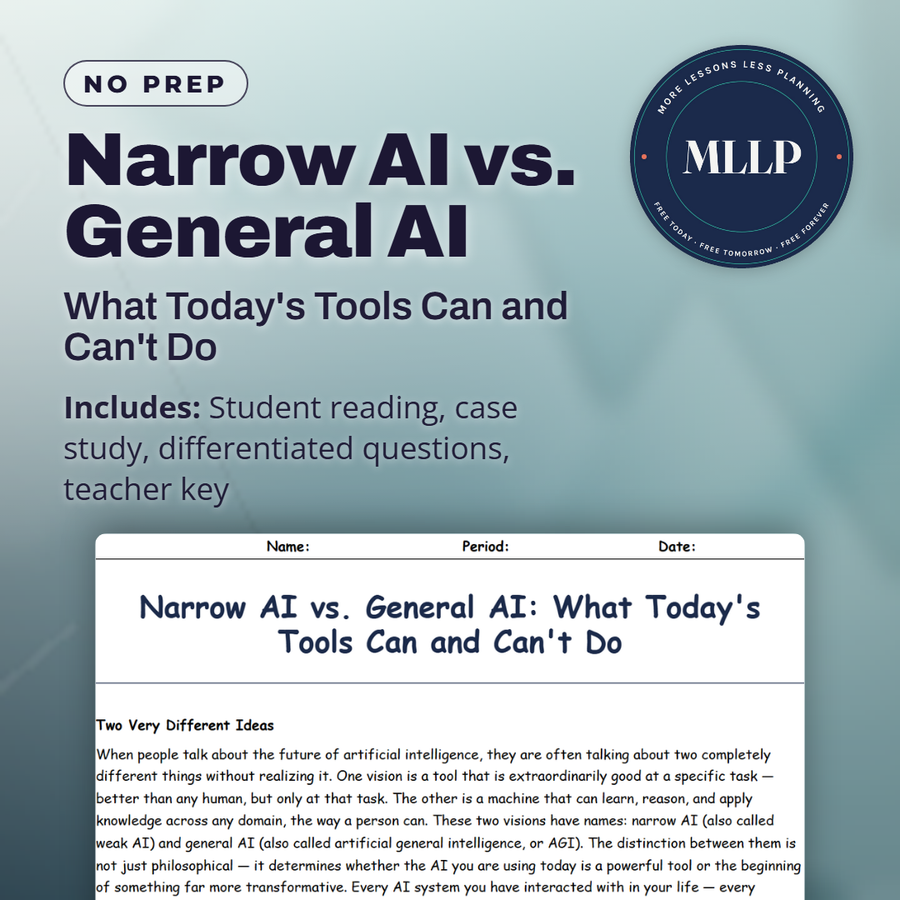
Narrow AI vs. General AI: What Today's Tools Can and Can't Do
Quality reviewed September 2026
Facts verified September 20, 2026
- Subject
- Career & Life Skills
- Grades
- Grades 9-12
- Length
- 9-page student worksheet
- Time
- About one 50-minute class period
- Great for
- Sub plans and independent work
- Includes
- Reading passage, comprehension questions + full answer key
- Format
- Print-and-go PDF
What students do
- Fill in three blanks naming chess, training data, and scale as the limits of today's narrow AI
- Mr. Chen's emergency-room chatbot misdiagnosis supplies two case study questions on training-data limits
- Sort narrow AI systems, like AlphaGo and image-recognition tools, from the hypothetical traits of general AI
- ChatGPT's fluency across history, code, and law gets explained as broad training data, not transferable understanding
What it covers
- The difference between narrow AI, which is every system in use today, and hypothetical artificial general intelligence
- AlphaGo's Go-only mastery, and why breadth in a chatbot's answers still comes from narrow training data
- A case study on an emergency-room chatbot that misreads a patient's symptoms outside its training population
Start reading this worksheet
Two Very Different Ideas
When people talk about the future of artificial intelligence, they are often talking about two completely different things without realizing it. One vision is a tool that is extraordinarily good at a specific task (better than any human, but only at that task). The other is a machine that can learn, reason, and apply knowledge across any domain, the way a person can. These two visions have names: narrow AI (also called weak AI) and general AI (also called artificial general intelligence, or AGI). The distinction between them is not just philosophical: it determines whether the AI you are using today is a powerful tool or the beginning of something far more consequential. Every AI system you have interacted with in your life (every recommendation engine, every chatbot, every voice assistant, every spam filter) is narrow AI. Without exception. Despite the impressive performances of tools like ChatGPT, they are still narrow AI systems operating within specific domains. Understanding why that is, and what it would take to build genuine general intelligence, is one of the most important things you can learn about this technology.
What Narrow AI Is, and Why It Is Impressive
Narrow AI refers to systems designed and trained to perform specific tasks. The 'narrow' label can be misleading: it does not mean the system is simple or unimpressive. Google's AlphaGo defeated the world champion in the ancient board game Go in 2016, achieving a level of strategic mastery that stunned experts who had expected the milestone to be years away. But AlphaGo cannot play chess. It cannot answer a question in English. It cannot book a restaurant reservation. It was built to play Go, it plays Go brilliantly, and that is the limit of its capability. This is true of virtually every AI system in use today. Image recognition AI can identify a tumor in a medical scan better than most radiologists, but it cannot explain its diagnosis in plain language. A large language model like ChatGPT can carry on a remarkably coherent conversation, summarize complex documents, and help debug code. But it has no persistent memory of you between conversations, no ability to learn from your individual interactions (unless explicitly designed to do so), and no genuine understanding of the concepts it discusses. It generates statistically plausible text based on patterns learned from training data. The reason narrow AI has achieved such impressive results is that it can apply enormous computational resources to a single, well-defined problem. When an AI system does nothing but play chess, it can devote billions of parameters and thousands of training hours to chess alone. This is fundamentally different from how human intelligence works; humans distribute attention and capability across a vast range of tasks simultaneously.
What General AI Would Look Like
Artificial General Intelligence (AGI) is a hypothetical system that can learn, understand, and apply knowledge across essentially any domain a human can. It would transfer skills from one area to another: if it learned to cook by watching videos, it could apply spatial reasoning and chemical knowledge from cooking to help fix a plumbing problem. It would understand context in the deep sense: knowing not just what you said, but why you said it, what emotional undercurrent might be driving your question, and how to calibrate its response for your situation. It would, in short, be as flexible as a person. No AGI exists today. This is not a matter of opinion or corporate spin; it is the consensus of the overwhelming majority of AI researchers. The systems that exist in 2026, however sophisticated they appear, are not general. They lack genuine understanding, causal reasoning, persistent learning from individual experience, and the common-sense knowledge that allows humans to navigate novel situations. When a large language model seems to generalize brilliantly across topics, it is because the internet, its training data, contained writing on all of those topics. It is not transferring understanding; it is matching patterns.
Like what you read? The full reading, the case study, and every question set are in the free download below, along with the answer key.
Why this matters
Students will keep hearing predictions that general AI is five to ten years away, and this reading gives them the tools to evaluate that claim instead of just repeating it. Mr. Chen's story matters because it shows the real-world cost of treating a narrow tool as if it understood something it does not, in a setting where the mistake could have cost him his life. Once a student can name what a specific AI tool was actually trained on, they can ask sharper questions before trusting it with anything that matters, from a medical chatbot to a college application essay checker.
From one teacher to another
AlphaGo can beat any human alive at the board game Go, but it cannot play chess, hold a conversation, or book a restaurant reservation, and that gap is the whole subject of this worksheet. Students read about the difference between narrow AI, which is every AI system that exists today, and artificial general intelligence, a hypothetical system that could transfer knowledge across domains the way a person does. A case study follows Mr. Chen, a patient whose emergency-room chatbot confidently misreads his chest pain because the system was trained mostly on data from younger patients, showing what happens when a narrow tool gets used outside the population it was built for. The reading also explains why a chatbot that discusses medieval history, Python, and legal contracts in the same conversation reflects broad training data rather than general intelligence.
What you get
Download
Where should I send the next one?
Everything here is free and it stays that way. Leave your email and I'll send you the new lessons as they go up. You can unsubscribe from any one of them.
Related resources
A Short History of AI: From Turing to ChatGPT
AI Hype vs. AI Reality: Cutting Through the Noise
How AI Got Smart So Fast: The 2022-2026 Boom
Meet the Big AI Tools: ChatGPT, Gemini, Claude, Copilot
The Difference Between AI, Machine Learning, and Algorithms
The Vocabulary of AI: 20 Terms You'll Hear Everywhere
Every lesson on this site is free to download and use. If one of them saved you a prep period, you can chip in a few bucks toward my three kids' daycare fund. That's genuinely where tips go.