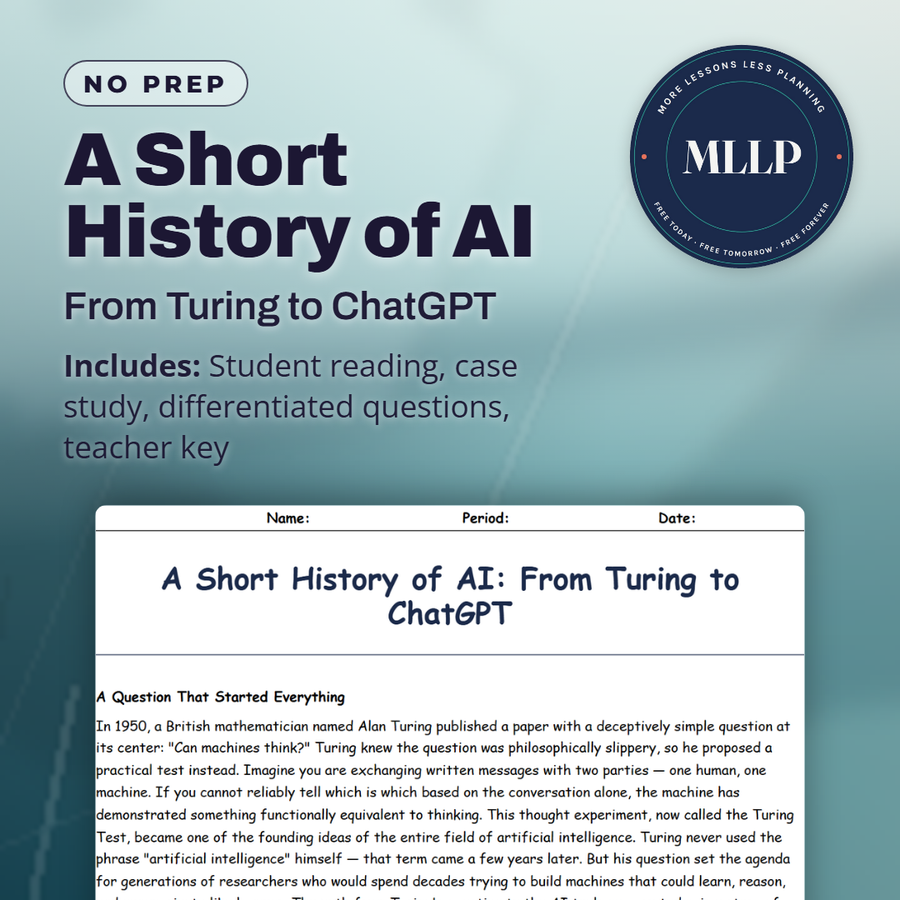
A Short History of AI: From Turing to ChatGPT
Quality reviewed September 2026
Facts verified September 20, 2026
- Subject
- Career & Life Skills
- Grades
- Grades 9-12
- Length
- 9-page student worksheet
- Time
- About one 50-minute class period
- Great for
- Sub plans and independent work
- Includes
- Reading passage, comprehension questions + full answer key
- Format
- Print-and-go PDF
What students do
- Match five history terms, from the Turing Test to the transformer architecture, to their definitions
- Three multiple-choice questions cover the AI winters, Deep Blue's 1997 win, and the 2017 transformer paper
- Fill in three blanks naming Dartmouth College, Kasparov, and ChatGPT's five-day user milestone
- Dr. Patel's 1984 grant rejection sets up three short-answer questions on why good ideas get dismissed too early
What it covers
- Turing's 1950 test, the 1956 Dartmouth workshop, and two AI winters that nearly ended the field
- IBM's Deep Blue, the 2012 deep learning breakthrough, and the 2017 transformer paper
- A case study on a researcher whose neural network research was rejected in 1984, decades before it proved correct
Start reading this worksheet
A Question That Started Everything
In 1950, a British mathematician named Alan Turing published a paper with a deceptively simple question at its center: "Can machines think?" Turing knew the question was philosophically slippery, so he proposed a practical test instead. Imagine you are exchanging written messages with two parties: one human, one machine. If you cannot reliably tell which is which based on the conversation alone, the machine has demonstrated something functionally equivalent to thinking. This thought experiment, now called the Turing Test, became one of the founding ideas of the entire field of artificial intelligence. Turing never used the phrase "artificial intelligence" himself. That term came a few years later. But his question set the agenda for generations of researchers who would spend decades trying to build machines that could learn, reason, and communicate like humans. The path from Turing's question to the AI tools you use today is a story of explosive optimism, crushing setbacks, and finally, in the last decade, a transformation that no one fully predicted. Understanding that history is not just interesting trivia; it explains why AI works the way it does today and why it has the limitations it does.
The Birth of the Field: 1950s-1960s
In the summer of 1956, a small group of scientists gathered at Dartmouth College in New Hampshire for a workshop that became a landmark moment in computing history. The organizer, a mathematician named John McCarthy, coined the term "artificial intelligence" for the event. The participants (who included Marvin Minsky, Claude Shannon, and Nathaniel Rochester) were optimistic to the point of audacity. McCarthy's original proposal suggested that a team working for just two months could make significant progress on teaching machines to use language, form abstractions, and solve problems reserved for humans. They did not solve it in two months. But the Dartmouth workshop established AI as a serious academic discipline and launched the first wave of serious research. In the late 1950s and 1960s, researchers built early programs that could play checkers, solve algebra problems, and prove mathematical theorems. These systems were impressive given the hardware constraints of the era, and they generated enormous excitement. Government funding poured in, particularly from the U.S. Department of Defense, which saw strategic value in machines that could process intelligence reports and support military decision-making.
The AI Winters: 1970s and 1980s
The excitement of the early decades eventually collided with reality. Researchers discovered that the tasks they had assumed were simple (understanding spoken language, recognizing a face, navigating a room) were in fact extraordinarily difficult for machines. Meanwhile, the tasks that seemed hard (playing chess, proving theorems) turned out to be tractable through brute-force search. This gap between public expectation and actual capability led to two major periods of reduced funding and interest, known as the "AI winters." The first AI winter began in the mid-1970s, when a British government report (the Lighthill Report) concluded that AI had failed to deliver on its promises and recommended cutting funding. The second AI winter hit in the late 1980s after a wave of investment in so-called "expert systems" (programs that encoded human expertise as if-then rules) proved brittle and expensive to maintain. These systems worked well in narrow, controlled environments but collapsed when confronted with situations their designers had not anticipated. The AI field's credibility took serious damage during these years.
Like what you read? The full reading, the case study, and every question set are in the free download below, along with the answer key.
Why this matters
Students hear "AI" used as if it appeared overnight, but the tools they use every day sit on top of seventy years of failure, funding cuts, and slow rebuilding. Knowing that ChatGPT rests on ideas that were rejected twice, in the 1970s and again in the 1980s, changes how a student reads the next breathless AI headline. The history in this worksheet gives students a reason to ask what happened the last time a technology got this much hype, and what that pattern suggests about the claims being made about AI right now.
From one teacher to another
Alan Turing asked a deceptively simple question in 1950: can machines think? This worksheet traces the seventy-year path from that question to the AI tools students use today, through the 1956 Dartmouth workshop where John McCarthy coined the phrase "artificial intelligence," two AI winters that gutted research funding, and the 2017 transformer paper that made ChatGPT possible. Students also work through a case study about a 1984 grant rejection, where a researcher's neural network proposal gets dismissed by her department chair, decades before the same approach becomes the foundation of modern AI. The reading names real milestones along the way: Deep Blue's 1997 defeat of Garry Kasparov, the 2012 deep learning breakthrough at the University of Toronto, and ChatGPT's five-day sprint to one million users in November 2022.
What you get
Download
Where should I send the next one?
Everything here is free and it stays that way. Leave your email and I'll send you the new lessons as they go up. You can unsubscribe from any one of them.
Related resources
AI Hype vs. AI Reality: Cutting Through the Noise
How AI Got Smart So Fast: The 2022-2026 Boom
Meet the Big AI Tools: ChatGPT, Gemini, Claude, Copilot
Narrow AI vs. General AI: What Today's Tools Can and Can't Do
The Difference Between AI, Machine Learning, and Algorithms
The Vocabulary of AI: 20 Terms You'll Hear Everywhere
Every lesson on this site is free to download and use. If one of them saved you a prep period, you can chip in a few bucks toward my three kids' daycare fund. That's genuinely where tips go.