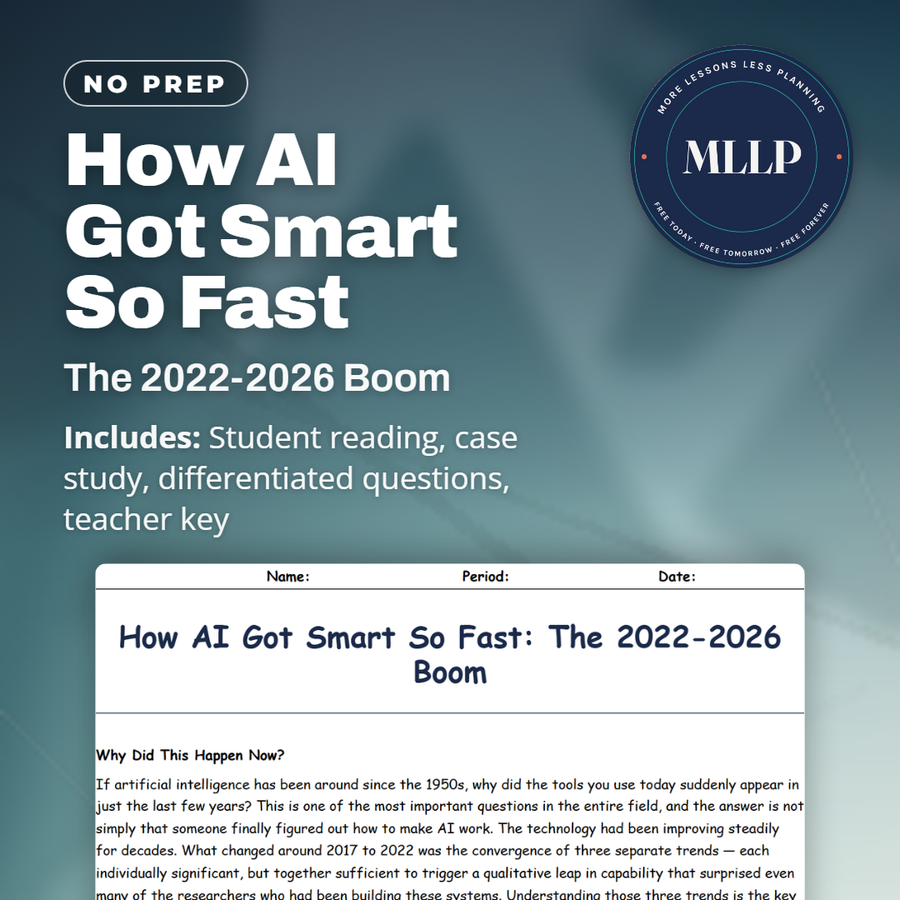
How AI Got Smart So Fast: The 2022-2026 Boom
Quality reviewed September 2026
Facts verified September 20, 2026
- Subject
- Career & Life Skills
- Grades
- Grades 9-12
- Length
- 9-page student worksheet
- Time
- About one 50-minute class period
- Great for
- Sub plans and independent work
- Includes
- Reading passage, comprehension questions + full answer key
- Format
- Print-and-go PDF
What students do
- Trace how the transformer, internet-scale data, and GPU hardware combined into the 2022 to 2026 AI boom
- Sandra Okafor's export-control decision sets up two case-study questions about chips becoming a national security issue
- Write short answers explaining why removing any one of the three trends would have kept today's AI tools out of reach
- GPT-3's 45-terabyte training set and NVIDIA's H100 chips supply the specifics behind three fill-in-the-blank answers
What it covers
- The 2017 transformer paper, GPT-3's massive training data, and the GPU hardware that made large-scale training possible
- Scaling laws, and why bigger models trained on more data and compute reliably got better
- A case study on a chip company CEO forced to reject an order once U.S. export controls take effect
Start reading this worksheet
Why Did This Happen Now?
If artificial intelligence has been around since the 1950s, why did the tools you use today suddenly appear in just the last few years? This is one of the most important questions in the entire field, and the answer is not simply that someone finally figured out how to make AI work. The technology had been improving steadily for decades. What changed around 2017 to 2022 was the convergence of three separate trends, each individually significant, but together sufficient to trigger a qualitative leap in capability that surprised even many of the researchers who had been building these systems. Understanding those three trends is the key to understanding why AI seems to have come out of nowhere. The three trends are: the invention of a new type of neural network architecture (the transformer), the availability of vast amounts of data from the internet, and a dramatic improvement in computing hardware, particularly graphics processing units (GPUs) that turned out to be ideal for running AI calculations. Remove any one of these three, and the current generation of AI tools would not exist. Together, they created what researchers sometimes call a 'phase transition': a point where gradual improvement suddenly produced qualitatively different results.
The Transformer Architecture: The Spark
In June 2017, a team of Google researchers published a paper with the understated title 'Attention Is All You Need.' The paper introduced a new type of neural network architecture called the transformer. Before the transformer, the dominant approach to language-related AI tasks used a type of network called a recurrent neural network (RNN), which processed text one word at a time in sequence, making it slow and prone to losing track of earlier context in long texts. The transformer replaced this sequential approach with a mechanism called 'attention,' which allows the model to consider all parts of a text simultaneously and weigh which parts are most relevant to each other. The practical effect was significant: transformer-based models trained faster, handled longer texts more effectively, and scaled in a way that RNNs did not, meaning that making a transformer larger by adding more parameters consistently produced better performance. This 'scaling law' turned out to be crucial. It meant that the path to more capable AI was, in part, simply to build bigger models and train them on more data. Companies with the resources to do this (Google, OpenAI, Anthropic, Meta) had a clear roadmap for improvement.
The Data Advantage: The Internet as a Training Set
The second ingredient was data. Modern large language models are trained on staggering amounts of text. GPT-3, released in 2020, was trained on a dataset filtered down from roughly 45 terabytes of raw crawled text: a dataset that included large portions of the English-language internet, books, Wikipedia, and other sources. GPT-4 and subsequent models used training sets that were larger still. The key insight is that the internet, which had been growing for 25 years by the time these models were being trained, had essentially created the world's largest annotated corpus of human language and knowledge, available for free. This data advantage was not evenly distributed. Creating a capable large language model requires not just raw text but carefully curated training datasets, human feedback to align the model's behavior, and ongoing safety testing. These requirements mean that the best-performing models are concentrated at a handful of large technology companies with the resources to acquire and process data at scale. Smaller research teams and open-source projects can build capable models, but closing the gap with frontier models requires the kind of infrastructure investment only a few organizations can make. The data story also has a problematic side. Training data scraped from the internet reflects all of the biases, inaccuracies, and harmful content present on the internet. Managing these problems has become one of the central challenges of AI development; companies employ large teams of human reviewers to label data, identify harmful outputs, and provide feedback that steers model behavior away from problematic patterns.
Like what you read? The full reading, the case study, and every question set are in the free download below, along with the answer key.
Why this matters
Every student in this class has watched AI tools go from a novelty to something embedded in their phone, their school laptop, and their afterschool job applications within a few years, and this reading explains what had to line up first for it to happen when it did. Understanding that the boom required a specific architecture, a specific volume of data, and a specific generation of chips helps students reason about what might slow the pace down next, rather than assuming the current rate of change is permanent. It also connects a physics-and-engineering story to a geopolitics story, since the same H100 chip that trains a chatbot is now subject to federal export law.
From one teacher to another
Three separate trends had to converge before ChatGPT could exist: a new neural network design called the transformer, decades of accumulated internet text, and graphics chips originally built for video games. This worksheet walks through each ingredient on its own, from the 2017 Google paper that introduced the transformer's attention mechanism to NVIDIA's H100 chips becoming central enough to trigger U.S. export controls on China. Students also read about Sandra Okafor, a chip company CEO who has to decide whether to fulfill an order that federal export restrictions have just made illegal, and see how a hardware decision made in a boardroom connects directly to the scaling laws described earlier in the reading. By the end, students can explain why removing any one of the three trends would have kept today's AI tools out of reach.
What you get
Download
Where should I send the next one?
Everything here is free and it stays that way. Leave your email and I'll send you the new lessons as they go up. You can unsubscribe from any one of them.
Related resources
A Short History of AI: From Turing to ChatGPT
AI Hype vs. AI Reality: Cutting Through the Noise
Meet the Big AI Tools: ChatGPT, Gemini, Claude, Copilot
Narrow AI vs. General AI: What Today's Tools Can and Can't Do
The Difference Between AI, Machine Learning, and Algorithms
The Vocabulary of AI: 20 Terms You'll Hear Everywhere
Every lesson on this site is free to download and use. If one of them saved you a prep period, you can chip in a few bucks toward my three kids' daycare fund. That's genuinely where tips go.