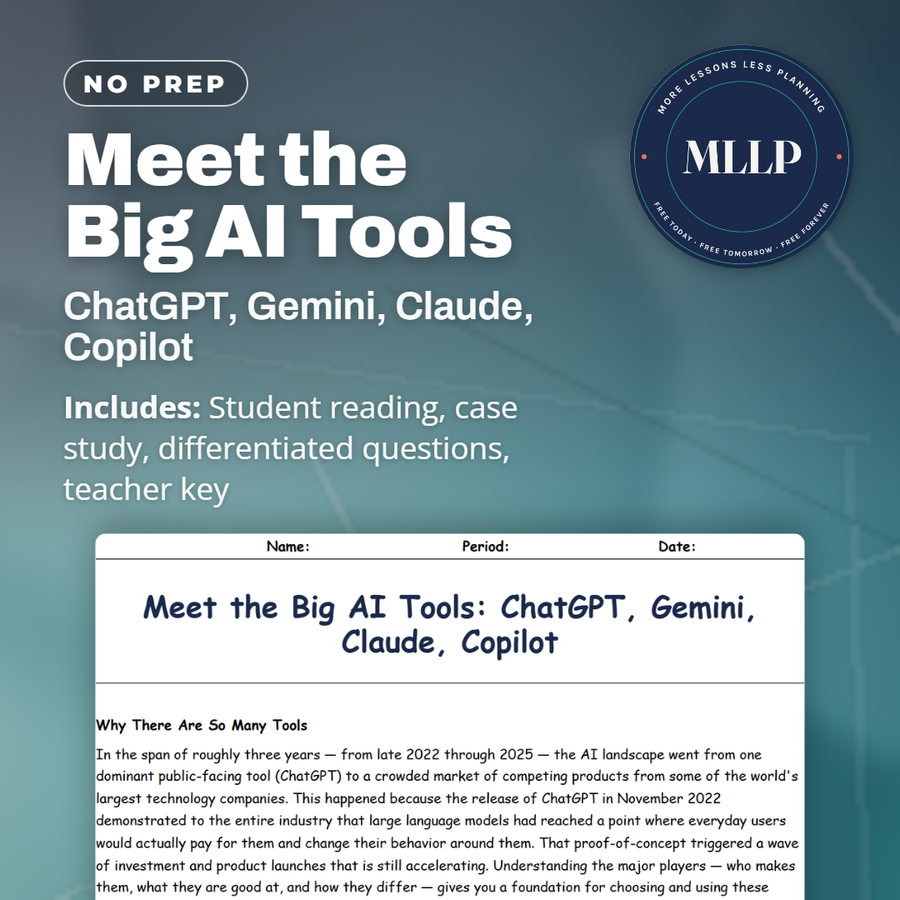
Meet the Big AI Tools: ChatGPT, Gemini, Claude, Copilot
Quality reviewed September 2026
Facts verified September 20, 2026
- Subject
- Career & Life Skills
- Grades
- Grades 9-12
- Length
- 9-page student worksheet
- Time
- About one 50-minute class period
- Great for
- Sub plans and independent work
- Includes
- Reading passage, comprehension questions + full answer key
- Format
- Print-and-go PDF
What students do
- Explain why the same student got three different results from ChatGPT, Claude, and Copilot on one research paper
- Four AI companies and their standout features, from Claude's long-document handling to Copilot's place inside Word, get profiled in the reading
- Match each tool's founding story and safety approach to the company that built it
- Three fill-in-the-blank questions target ChatGPT's user growth, Gemini's ecosystem, and Anthropic's founding
What it covers
- ChatGPT, Google Gemini, Claude, and Microsoft Copilot, including who built each one and what it is built for
- The difference between an AI's underlying model and the product interface layered on top of it
- A case study on a student getting three different results from three different tools on the same research paper
Start reading this worksheet
Why There Are So Many Tools
In the span of roughly three years, from late 2022 through 2025, the AI landscape went from one dominant public-facing tool (ChatGPT) to a crowded market of competing products from some of the world's largest technology companies. This happened because the release of ChatGPT in November 2022 demonstrated to the entire industry that large language models had reached a point where everyday users would actually pay for them and change their behavior around them. That proof-of-concept triggered a wave of investment and product launches that is still accelerating. Understanding the major players (who makes them, what they are good at, and how they differ) gives you a foundation for choosing and using these tools intelligently. Before we go tool by tool, one important concept: almost all of these products are built on top of large language models (LLMs), which are AI systems trained on massive text datasets to predict and generate language. The 'product' you interact with is typically a user interface and a set of safety guidelines layered on top of an underlying model. This means the same base model might power multiple products: for example, the models behind ChatGPT are also available to businesses through an API. Understanding the product layer versus the model layer helps you think more clearly about what you are actually using.
ChatGPT: The Tool That Started the Public AI Era
ChatGPT is a product of OpenAI, an AI safety company founded in 2015 that has since become one of the most influential technology organizations in the world. OpenAI's underlying model family is called GPT (Generative Pre-trained Transformer), with versions including GPT-3, GPT-4, and subsequent releases. ChatGPT is the consumer-facing interface that made these models accessible to the general public without requiring any technical expertise. When ChatGPT launched in November 2022, it reached one million users in five days and 100 million users within two months: the fastest adoption of any consumer technology in history at that point. It can draft emails, write code, explain complex concepts, summarize documents, brainstorm ideas, and engage in extended conversations. As of 2026, it has incorporated web browsing, image generation (through DALL-E), voice interaction, and the ability to analyze uploaded documents. OpenAI offers a free tier with limitations and a paid ChatGPT Plus subscription with access to more capable models and features. One important thing to know about ChatGPT: its knowledge is based on its training data, which has a cutoff date. Anything that happened after that date (news events, new research, product releases) is not something the base model knows. The web browsing feature addresses this limitation but introduces its own considerations around source reliability.
Google Gemini: The Search Giant's AI Bet
Google's AI assistant, Gemini, represents the company's most significant product pivot in years. Google had been doing foundational AI research for longer than almost any company. The transformer architecture that made modern language models possible came from Google in 2017. But the company moved cautiously on consumer products partly because a mistaken AI answer could damage its core search business. ChatGPT's success forced Google's hand. Gemini is powered by Google's Gemini model family and is notable for its deep integration with Google's ecosystem: Google Search, Gmail, Google Docs, Google Drive, and YouTube. If you are already a heavy Google user, Gemini can pull context from your emails and documents to give more personalized answers. It also has stronger real-time capabilities than some competitors because of its connection to Google Search. Google offers Gemini free through its consumer apps and as a paid tier (Gemini Advanced) with access to more powerful model versions. An important distinction: Gemini is both the product name and the model family name. This can be confusing. When people say they are 'using Gemini,' they might mean the consumer app or they might mean they are accessing Gemini models through Google's API in their own software.
Like what you read? The full reading, the case study, and every question set are in the free download below, along with the answer key.
Why this matters
Students already have opinions about which AI tool is "better," usually based on whichever one they opened first, and this reading gives them a real basis for comparison instead of brand loyalty. Knowing that Claude was built by researchers who left OpenAI over safety disagreements, or that Copilot's advantage is living inside Word rather than a separate app, changes which tool a student reaches for on a given assignment. Destiny's story matters because it shows that picking the wrong tool for a task, like trusting ChatGPT for citations, has real consequences for the quality of a student's work.
From one teacher to another
Four AI tools now dominate most students' daily lives, and this worksheet gives each one its own passage: OpenAI's ChatGPT, which reached one million users in five days after its November 2022 launch; Google's Gemini, built on the transformer research Google published in 2017 and wired into Gmail and Docs; Anthropic's Claude, built by former OpenAI researchers around a safety-first philosophy and strong long-document handling; and Microsoft Copilot, embedded directly inside Word, Excel, and Teams. Students read a case study about Destiny, a junior writing a research paper, who gets confidently wrong citations from ChatGPT, a clean long-document outline from Claude, and useful in-document editing from Copilot, and has to explain why one student got three different results from three different tools. The reading also draws out the difference between the underlying model and the product built on top of it, since the same base model can power more than one tool.
What you get
Download
Where should I send the next one?
Everything here is free and it stays that way. Leave your email and I'll send you the new lessons as they go up. You can unsubscribe from any one of them.
Related resources
A Short History of AI: From Turing to ChatGPT
AI Hype vs. AI Reality: Cutting Through the Noise
How AI Got Smart So Fast: The 2022-2026 Boom
Narrow AI vs. General AI: What Today's Tools Can and Can't Do
The Difference Between AI, Machine Learning, and Algorithms
The Vocabulary of AI: 20 Terms You'll Hear Everywhere
Every lesson on this site is free to download and use. If one of them saved you a prep period, you can chip in a few bucks toward my three kids' daycare fund. That's genuinely where tips go.