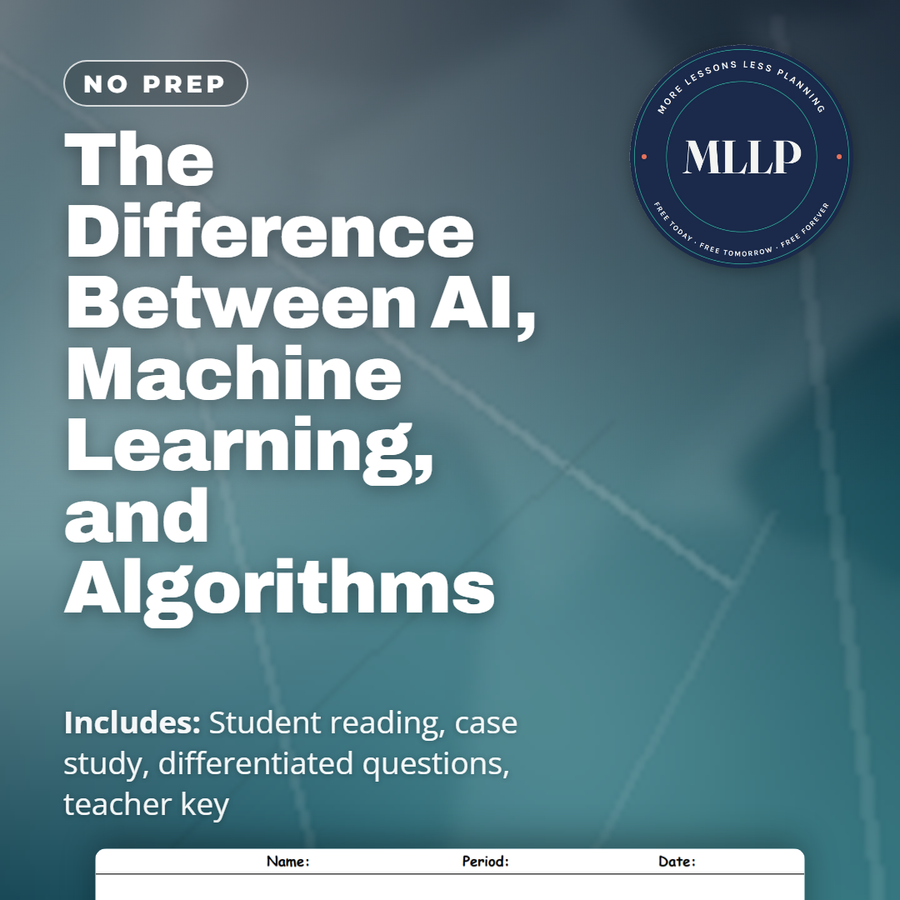
The Difference Between AI, Machine Learning, and Algorithms
Quality reviewed September 2026
Facts verified September 20, 2026
- Subject
- Career & Life Skills
- Grades
- Grades 9-12
- Length
- 9-page student worksheet
- Time
- About one 50-minute class period
- Great for
- Sub plans and independent work
- Includes
- Reading passage, comprehension questions + full answer key
- Format
- Print-and-go PDF
What students do
- Answer three multiple-choice questions testing whether a traditional algorithm or a machine learning model is deterministic
- Jasmine's hiring-algorithm case study supplies two case study questions on where bias in training data comes from
- Explain the nested relationship between algorithms, machine learning, and deep learning, from oldest idea to newest
- Three fill-in-the-blank answers name algorithms, subset, and training data as the reading's core vocabulary
What it covers
- The nested relationship between algorithms, machine learning, and artificial intelligence, from oldest to newest
- The difference between a rule-based spam filter and one trained through machine learning on labeled data
- A case study on a hiring algorithm that learned bias from ten years of mostly male hiring data
Start reading this worksheet
Three Terms, One Confusion
If you have spent any time reading about technology, you have almost certainly encountered three terms that seem to get used interchangeably: artificial intelligence, machine learning, and algorithms. A news article will say an algorithm recommended a video to you. A tech company will claim their product uses machine learning to personalize your experience. A politician will warn about the dangers of AI decision-making. In many cases, these terms point to different things, but the people using them often do not make the distinction clear, and sometimes they use one term when they really mean another. This matters because the differences are real, and mixing them up leads to confused thinking about what these technologies actually do and who is responsible for them. This reading is going to cut through that confusion. By the end, you will have a clear mental model of how these three concepts relate to each other: which ones are larger categories, which are subsets, and which is the foundation everything else is built on. Think of it like the relationship between vehicles, cars, and electric cars: one contains the others, and understanding that hierarchy helps you ask the right questions.
Start With Algorithms: They Are the Foundation
An algorithm, at its most basic, is a set of step-by-step instructions for solving a problem or completing a task. There is nothing futuristic or complicated about this concept. Algorithms are ancient. A recipe is an algorithm. Long division is an algorithm. The directions from your house to the grocery store are an algorithm. What all algorithms share is that they are precise, ordered instructions that, when followed correctly, reliably produce a specific outcome. In computing, algorithms are the instructions that tell a computer exactly what to do. The program that sorts your photos by date uses an algorithm. The formula that calculates your GPA is an algorithm. The code that decides which posts appear at the top of your social media feed is an algorithm (a very complicated one, but still a set of instructions a programmer wrote). What is crucial to understand is that traditional algorithms are deterministic: given the same input, they always produce the same output. They do not learn, adapt, or change unless a programmer explicitly updates them. When you hear someone say 'the algorithm put this video in my feed,' they are usually referring to a recommendation system. Whether that system uses traditional rule-based logic or something more sophisticated involving machine learning depends on the company and the product. The word 'algorithm' in everyday speech has come to mean approximately 'the automated system that made this decision,' which is technically imprecise but reflects how people experience these technologies.
Machine Learning: Algorithms That Learn
Machine learning is a specific approach to building software where, instead of writing out every rule, you train the program on data and let it figure out the patterns itself. Machine learning is a subset of AI, meaning all machine learning is AI, but not all AI is machine learning. It is also a more specialized use of algorithms, where the algorithm is not just following instructions but updating its own internal parameters based on feedback. Here is a concrete example. Imagine you want to build a system that can tell whether an email is spam or not. One approach: write rules. If the subject contains the phrase 'click here to claim,' mark it as spam. If the sender is not in the contact list and the email contains the word 'urgent,' mark it as spam. This rule-based approach can work reasonably well, but it requires someone to anticipate every variation of spam and update the rules constantly as spammers adapt. The other approach: machine learning. Collect a million emails, label them 'spam' or 'not spam,' and train a model on that data. The model learns to recognize patterns in spam that the rule-writer never explicitly defined. These include things like unusual combinations of words, suspicious formatting patterns, or links to certain domains. Over time, as spammers change tactics, you retrain the model on new data. Machine learning has become the dominant approach in modern AI because it scales much better than hand-coding rules. The more data you have, and the more powerful your computers, the better the system gets, without requiring a programmer to sit down and update a rulebook. This is why the explosion in internet data over the past two decades has been so important to AI progress.
Like what you read? The full reading, the case study, and every question set are in the free download below, along with the answer key.
Why this matters
Students hear "algorithm" and "AI" used as if they mean the same thing, and that confusion makes it harder for them to ask the right question when a tool affects their life, whether that is a college recommendation engine or, like Jasmine, a job application. Knowing that a rule-based system's bias traces back to a specific person's rule, while a machine learning system's bias traces back to historical data, changes who a student should hold accountable when something goes wrong. That distinction matters for a student about to submit applications that will likely be screened by exactly this kind of system.
From one teacher to another
A recipe counts as an algorithm, and so does the code that sorts a social media feed, because an algorithm is simply a set of step-by-step instructions that always produces the same result from the same input. This worksheet untangles three terms people use interchangeably: algorithms, which are the oldest and most basic idea; machine learning, a way of building software that learns patterns from data instead of following hand-written rules; and artificial intelligence, the broad umbrella term that includes both. Students read a case study about Jasmine, a recent graduate whose job application gets filtered by a hiring system trained on ten years of a mostly male workforce, and work through where the resulting bias actually came from. The reading argues that knowing which of the three terms actually applies to a given tool changes who can be held responsible when that tool gets something wrong.
What you get
Download
Where should I send the next one?
Everything here is free and it stays that way. Leave your email and I'll send you the new lessons as they go up. You can unsubscribe from any one of them.
Related resources
A Short History of AI: From Turing to ChatGPT
AI Hype vs. AI Reality: Cutting Through the Noise
How AI Got Smart So Fast: The 2022-2026 Boom
Meet the Big AI Tools: ChatGPT, Gemini, Claude, Copilot
Narrow AI vs. General AI: What Today's Tools Can and Can't Do
The Vocabulary of AI: 20 Terms You'll Hear Everywhere
Every lesson on this site is free to download and use. If one of them saved you a prep period, you can chip in a few bucks toward my three kids' daycare fund. That's genuinely where tips go.