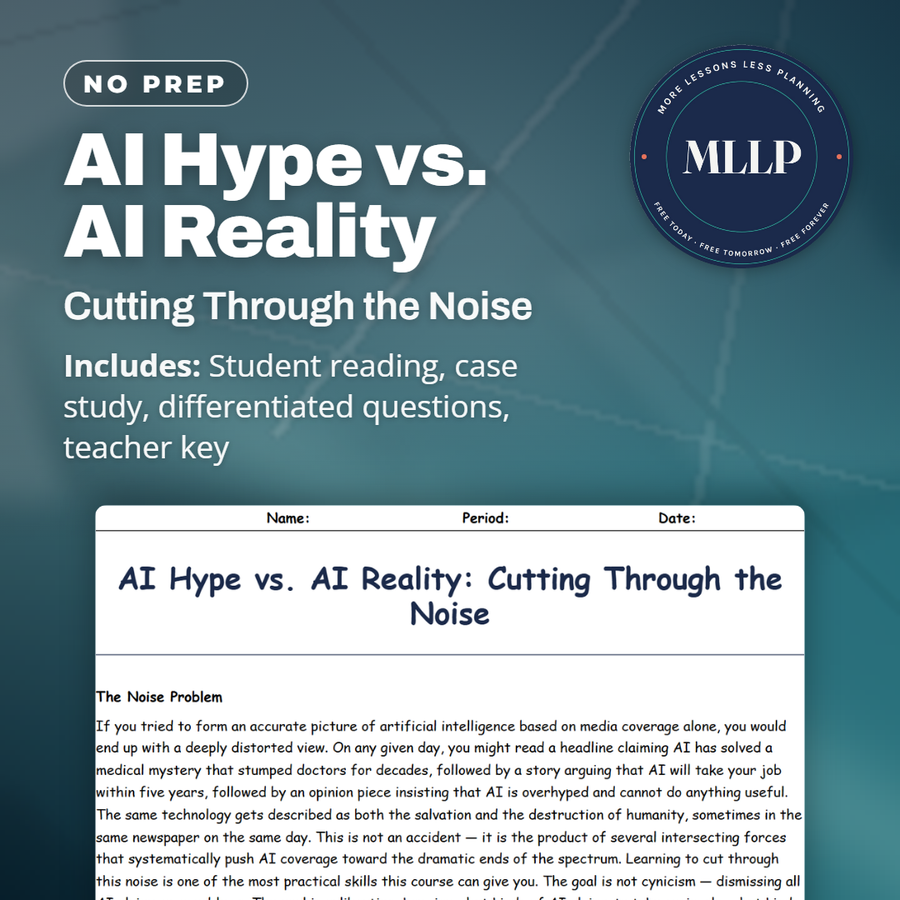
AI Hype vs. AI Reality: Cutting Through the Noise
Quality reviewed September 2026
Facts verified September 20, 2026
- Subject
- Career & Life Skills
- Grades
- Grades 9-12
- Length
- 9-page student worksheet
- Time
- About one 50-minute class period
- Great for
- Sub plans and independent work
- Includes
- Reading passage, comprehension questions + full answer key
- Format
- Print-and-go PDF
What students do
- Sort red flags and green flags from the reading's checklist for evaluating AI news claims
- Jordan's cancer-headline case study sets up three questions about a 99 percent accuracy claim that falls apart under scrutiny
- Answer three multiple-choice questions covering the Gartner Hype Cycle and the gap between benchmark scores and real-world performance
- Three fill-in-the-blank questions target the vocabulary of hype, inflated expectations, causal language, and training data overlap
What it covers
- The Gartner Hype Cycle and why both AI optimists and AI skeptics have credible evidence right now
- The gap between benchmark test scores and real-world performance, including why exam-trained models ace exam questions
- A case study on a viral cancer-detection headline and the red flags hiding inside its 99 percent claim
Start reading this worksheet
The Noise Problem
If you tried to form an accurate picture of artificial intelligence based on media coverage alone, you would end up with a deeply distorted view. On any given day, you might read a headline claiming AI has solved a medical mystery that stumped doctors for decades, followed by a story arguing that AI will take your job within five years, followed by an opinion piece insisting that AI is overhyped and cannot do anything useful. The same technology gets described as both the salvation and the destruction of humanity, sometimes in the same newspaper on the same day. This is not an accident; it is the product of several intersecting forces that systematically push AI coverage toward the dramatic ends of the spectrum. Learning to cut through this noise is one of the most practical skills this course can give you. The goal is not cynicism: dismissing all AI claims as overblown. The goal is calibration: knowing what kinds of AI claims to take seriously, what kinds of evidence actually support those claims, and what questions to ask when you encounter a dramatic AI headline. These are the same critical thinking skills that apply to any domain with high stakes, fast change, and strong financial incentives.
The Sources of Hype
AI hype comes from several distinct sources, each with different motivations. Technology companies have powerful financial incentives to overstate their products' capabilities. Investor valuations, stock prices, talent recruitment, and competitive positioning all benefit from the perception that a company's AI is smarter, more capable, and more revolutionary than it actually is. This is not new (technology companies have exaggerated capabilities for decades), but the stakes are higher now because AI has attracted trillions of dollars of investment, creating extraordinary pressure to justify that investment with impressive-sounding claims. Journalists and media organizations have their own incentives. Stories about AI curing cancer or threatening humanity generate far more clicks, shares, and advertising revenue than accurate but nuanced stories about incremental technical progress. The economics of digital media reward alarm, wonder, and conflict over precision. This does not mean journalists are dishonest, since most are trying to make complex topics accessible and compelling, but the structural pressures of the industry systematically favor dramatic framings. Researchers and academics are not immune either. Academic funding, conference invitations, and professional reputation are partly tied to the significance of one's work. A researcher who discovers a modest improvement in model efficiency has less incentive to downplay it than one whose career benefits from it being framed as a breakthrough. The pressure to claim significance affects how even careful scientists describe their work to the public.
The Hype Cycle and Where We Are
Gartner, a technology research firm, has documented a recurring pattern in how new technologies get discussed publicly, called the Hype Cycle. The pattern goes: trigger (a new technology emerges) → peak of inflated expectations (breathless coverage of what the technology will do) → trough of disillusionment (reality sets in, failures become more prominent in coverage) → slope of enlightenment (practical applications that actually work become clearer) → plateau of productivity (mainstream adoption of what actually works). AI has gone through multiple Hype Cycles over its history. Each of the two AI winters was, in part, the 'trough of disillusionment' after a peak of inflated expectations. The question of where we are in the current cycle is one of the most debated topics in the field. Some researchers argue that current AI capabilities genuinely change what is possible and that the hype is approximately accurate. Others argue that we are near the peak of inflated expectations and that a significant correction, a third AI winter, is coming as current techniques hit diminishing returns. Both groups have credible evidence for their positions.
Like what you read? The full reading, the case study, and every question set are in the free download below, along with the answer key.
Why this matters
Students are going to keep seeing AI headlines that promise miracles or doom, often about topics that touch their own families the way Jordan's mother's diagnosis touches his. Teaching them to ask where a claim came from, whether it was peer-reviewed, and whether a benchmark score reflects anything like real-world use gives them a durable skill that outlasts any single AI product. The same checklist works on a cancer-detection claim today and whatever the next viral AI story turns out to be.
From one teacher to another
Every AI headline seems to promise either salvation or disaster, often in the same newspaper on the same day. This worksheet breaks down where that noise comes from, including the financial incentives that push technology companies, journalists, and researchers toward dramatic claims, and walks through the Gartner Hype Cycle that explains why AI coverage swings from inflated expectations to disillusionment and back. Students read a case study about Jordan, whose mother has cancer, encountering a headline claiming an AI detects cancer with 99 percent accuracy, and work through why that number does not mean what it appears to mean. The reading gives students a specific checklist of red flags, like unverified company claims and causal language, and green flags, like peer review and replication, they can apply the next time an AI story crosses their feed.
What you get
Download
Where should I send the next one?
Everything here is free and it stays that way. Leave your email and I'll send you the new lessons as they go up. You can unsubscribe from any one of them.
Related resources
A Short History of AI: From Turing to ChatGPT
How AI Got Smart So Fast: The 2022-2026 Boom
Meet the Big AI Tools: ChatGPT, Gemini, Claude, Copilot
Narrow AI vs. General AI: What Today's Tools Can and Can't Do
The Difference Between AI, Machine Learning, and Algorithms
The Vocabulary of AI: 20 Terms You'll Hear Everywhere
Every lesson on this site is free to download and use. If one of them saved you a prep period, you can chip in a few bucks toward my three kids' daycare fund. That's genuinely where tips go.