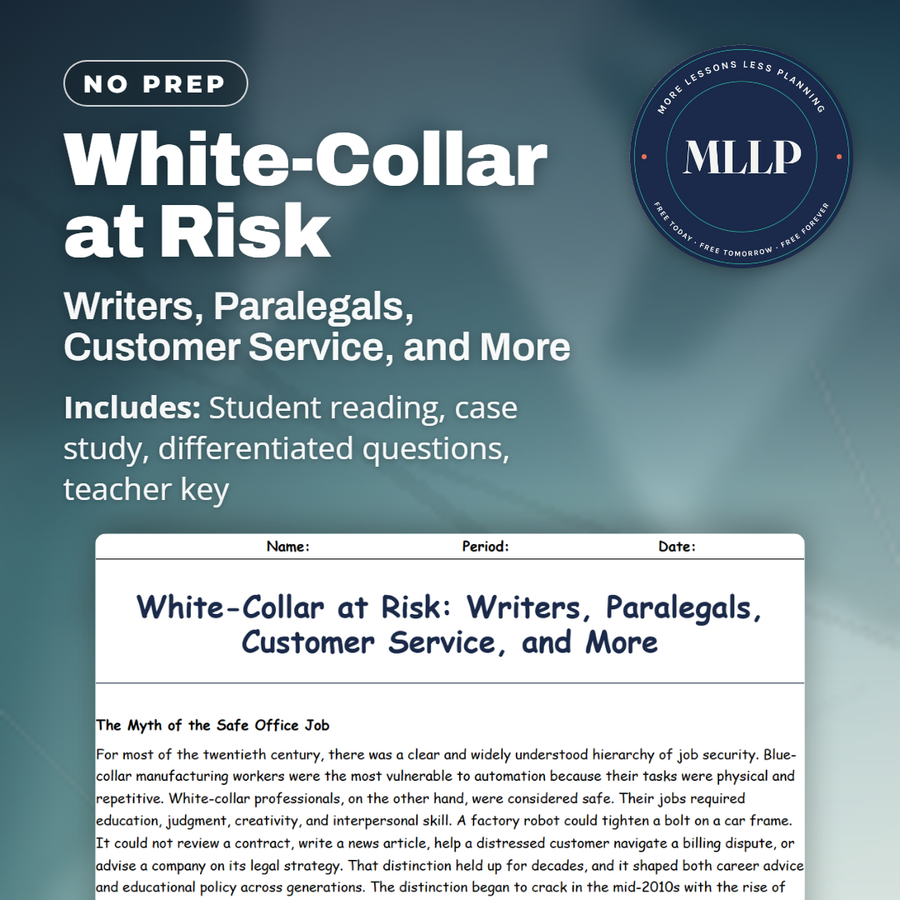
White-Collar at Risk: Writers, Paralegals, Customer Service, and More
Quality reviewed September 2026
Facts verified September 20, 2026
- Subject
- Career & Life Skills
- Grades
- Grades 9-12
- Length
- 10-page student worksheet
- Time
- About one 50-minute class period
- Great for
- Sub plans and independent work
- Includes
- Reading passage, comprehension questions + full answer key
- Format
- Print-and-go PDF
What students do
- Five terms, including document review, competency threshold, and niche expertise, get matched to their definitions
- Fill in three blanks on the legal AI tools and writing bylines named in the reading
- Priya's case study, a freelance writer whose per-word rate collapses from $0.20 to $0.05, gets read and analyzed
- Answer short answer questions on why removing junior legal tasks costs firms more than headcount alone
What it covers
- Why the old assumption that white-collar jobs are safe from automation collapsed between 2022 and 2025
- Real cases in writing, paralegal work, and customer service, including Klarna and Sports Illustrated
- A case study on a freelance writer who rebuilds her income around a paid newsletter
Start reading this worksheet
The Myth of the Safe Office Job
For most of the twentieth century, there was a clear and widely understood hierarchy of job security. Blue-collar manufacturing workers were the most vulnerable to automation because their tasks were physical and repetitive. White-collar professionals, on the other hand, were considered safe. Their jobs required education, judgment, creativity, and interpersonal skill. A factory robot could tighten a bolt on a car frame. It could not review a contract, write a news article, help a distressed customer navigate a billing dispute, or advise a company on its legal strategy. That distinction held up for decades, and it shaped both career advice and educational policy across generations. The distinction began to crack in the mid-2010s with the rise of machine learning tools capable of classifying and processing language. It collapsed almost entirely between 2022 and 2025, when large language models reached the capability threshold required to perform many professional knowledge tasks with competence. The attorneys, journalists, writers, financial analysts, and administrative professionals who were told their jobs were safe are now confronting a very different reality. AI tools can draft contracts, summarize case law, write first-draft news articles, generate financial reports, and respond to customer inquiries. In many of these areas, AI performance is already at or above the level of an entry-level professional. Understanding which specific roles are most at risk, and why, is not a reason for panic. It is a reason for clear-eyed planning. The workers who are navigating this transition most successfully are the ones who understand what is actually happening to their industry rather than waiting to be surprised by it.
What Is Happening to Writers and Content Creators
Writing has historically been considered among the most distinctly human professions. It requires a voice, a perspective, cultural knowledge, and the ability to shape ideas for a specific audience. Many of those qualities remain valuable, but a large portion of the writing economy does not depend on any of them. Content marketing, SEO articles, product descriptions, corporate communications, newsletter text, press release drafts, and basic journalism covering data-driven topics like earnings reports and sports scores are categories where AI tools have already replaced a significant portion of human labor. News organizations including the Associated Press, Reuters, and a number of regional publishers have been using automated content generation for structured stories since before 2022. After ChatGPT and similar tools arrived, the volume and range of automated content expanded dramatically. In 2023 and 2024, several media companies conducted layoffs of their writing staffs while publicly noting that AI tools would absorb some of the work. BuzzFeed's content operation was restructured with explicit reference to AI capabilities. Sports Illustrated became embroiled in controversy when it was discovered that AI-generated articles had been published under fictional human bylines. The creative end of writing, the work that requires a distinct voice, deep cultural knowledge, original insight, and narrative risk, remains more human-dependent. But that end of the market is also smaller and harder to break into. The volume work that used to provide income to freelance writers while they built their reputations has largely dried up. A young writer who once might have paid rent with content marketing contracts while working on more meaningful projects now faces a market where those contracts have evaporated.
Paralegals and the Legal Field Under Pressure
Law has long been considered a profession insulated from automation because legal work requires judgment, ethical reasoning, client relationships, and expertise developed over years of practice. The senior partner drafting complex litigation strategy is not in immediate danger of being replaced. The paralegal reviewing thousands of documents to find relevant precedents for a case is a different story. Document review has always been among the most labor-intensive and time-consuming aspects of legal work. It is also among the most easily automated. AI tools designed specifically for legal document review, contract analysis, and legal research have been adopted rapidly by large law firms and corporate legal departments. Tools like Harvey, Relativity, and Casetext have demonstrated the ability to analyze and summarize thousands of pages of legal documents in minutes rather than days. Tasks that previously required teams of junior associates and paralegals billing hundreds of hours can now be completed for a fraction of the cost in a fraction of the time. The impact on entry-level legal employment has been significant and has been widely discussed in legal industry publications since 2023. The paralegal role is not disappearing entirely, but it is changing. The tasks that AI handles best, document sorting, citation checking, basic contract review, and deposition summarizing, were precisely the tasks that filled the junior years of a legal career. Those tasks served a dual purpose: they generated billable hours and they taught junior lawyers how to think about legal problems. Removing them does not just reduce headcount. It removes the training pathway through which legal judgment has traditionally been developed.
Like what you read? The full reading, the case study, and every question set are in the free download below, along with the answer key.
Why this matters
My students have heard that a college degree or a marketable skill guarantees a safe office job, and this reading pushes back on that directly with real companies and real numbers instead of a vague warning. It matters because the jobs described here, writing, paralegal work, and customer service, are common first jobs and career paths for people without long specialized training, which describes a lot of my students' likely path. Priya's story keeps it from feeling hopeless: her business collapsed and then she rebuilt it, and the reading spells out what she did differently the second time.
From one teacher to another
Writers, paralegals, and customer service reps get treated as three separate case studies in one reading, each showing how a job long considered safe from automation is being reshaped by AI in its own specific way. The writing section names real companies, BuzzFeed's restructured writing staff and the Sports Illustrated scandal over AI articles under fake bylines, alongside the collapse of volume content work that used to fund freelance careers. The legal section is more specific still: named tools like Harvey and Casetext, and the argument that cutting junior document review removes the training pathway that used to build legal judgment. Priya's case study follows one freelance writer through the actual numbers, her rate dropping from $0.20 a word to $0.05, and how she rebuilt her income around a paid newsletter instead of competing with AI on volume.
What you get
Download
Where should I send the next one?
Everything here is free and it stays that way. Leave your email and I'll send you the new lessons as they go up. You can unsubscribe from any one of them.
Related resources
"Vibe Coders" and Surface Workers: Why Real Skills Still Matter
AI Dependence: When the Tool Becomes a Crutch You Can't Put Down
AI and Inequality: Who Gets Left Behind When Tools Get Smarter
Cognitive Offloading: When You Stop Thinking for Yourself
Skill Atrophy in Real Life: Stories From College and the Workplace
The "Junior Employee Crisis": How Will Anyone Learn the Job?
Every lesson on this site is free to download and use. If one of them saved you a prep period, you can chip in a few bucks toward my three kids' daycare fund. That's genuinely where tips go.