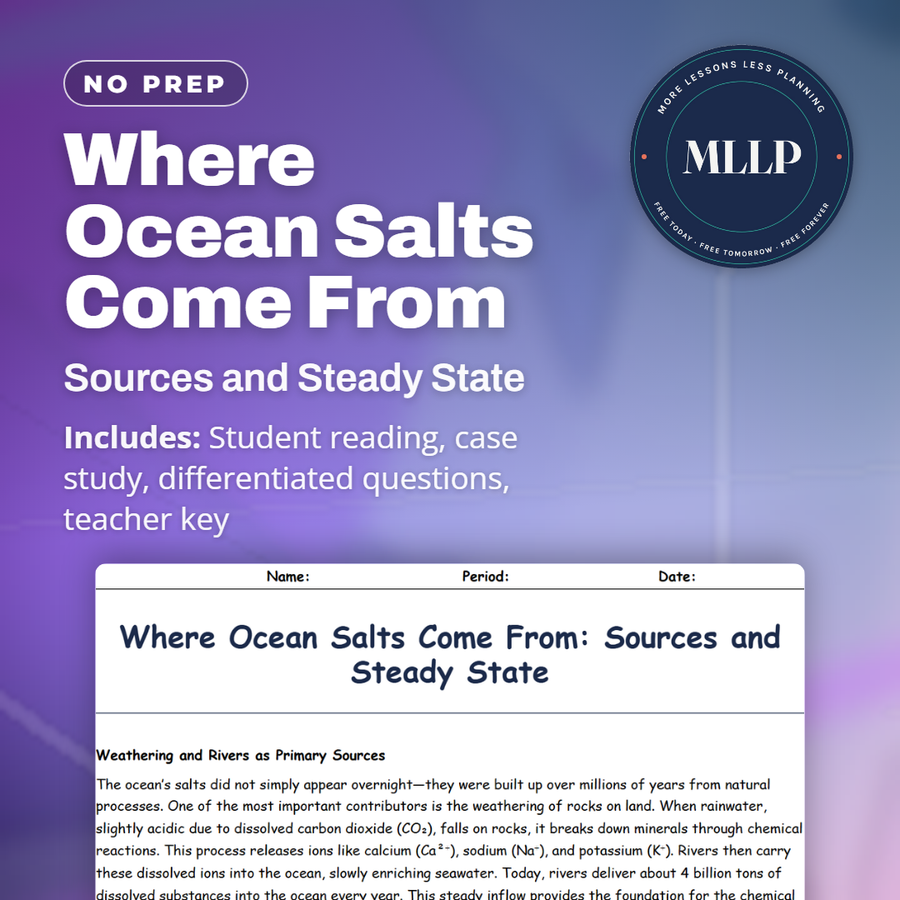
Where Ocean Salts Come From: Sources and Steady State
Quality reviewed September 2026
Facts verified September 14, 2026
- Subject
- Science
- Grades
- Grades 9-12
- Length
- 7-page student worksheet
- Time
- About one 50-minute class period
- Great for
- Sub plans and independent work
- Includes
- Reading passage, comprehension questions + full answer key
- Format
- Print-and-go PDF
What students do
- Match terms like evaporites, residence time, steady state, sodium, and hydrothermal vents to their correct definitions
- Fill in the blank sentences on what weathers rocks and delivers ions to rivers, what formed thick deposits in the Mediterranean, and what keeps salt levels balanced
- Answer multiple choice questions on which process delivers most dissolved ions to the ocean, which element hydrothermal vents remove, and what steady state explains
- Write short answers and case study questions on why rivers and vents alone don't make the ocean saltier over time, how sodium's residence time compares to iron's, and how melting ice sheets could disrupt steady state
What it covers
- How rock weathering and rivers deliver dissolved ions to the ocean while hydrothermal vents along mid-ocean ridges add and remove others
- How steady state keeps ocean salinity stable over millions of years by balancing salt inputs against removal through evaporites, shells, and sediment burial
- A case study on the Mediterranean Sea's Messinian Salinity Crisis, when the sea nearly dried out and left behind kilometers-thick salt deposits
Start reading this worksheet
Weathering and Rivers as Primary Sources
The ocean’s salts did not simply appear overnight—they were built up over millions of years from natural processes. One of the most important contributors is the weathering of rocks on land. When rainwater, slightly acidic due to dissolved carbon dioxide (CO₂), falls on rocks, it breaks down minerals through chemical reactions. This process releases ions like calcium (Ca²⁺), sodium (Na⁺), and potassium (K⁺). Rivers then carry these dissolved ions into the ocean, slowly enriching seawater. Today, rivers deliver about 4 billion tons of dissolved substances into the ocean every year. This steady inflow provides the foundation for the chemical composition we recognize in seawater. Without this constant input, the ocean’s salinity would be dramatically different. The rivers serve as a continuous “conveyor belt” delivering materials that shape both ocean chemistry and marine ecosystems. However, not all of the salts in seawater come directly from rivers. If that were the only source, we would expect the ocean to grow increasingly salty with time. This is where the concept of steady state comes into play.
Hydrothermal Vents and Submarine Sources
Another significant source of salts comes from the seafloor itself. Along mid-ocean ridges, cracks in Earth’s crust allow seawater to seep deep into the hot, underlying rocks. As this water heats up, it reacts with minerals, dissolving metals and other ions. When it reemerges at the seafloor through hydrothermal vents, it delivers new chemical compounds into the ocean. This process not only adds salts but also helps recycle some existing ions. For example, magnesium is removed from seawater during hydrothermal circulation, while elements like calcium and potassium may be added. These geochemical exchanges highlight how dynamic the ocean’s chemistry truly is. The discovery of hydrothermal vents in the late 1970s was groundbreaking. It showed that the ocean’s chemical balance depends not only on rivers from the land but also on deep-sea geological processes. Combined with river inputs, these sources keep the ocean supplied with salts in a way that has been stable for millions of years.
The Concept of Steady State
If rivers and hydrothermal vents constantly add salts to the ocean, why hasn’t the ocean become saltier and saltier over time? The answer lies in removal processes. The input of salts is balanced by their removal, maintaining a steady state. Salts can be removed when ions form evaporite deposits in shallow, hot regions where water evaporates rapidly. Other salts become locked in the shells and skeletons of marine organisms. For instance, calcium is removed from seawater when corals and shellfish build their skeletons. Some salts are also buried in sediments at the bottom of the ocean, removed from circulation for millions of years. The residence time of an element—the average time an atom stays in the ocean—helps scientists understand this balance. Sodium, for example, has a residence time of about 260 million years, meaning it is rarely removed compared to how often it is added. This explains why sodium concentrations stay remarkably constant around the globe. In contrast, elements like iron have much shorter residence times and can vary significantly by location.
Like what you read? The full reading, the case study, and every question set are in the free download below, along with the answer key.
Why this matters
Rivers have been carrying dissolved minerals from weathered rock into the ocean for millions of years, and hydrothermal vents along mid-ocean ridges add and remove ions of their own, yet the ocean has not kept getting saltier. Steady state is the balance that explains it: whatever salt goes in through rivers and vents eventually leaves again through evaporites, shells, and buried sediment.
The Mediterranean Sea's Messinian Salinity Crisis is what I use to show students what happens when that balance actually fails. Evaporation took over, the sea nearly dried out, and it left behind salt deposits kilometers thick, proof that steady state is a genuine balance point and not a fact of ocean chemistry guaranteed from the start.
From one teacher to another
Ocean salt didn't show up all at once. This worksheet traces where it comes from, from rock weathering carried in by rivers to the mineral-rich water seeping out of hydrothermal vents along mid-ocean ridges. It also covers steady state, the balance that keeps salinity from climbing higher every year even though rivers keep adding ions. The case study on the Mediterranean Sea's Messinian Salinity Crisis shows what happens when that balance breaks down and evaporation takes over.
What you get
Download
Where should I send the next one?
Everything here is free and it stays that way. Leave your email and I'll send you the new lessons as they go up. You can unsubscribe from any one of them.
Related resources
Chemical Tracers and Ocean Circulation
Dissolved Gases in Seawater: Oxygen, CO₂, and Nitrogen
Gas Solubility in the Ocean: Temperature and Salinity Effects
Nitrogen and Phosphorus in the Ocean: Vital Nutrient Cycles
Nutrient Limitation Across Ocean Zones
Ocean Acidification: Threats to Marine Life
Every lesson on this site is free to download and use. If one of them saved you a prep period, you can chip in a few bucks toward my three kids' daycare fund. That's genuinely where tips go.