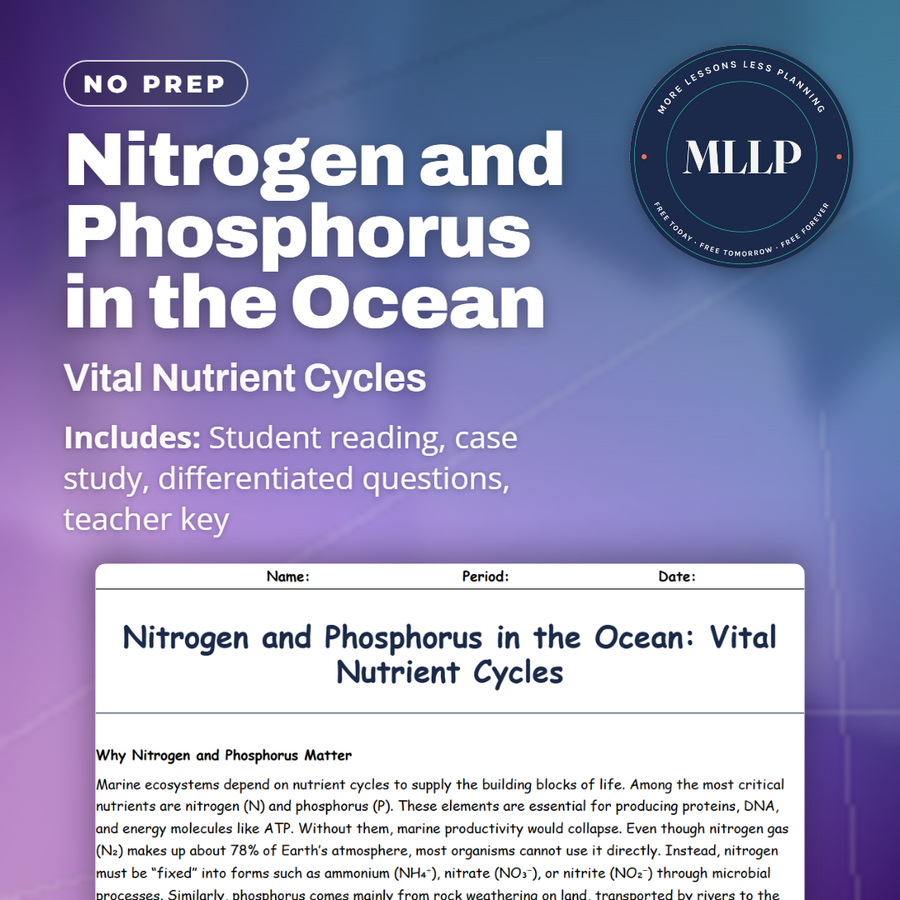
Nitrogen and Phosphorus in the Ocean: Vital Nutrient Cycles
Quality reviewed September 2026
Facts verified September 14, 2026
- Subject
- Science
- Grades
- Grades 9-12
- Length
- 6-page student worksheet
- Time
- About one 50-minute class period
- Great for
- Sub plans and independent work
- Includes
- Reading passage, comprehension questions + full answer key
- Format
- Print-and-go PDF
What students do
- Match terms like nitrogen fixation, phosphorus, denitrification, weathering, and assimilation to their correct definitions
- Fill in the blank sentences on how nitrogen gets fixed, what excess nutrients cause, and the gas phase phosphorus lacks
- Answer multiple choice questions on why organisms can't use atmospheric nitrogen directly, how the nitrogen and phosphorus cycles differ, and which process returns nitrogen to the atmosphere
- Write short answers and case study questions on why phosphorus limits ocean productivity, how human activity disrupts the nitrogen cycle, and why phosphorus keeps fueling algal blooms in the Baltic Sea
What it covers
- How the nitrogen cycle moves through fixation, nitrification, assimilation, and denitrification to supply usable nitrogen to marine life
- Why phosphorus, delivered mainly through rock weathering and river transport, often acts as the ocean's ultimate limiting nutrient
- A case study on how phosphorus pollution from agriculture and sewage fuels algal blooms and long-term eutrophication in the Baltic Sea
Start reading this worksheet
Why Nitrogen and Phosphorus Matter
Marine ecosystems depend on nutrient cycles to supply the building blocks of life. Among the most critical nutrients are nitrogen (N) and phosphorus (P). These elements are essential for producing proteins, DNA, and energy molecules like ATP. Without them, marine productivity would collapse. Even though nitrogen gas (N₂) makes up about 78% of Earth’s atmosphere, most organisms cannot use it directly. Instead, nitrogen must be “fixed” into forms such as ammonium (NH₄⁺), nitrate (NO₃⁻), or nitrite (NO₂⁻) through microbial processes. Similarly, phosphorus comes mainly from rock weathering on land, transported by rivers to the ocean. Once there, it cycles through marine organisms and sediments. Both nutrients are often limiting factors in ocean productivity. In many areas, growth of phytoplankton halts not because there is no sunlight or carbon dioxide, but because nitrogen or phosphorus runs out. This makes these cycles key regulators of food webs and the global carbon balance.
The Nitrogen Cycle in the Ocean
The marine nitrogen cycle is complex, involving several transformations: Nitrogen fixation: Specialized bacteria and archaea convert N₂ into ammonium. Nitrification: Ammonium is oxidized into nitrate and nitrite. Assimilation: Phytoplankton absorb nitrate and ammonium to build organic matter. Denitrification: In oxygen-poor zones, microbes convert nitrate back into N₂ gas, releasing it into the atmosphere. These processes maintain balance, but they are sensitive to environmental changes. For example, oxygen minimum zones often promote denitrification, reducing the pool of available nitrogen. Human activities, such as fertilizer use, also disrupt the cycle by adding excessive nitrogen, fueling algal blooms and hypoxic zones.
Like what you read? The full reading, the case study, and every question set are in the free download below, along with the answer key.
Why this matters
Nitrogen and phosphorus reach the ocean by almost opposite routes. Nitrogen arrives mostly as a gas that bacteria have to fix before life can use it, while phosphorus only shows up after rock slowly weathers away and rivers carry it out to sea, a much slower process.
That difference in speed is why the Baltic Sea case study centers on phosphorus rather than nitrogen: once phosphorus pollution builds up in a system, it keeps fueling algal blooms for decades because nothing removes it quickly. Students leave with a reason nutrient pollution is not one uniform problem.
From one teacher to another
Marine life runs on nitrogen and phosphorus, but the two nutrients reach the ocean in very different ways. This worksheet traces the nitrogen cycle through fixation, nitrification, and denitrification, then compares it to the slower, rock-weathering path phosphorus takes to reach seawater. The case study on the Baltic Sea shows what happens when decades of fertilizer and sewage runoff overload a nutrient cycle that recovers only slowly.
What you get
Download
Where should I send the next one?
Everything here is free and it stays that way. Leave your email and I'll send you the new lessons as they go up. You can unsubscribe from any one of them.
Related resources
Chemical Tracers and Ocean Circulation
Dissolved Gases in Seawater: Oxygen, CO₂, and Nitrogen
Gas Solubility in the Ocean: Temperature and Salinity Effects
Nutrient Limitation Across Ocean Zones
Ocean Acidification: Threats to Marine Life
Salinity and the Chemical Makeup of Seawater
Every lesson on this site is free to download and use. If one of them saved you a prep period, you can chip in a few bucks toward my three kids' daycare fund. That's genuinely where tips go.