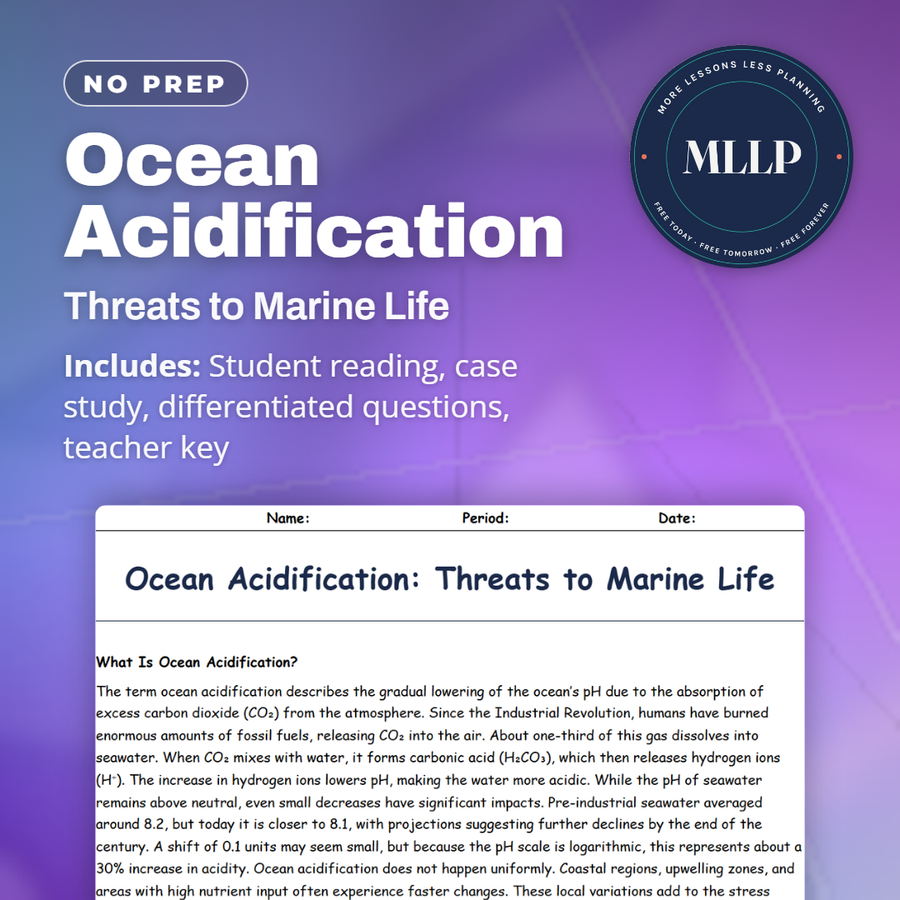
Ocean Acidification: Threats to Marine Life
Quality reviewed September 2026
Facts verified September 14, 2026
- Subject
- Science
- Grades
- Grades 9-12
- Length
- 6-page student worksheet
- Time
- About one 50-minute class period
- Great for
- Sub plans and independent work
- Includes
- Reading passage, comprehension questions + full answer key
- Format
- Print-and-go PDF
What students do
- Match terms like ocean acidification, shellfish, coral reefs, the biological pump, and climate change to their correct definitions
- Fill in the blank sentences on what drives acidification, what corals and shellfish build their skeletons from, and what carbon sink is at risk
- Answer multiple choice questions on today's average seawater pH, why acidification lowers carbonate availability, and which industry has already felt the impact
- Write short answers and case study questions on how acidification affects fish behavior, why coral reefs matter to people and ecosystems, and how the Pacific Northwest oyster industry responded to falling pH
What it covers
- How rising atmospheric carbon dioxide lowers ocean pH and reduces the carbonate ions that corals, shellfish, and plankton need to build shells and skeletons
- How ocean acidification ripples outward to affect coral reef biodiversity, fisheries, and the ocean's role in storing carbon
- A case study on how oyster hatcheries in Oregon and Washington responded when acidic upwelled water began killing off young larvae
Start reading this worksheet
What Is Ocean Acidification?
The term ocean acidification describes the gradual lowering of the ocean’s pH due to the absorption of excess carbon dioxide (CO₂) from the atmosphere. Since the Industrial Revolution, humans have burned enormous amounts of fossil fuels, releasing CO₂ into the air. About one-third of this gas dissolves into seawater. When CO₂ mixes with water, it forms carbonic acid (H₂CO₃), which then releases hydrogen ions (H⁺). The increase in hydrogen ions lowers pH, making the water more acidic. While the pH of seawater remains above neutral, even small decreases have significant impacts. Pre-industrial seawater averaged around 8.2, but today it is closer to 8.1, with projections suggesting further declines by the end of the century. A shift of 0.1 units may seem small, but because the pH scale is logarithmic, this represents about a 30% increase in acidity. Ocean acidification does not happen uniformly. Coastal regions, upwelling zones, and areas with high nutrient input often experience faster changes. These local variations add to the stress caused by global CO₂ increases. The combination of natural variability and human-driven change makes predicting impacts both complex and urgent.
How Acidification Impacts Marine Organisms
The organisms most directly affected by acidification are those that build shells or skeletons of calcium carbonate (CaCO₃), such as corals, oysters, mussels, and some plankton. As seawater becomes more acidic, the concentration of carbonate ions (CO₃²⁻) decreases. Without enough carbonate, these organisms struggle to build or maintain their structures. For corals, this means slower reef growth and weaker skeletons, which are more vulnerable to storm damage and erosion. For shellfish, acidification can interfere with larval development, reducing survival rates. Even tiny planktonic organisms, which form the base of the marine food web, are affected—threatening ecosystems from the bottom up. Beyond structural issues, acidification influences physiology. Fish exposed to low pH conditions can show altered behavior, such as difficulty detecting predators. Some species experience changes in metabolism, reproduction, and immune function. The impacts vary widely, but the trend is clear: acidification creates new challenges for marine life across ecosystems.
Like what you read? The full reading, the case study, and every question set are in the free download below, along with the answer key.
Why this matters
A change of one tenth of a point on the pH scale sounds too small to matter, but it represents a real jump in ocean acidity and a real drop in the carbonate ions corals and shellfish need to build anything at all. Oyster hatcheries in Oregon and Washington felt that jump directly when acidic upwelled water began killing off young larvae.
I start with the hatcheries because the effect there was not a projection about the future, it already happened to a working industry. That case makes the chemistry concrete before students have to reason about pH and carbonate availability in the abstract.
From one teacher to another
A shift of just a tenth of a point on the pH scale sounds small, but it represents a real jump in ocean acidity. This worksheet explains where that extra acidity comes from, how it strips away the carbonate ions that corals and shellfish need, and why the effects reach all the way up to fish behavior. The case study on Pacific Northwest oyster hatcheries shows how falling pH turned from a scientific concern into an immediate problem for hatchery survival rates.
What you get
Download
Where should I send the next one?
Everything here is free and it stays that way. Leave your email and I'll send you the new lessons as they go up. You can unsubscribe from any one of them.
Related resources
Chemical Tracers and Ocean Circulation
Dissolved Gases in Seawater: Oxygen, CO₂, and Nitrogen
Gas Solubility in the Ocean: Temperature and Salinity Effects
Nitrogen and Phosphorus in the Ocean: Vital Nutrient Cycles
Nutrient Limitation Across Ocean Zones
Salinity and the Chemical Makeup of Seawater
Every lesson on this site is free to download and use. If one of them saved you a prep period, you can chip in a few bucks toward my three kids' daycare fund. That's genuinely where tips go.