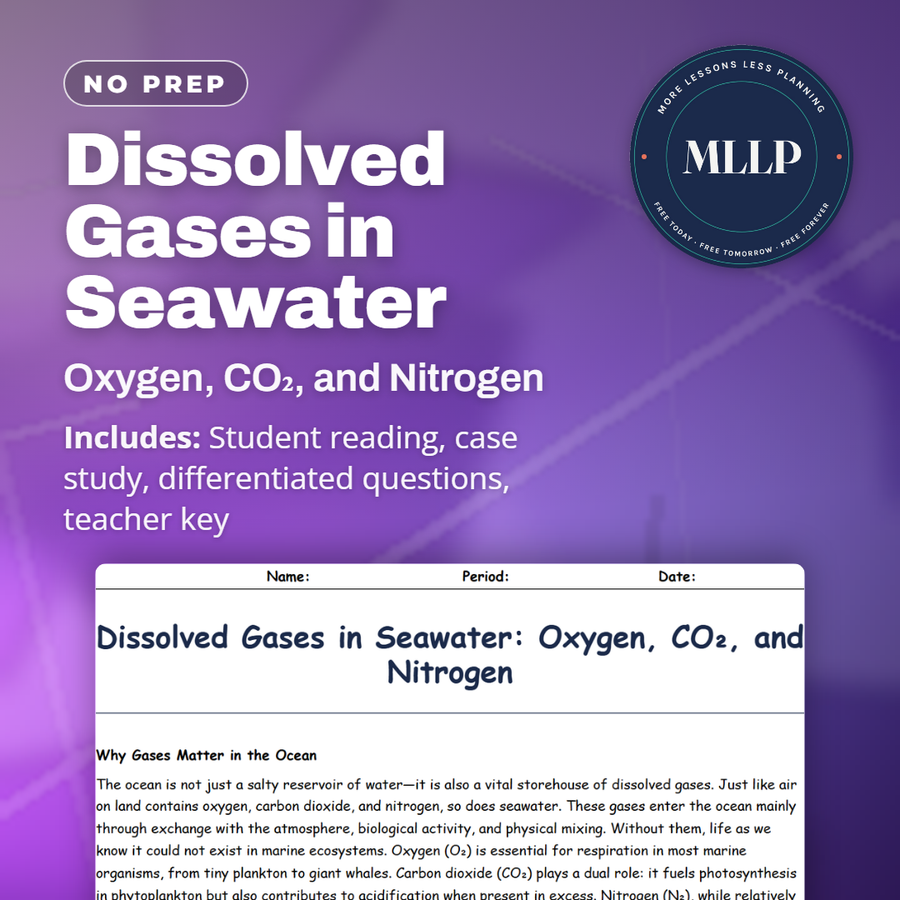
Dissolved Gases in Seawater: Oxygen, CO₂, and Nitrogen
Quality reviewed September 2026
Facts verified September 14, 2026
- Subject
- Science
- Grades
- Grades 9-12
- Length
- 6-page student worksheet
- Time
- About one 50-minute class period
- Great for
- Sub plans and independent work
- Includes
- Reading passage, comprehension questions + full answer key
- Format
- Print-and-go PDF
What students do
- Match terms like oxygen minimum zone, phytoplankton, nitrogen fixation, dead zone, and diazotrophs to their correct definitions
- Fill in the blank sentences on which water holds more oxygen, what excess carbon dioxide does to the ocean, and how nitrogen gets converted into usable forms
- Answer multiple choice questions on what raises oxygen solubility, what causes the Gulf of Mexico's dead zone, and which microbes fix nitrogen gas
- Write short answers and case study questions on why polar waters run oxygen-rich, how nutrient pollution creates hypoxic zones, and why nitrogen fixation matters for marine food webs
What it covers
- How oxygen, carbon dioxide, and nitrogen move through the ocean and why temperature and salinity affect how much gas seawater can hold
- How nitrogen fixation makes an otherwise unusable gas available to marine life, and how oxygen minimum zones form in deeper water
- A case study on the seasonal dead zone that forms in the Gulf of Mexico when fertilizer runoff fuels algal blooms that consume oxygen
Start reading this worksheet
Why Gases Matter in the Ocean
The ocean is not just a salty reservoir of water—it is also a vital storehouse of dissolved gases. Just like air on land contains oxygen, carbon dioxide, and nitrogen, so does seawater. These gases enter the ocean mainly through exchange with the atmosphere, biological activity, and physical mixing. Without them, life as we know it could not exist in marine ecosystems. Oxygen (O₂) is essential for respiration in most marine organisms, from tiny plankton to giant whales. Carbon dioxide (CO₂) plays a dual role: it fuels photosynthesis in phytoplankton but also contributes to acidification when present in excess. Nitrogen (N₂), while relatively inert in its gaseous form, becomes biologically critical when converted into usable compounds through processes like nitrogen fixation. The concentration of dissolved gases in seawater depends on several factors, including temperature, salinity, and depth. Cold water holds more oxygen than warm water, and fresh water holds more than salty water. This explains why polar regions, despite their harsh conditions, often teem with oxygen-rich ecosystems, while tropical waters can sometimes be oxygen-poor.
Oxygen Distribution in the Ocean
Oxygen is produced in the surface ocean through photosynthesis by phytoplankton. Sunlight drives this process, creating oxygen as a by-product. As a result, surface waters are often rich in oxygen. Deeper down, however, oxygen decreases as organisms consume it during respiration and decomposition. This creates what scientists call the oxygen minimum zone (OMZ)—a layer in the mid-ocean where oxygen concentrations are very low. Oxygen is eventually replenished in deep waters through thermohaline circulation, the global “conveyor belt” that brings cold, oxygen-rich waters from the surface into the ocean’s depths. This mixing process ensures that even the darkest layers of the sea can support life, though oxygen levels there are much lower than at the surface. Low-oxygen areas can create serious challenges for marine organisms. Fish and other animals may be forced to migrate, and ecosystems can collapse when oxygen levels fall below critical thresholds. Human activities such as nutrient pollution can make this worse by fueling algal blooms, which deplete oxygen when they decay.
Like what you read? The full reading, the case study, and every question set are in the free download below, along with the answer key.
Why this matters
Seawater is not just water with salt added. It is a different chemical environment for the gases every organism needs: cold polar water holds more oxygen than warm tropical water, nitrogen in the ocean is useless to most life until diazotrophs convert it, and carbon dioxide changes ocean chemistry once dissolved.
I've found nitrogen fixation is easy for students to shrug off as a vocabulary term until it is tied to a real hypoxic zone. The Gulf of Mexico's dead zone gives them an image for the chemistry: fertilizer washed downriver, an algal bloom, then the oxygen crash that follows once it decomposes.
From one teacher to another
Seawater carries more than salt. It holds dissolved gases that every marine organism depends on, and this worksheet breaks down how oxygen, carbon dioxide, and nitrogen behave differently once they're in the water. Students read about the oxygen minimum zone, the balancing act between carbon dioxide and ocean chemistry, and the microbes that make nitrogen usable for life. The case study on the Gulf of Mexico's dead zone connects fertilizer runoff on land to oxygen loss at sea.
What you get
Download
Where should I send the next one?
Everything here is free and it stays that way. Leave your email and I'll send you the new lessons as they go up. You can unsubscribe from any one of them.
Related resources
Chemical Tracers and Ocean Circulation
Gas Solubility in the Ocean: Temperature and Salinity Effects
Nitrogen and Phosphorus in the Ocean: Vital Nutrient Cycles
Nutrient Limitation Across Ocean Zones
Ocean Acidification: Threats to Marine Life
Salinity and the Chemical Makeup of Seawater
Every lesson on this site is free to download and use. If one of them saved you a prep period, you can chip in a few bucks toward my three kids' daycare fund. That's genuinely where tips go.