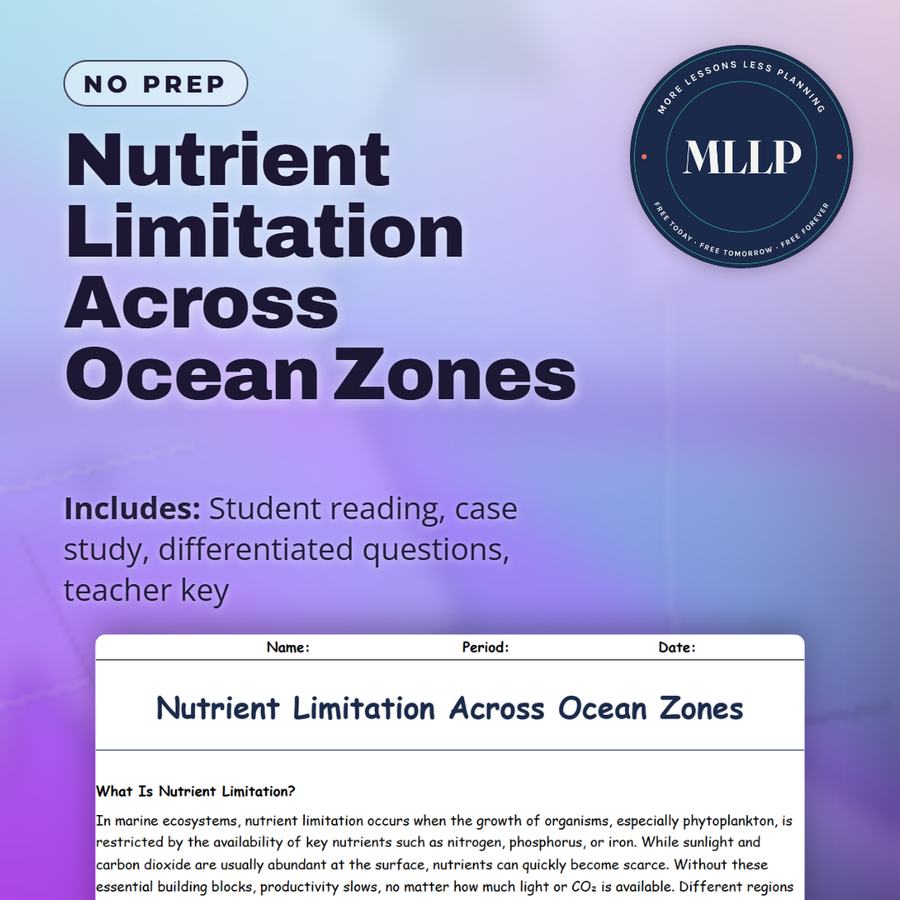
Nutrient Limitation Across Ocean Zones
Quality reviewed September 2026
Facts verified September 14, 2026
- Subject
- Science
- Grades
- Grades 9-12
- Length
- 7-page student worksheet
- Time
- About one 50-minute class period
- Great for
- Sub plans and independent work
- Includes
- Reading passage, comprehension questions + full answer key
- Format
- Print-and-go PDF
What students do
- Match terms like deep ocean, subtropical gyres, HNLC regions, iron fertilization, and upwelling to what they mean
- Fill in the blank sentences on the ocean's main limiting nutrient, HNLC regions, and the process that brings deep water to the surface
- Answer multiple choice questions on the ultimate limiting nutrient over geologic time, why upwelling zones are so productive, and what explains low productivity in HNLC waters
- Write short answers and case study questions on why nutrient limitation varies by region, how human activity changes natural nutrient patterns, and why iron matters as much as nitrogen or phosphorus in some ocean zones
What it covers
- How nitrogen, phosphorus, and iron each act as the limiting nutrient in different ocean regions, from subtropical gyres to the Southern Ocean
- How upwelling brings nutrient-rich deep water to the surface and fuels some of the most productive fisheries on Earth
- A case study on high-nutrient, low-chlorophyll regions, where scientists discovered that a lack of iron was holding back phytoplankton growth
Start reading this worksheet
What Is Nutrient Limitation?
In marine ecosystems, nutrient limitation occurs when the growth of organisms, especially phytoplankton, is restricted by the availability of key nutrients such as nitrogen, phosphorus, or iron. While sunlight and carbon dioxide are usually abundant at the surface, nutrients can quickly become scarce. Without these essential building blocks, productivity slows, no matter how much light or CO₂ is available. Different regions of the ocean are limited by different nutrients. In most of the world’s oceans, nitrogen is the primary limiting nutrient. However, in certain areas such as parts of the Pacific and Southern Ocean, iron is the limiting factor. Phosphorus, while vital, is usually less variable and often considered the ultimate limiting nutrient over geologic time because it enters the ocean only through the slow process of rock weathering. Understanding nutrient limitation is crucial because it shapes global productivity, influences food webs, and regulates how much carbon dioxide the ocean absorbs.
Nutrient Patterns Across Ocean Zones
The ocean is not uniform; nutrient levels vary widely depending on depth, circulation, and biological activity. Surface waters often run short on nutrients because phytoplankton consume them rapidly during photosynthesis. In contrast, deeper waters are often nutrient-rich because decomposition of sinking organic matter releases nitrogen and phosphorus back into solution. This creates a paradox: the sunlit surface, where photosynthesis is possible, often lacks nutrients, while the deep ocean, where nutrients are abundant, is too dark for photosynthesis. The cycle depends on upwelling, where deep, nutrient-rich waters are brought to the surface, fueling massive phytoplankton blooms. Upwelling zones, such as along the coasts of Peru and California, are among the most productive ecosystems in the world. Regional differences also matter. For example, the North Atlantic often has enough nitrogen and phosphorus but can be limited by iron. Meanwhile, subtropical gyres (vast rotating currents in the open ocean) tend to be nutrient deserts, with very low productivity. These contrasts show how nutrient availability defines the productivity of each ocean zone.
Like what you read? The full reading, the case study, and every question set are in the free download below, along with the answer key.
Why this matters
For years, low productivity in parts of the open ocean looked like a puzzle, since those waters had plenty of nitrogen and phosphorus and still supported barely any phytoplankton. The missing piece turned out to be iron, a nutrient needed only in trace amounts but still able to hold back growth across a region as large as the Southern Ocean.
By the time students compare that iron limitation to the upwelling zones off Peru and California, they stop assuming more nitrogen automatically means more life. They start asking which nutrient is actually scarce in a given region first.
From one teacher to another
Sunlight and carbon dioxide aren't usually the problem for ocean phytoplankton. What often holds growth back is a shortage of nitrogen, phosphorus, or iron, and where each nutrient runs short depends on the region. This worksheet compares nutrient-starved subtropical gyres to productive upwelling zones along coasts like Peru and California. The case study on high-nutrient, low-chlorophyll regions explains how scientists traced unexpectedly low productivity back to a missing trace element, iron.
What you get
Download
Where should I send the next one?
Everything here is free and it stays that way. Leave your email and I'll send you the new lessons as they go up. You can unsubscribe from any one of them.
Related resources
Chemical Tracers and Ocean Circulation
Dissolved Gases in Seawater: Oxygen, CO₂, and Nitrogen
Gas Solubility in the Ocean: Temperature and Salinity Effects
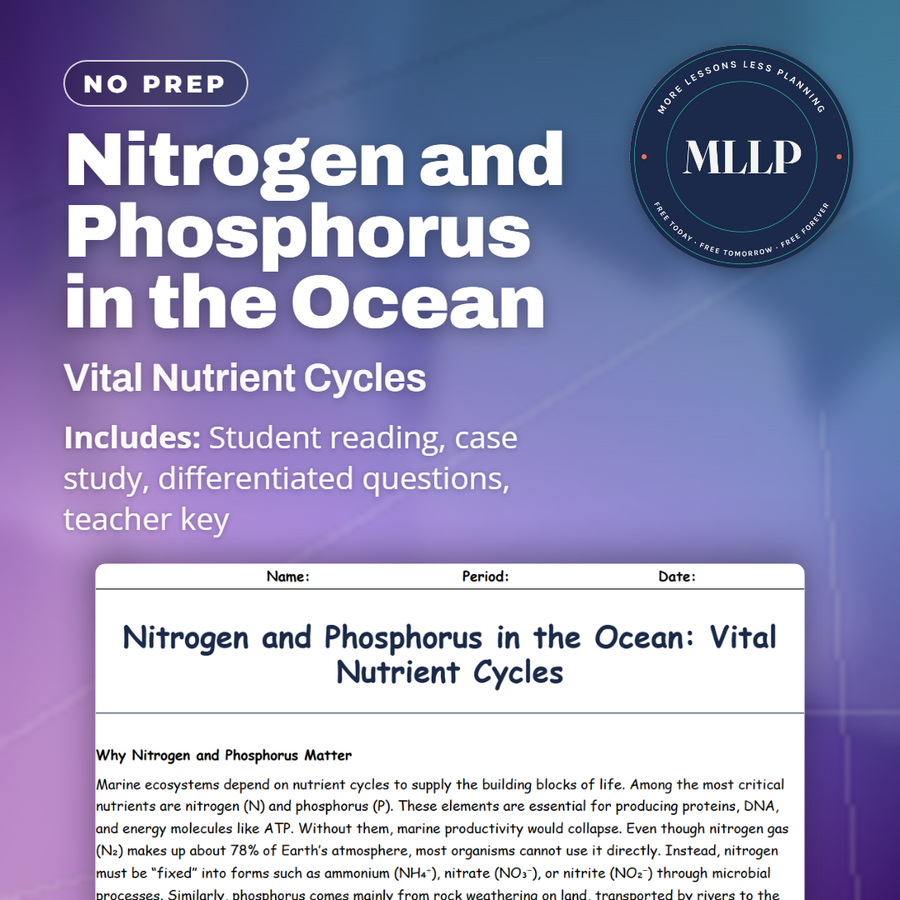
Nitrogen and Phosphorus in the Ocean: Vital Nutrient Cycles
Ocean Acidification: Threats to Marine Life
Salinity and the Chemical Makeup of Seawater
Every lesson on this site is free to download and use. If one of them saved you a prep period, you can chip in a few bucks toward my three kids' daycare fund. That's genuinely where tips go.