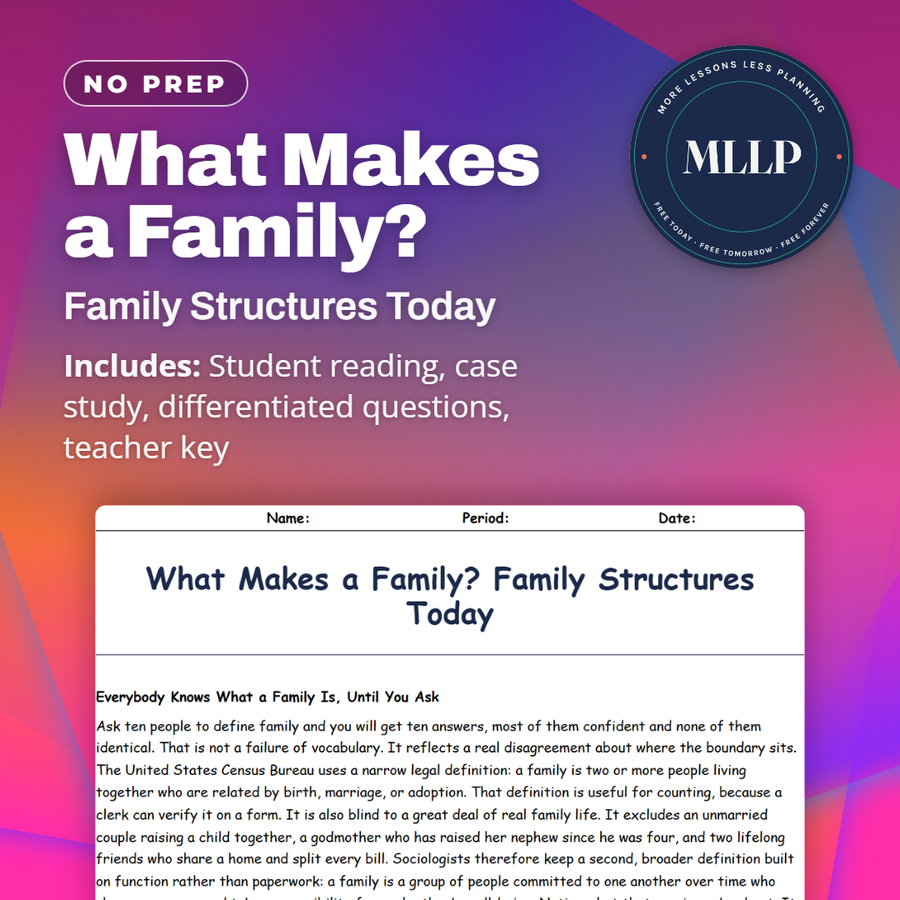
What Makes a Family? Family Structures Today
Quality reviewed September 2026
Facts verified September 23, 2026
- Subject
- Career & Life Skills
- Grades
- Grades 9-12
- Length
- 9-page student worksheet
- Time
- About one 50-minute class period
- Great for
- Sub plans and independent work
- Includes
- Reading passage, comprehension questions + full answer key
- Format
- Print-and-go PDF
What students do
- Mariela's family map case study adds a person the Census definition would leave out entirely
- Compare the legal definition of family against the reading's broader functional one
- The reading walks through eight family structures, from nuclear to grandfamily to childless
- Identify why family process predicts a child's outcomes better than the structure's label
What it covers
- The legal and functional definitions of family, compared against today's family structures
- What changed in American family life since 1960, including multigenerational households and marriage age
- Mariela's family map case study, built around her grandmother, her mother, and a neighbor named Miss Ruth
Start reading this worksheet
Everybody Knows What a Family Is, Until You Ask
Ask ten people to define family and you will get ten answers, most of them confident and none of them identical. That is not a failure of vocabulary. It reflects a real disagreement about where the boundary sits. The United States Census Bureau uses a narrow legal definition: a family is two or more people living together who are related by birth, marriage, or adoption. That definition is useful for counting, because a clerk can verify it on a form. It is also blind to a great deal of real family life. It excludes an unmarried couple raising a child together, a godmother who has raised her nephew since he was four, and two lifelong friends who share a home and split every bill. Sociologists therefore keep a second, broader definition built on function rather than paperwork: a family is a group of people committed to one another over time who share resources and take responsibility for each other's well-being. Notice what that version asks about. It asks what people actually do, not what a document says about them. It is also worth separating two words that get swapped constantly. A household is everyone occupying one housing unit, related or not, so three roommates are a household but not a family. A family, meanwhile, can be spread across several households, which is why a father who lives two states away is still family and the stranger renting the basement is not. Holding both definitions at once is the honest position. The legal one tells you who counts for insurance, custody, and taxes. The functional one tells you who shows up when something goes wrong.
The Shapes Families Take
Family structure is simply a description of who lives in a home and how they are connected. The nuclear family, meaning two parents and their children, dominated the American imagination for most of the twentieth century and remains common, but it is no longer the default. A single-parent family has one parent raising one or more children, and it forms through divorce, separation, death, or a birth outside marriage. An extended family includes relatives beyond the parent-child unit, such as grandparents, aunts, uncles, or cousins, either sharing a home or functioning as one unit across nearby homes. A blended family, also called a stepfamily, forms when adults bring children from previous relationships into a household together. A cohabiting family is an unmarried couple raising children. Grandfamilies are households where grandparents raise grandchildren with the parents absent, an arrangement estimated to involve roughly two and a half million grandparents nationwide. Adoptive and foster families take legal responsibility for children not born to them. Childless and child-free couples are families too, which surprises students who assume children are what earns the label. Same-sex couples raise children within every one of these arrangements. Two cautions matter. First, the categories overlap constantly, so a single household can be blended, extended, and multigenerational at the same time. Second, structure is a snapshot rather than a life sentence. Most families move through several structures across the years as people marry, separate, move in, move out, are born, and die. The category describes this year, not this person.
What Changed Since 1960
American family life looks different than it did two generations ago, and the change was gradual rather than sudden. In 1960, roughly seventy-three percent of children lived with two parents in a first marriage; later surveys found fewer than half did. Average household size fell from about 3.3 people to roughly 2.5 by later counts. The median age at first marriage climbed from about twenty for women and twenty-three for men to roughly twenty-eight and thirty by later counts. Several forces pushed in the same direction at once. Women's participation in the paid workforce rose sharply, changing both household income and the division of labor at home. Divorce became legally easier as no-fault laws spread through the 1970s, so unhappy marriages ended rather than continuing quietly. Life expectancy rose, creating decades of family life after children leave home. Housing and childcare costs climbed faster than wages, which kept adult children home longer and pulled grandparents back into daily caregiving. Multigenerational living, which had declined for most of the twentieth century, reversed course and, by later surveys, had roughly quadrupled since 1971, with about one in five Americans living in a multigenerational household. Cohabitation moved from rare to routine. None of these shifts is evidence of decline, though decline is how they are often framed. They describe adaptation to different economics, longer lives, and expanded legal rights. Families in 1960 faced constraints that today's families do not, and today's families face pressures that families in 1960 never imagined. Reading the change as adaptation is what makes an honest look at both possible.
Like what you read? The full reading, the case study, and every question set are in the free download below, along with the answer key.
Why this matters
A classroom of thirty students will contain nearly every structure this reading describes, and several students whose household does not match any single category cleanly, the way Mariela's did not. I think the functional definition matters more to a sixteen year old than the legal one, since it gives language for the neighbor, the godparent, or the family friend who actually shows up, people a legal form would leave out entirely. The finding that family process, warmth, stability, and consistent routines, predicts outcomes better than the structure itself is worth saying plainly to a room full of students whose families look nothing like a television version of one. Reading the shifts since 1960 as adaptation rather than decline also gives students a more accurate lens than the nostalgia framing most of them have already absorbed somewhere else.
From one teacher to another
Mariela's family map assignment stalled in the first five minutes, because the person who raised her since she was six is her grandmother, and the neighbor who has picked her up from school twice a week for nine years is nobody's relative at all. The reading opens with two competing definitions of family, the Census Bureau's narrow legal version based on birth, marriage, or adoption, and a broader functional definition built on who actually shares resources and takes responsibility over time. It walks through the range of structures a household can take today, nuclear, single parent, extended, blended, cohabiting, grandfamily, adoptive, and childless, and is careful to note that most families move through several of these across a lifetime rather than staying fixed in one. A full passage covers what changed since 1960, marriage age and household size, and a fourfold rise in multigenerational living since 1971, and frames the shift as adaptation rather than decline. The closing passage takes on the question students ask most directly, whether one structure is better for children than another, and answers it with the finding that money, stability, and family process explain most of the gap researchers find.
What you get
Download
Where should I send the next one?
Everything here is free and it stays that way. Leave your email and I'll send you the new lessons as they go up. You can unsubscribe from any one of them.
Related resources
Aging Parents and the Sandwich Generation
Building Your Support Network
Communication Skills That Actually Work
Dating, Boundaries, and Consent
Divorce, Blended Families, and Change
Family Roles and Shared Responsibilities
Every lesson on this site is free to download and use. If one of them saved you a prep period, you can chip in a few bucks toward my three kids' daycare fund. That's genuinely where tips go.