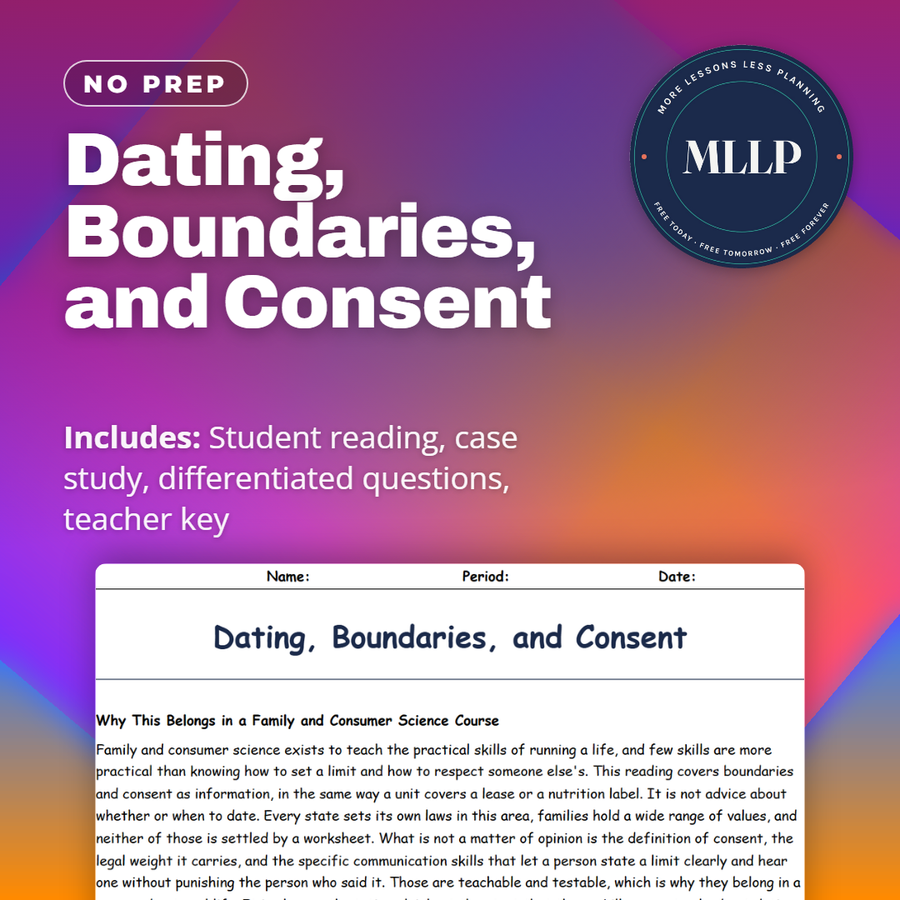
Dating, Boundaries, and Consent
Quality reviewed September 2026
Facts verified September 23, 2026
- Subject
- Career & Life Skills
- Grades
- Grades 9-12
- Length
- 8-page student worksheet
- Time
- About one 50-minute class period
- Great for
- Sub plans and independent work
- Includes
- Reading passage, comprehension questions + full answer key
- Format
- Print-and-go PDF
What students do
- Jordan's password case study turns three repeated requests into one clear signal
- Decide whether a stated line is a boundary or an attempt at control, using the reading's own test
- The five features of consent, freely given, reversible, informed, specific, and clear, get filled in from the reading's own list
- Boundaries get defined across five kinds, physical, emotional, time, digital, and material
What it covers
- The definition of a boundary, the five features of consent, and pressure versus coercion
- Jordan and Casey's case study on a boundary restated once instead of re-explained
- The skill of hearing a no well, covered alongside the skill of stating one clearly
Start reading this worksheet
Why This Belongs in a Family and Consumer Science Course
Family and consumer science exists to teach the practical skills of running a life, and few skills are more practical than knowing how to set a limit and how to respect someone else's. This reading covers boundaries and consent as information, in the same way a unit covers a lease or a nutrition label. It is not advice about whether or when to date. Every state sets its own laws in this area, families hold a wide range of values, and neither of those is settled by a worksheet. What is not a matter of opinion is the definition of consent, the legal weight it carries, and the specific communication skills that let a person state a limit clearly and hear one without punishing the person who said it. Those are teachable and testable, which is why they belong in a course about real life. It is also worth stating plainly at the start that these skills are not only about dating. A boundary is a limit you set about your own body, time, attention, information, or belongings, and the same skill applies to a friend who reads your phone, a relative who shows up unannounced, or a group chat you want out of. Students who practice stating limits in low-stakes situations find it far easier in high-stakes ones, which is the entire reason the topic is taught before it is needed rather than after.
What a Boundary Is and How to State One
A boundary is a statement about what you will do or accept, not a demand that controls another person. That distinction is the whole thing. I am not comfortable sharing my location is a boundary; you are not allowed to have friends is a control attempt disguised as one. Boundaries come in several kinds. Physical boundaries cover your body and personal space. Emotional boundaries cover how much you share and how much of someone else's distress you take on. Time boundaries cover your schedule and your obligations. Digital boundaries cover passwords, photos, location sharing, tagging, and how quickly you are expected to reply. Material boundaries cover money and belongings. Stating a boundary works best when it is specific, direct, and unapologetic. I do not share my passwords is clearer than I would rather not, probably. Adding a reason is optional and often backfires, because a reason invites negotiation, and a boundary is not an opening bid. Expect that stating limits will feel uncomfortable at first, especially for someone used to keeping the peace. The most important thing to know is how the other person responds. In a healthy relationship of any kind, a boundary is met with some version of okay, even if there is disappointment attached. Repeated pushing, sulking, guilt, or renegotiating the same limit weekly is information about the relationship, and it is information worth taking seriously.
Consent, Defined Plainly
Consent is a clear and voluntary agreement to a specific activity. Educators and legal materials generally describe several features, and it helps to learn them as a set. Consent must be freely given, meaning it is not produced by pressure, guilt, threats, or the use of authority. It is reversible, meaning any person may change their mind at any point, and agreeing earlier does not obligate anyone later. It must be informed, meaning it is based on honest information rather than a lie. It must be specific, since agreeing to one thing is not agreement to something else, and agreement on one day is not standing permission. And it must be clear, expressed through words or unmistakable behavior. Several conditions make consent legally impossible regardless of what was said. A person who is asleep, unconscious, or incapacitated by alcohol or drugs cannot consent. Every state sets an age of consent, below which the law does not recognize agreement at all, and the specific age and its exceptions vary by state. Many state laws also refuse to recognize agreement when there is a significant difference in power, such as between a student and an adult in authority. Two common myths are worth retiring. Silence is not consent, because consent is something given rather than something assumed from an absence of objection. And a previous relationship does not create ongoing consent. When there is any uncertainty, the correct action is to stop and ask, which costs nothing.
Like what you read? The full reading, the case study, and every question set are in the free download below, along with the answer key.
Why this matters
Boundaries are not only a dating topic, and the reading makes that point early, since the same skill applies to a friend reading your phone, a relative who shows up unannounced, or a group chat you cannot leave without a scene. Students practice something here that keeps mattering long after any one relationship ends, stating a limit clearly, without a justification attached, and accepting somebody else's the first time it is given. The reading is equally direct about the other half of the skill, since respecting a no well gets almost no practice compared to stating one. Teaching this while the stakes are still relatively low, a group chat, a shared photo, a borrowed sweater, is what makes the higher stakes version easier to handle later.
From one teacher to another
Jordan said one sentence about a password, and Casey asked again three times anyway. This reading treats boundaries and consent as information a family life course can actually teach and test, the definition of consent, its legal weight, and the communication skills for stating a limit and hearing one, without taking a position on if or when a student should date. It also covers mandated reporting and lists national hotlines for support, and it is worth previewing before you assign it, since the topic can prompt a student disclosure. Students learn the five features of consent, freely given, reversible, informed, specific, and clear, and the difference between a boundary and an attempt at control. The reading is careful to note that consent laws, including the age of consent, vary by state, so it never states one as a universal rule. Jordan's case study follows a password request renegotiated three times, and the questions ask students to explain what that repetition actually reveals.
What you get
Download
Where should I send the next one?
Everything here is free and it stays that way. Leave your email and I'll send you the new lessons as they go up. You can unsubscribe from any one of them.
Related resources
Aging Parents and the Sandwich Generation
Building Your Support Network
Communication Skills That Actually Work
Divorce, Blended Families, and Change
Family Roles and Shared Responsibilities
Friendships and Peer Relationships
Every lesson on this site is free to download and use. If one of them saved you a prep period, you can chip in a few bucks toward my three kids' daycare fund. That's genuinely where tips go.