Building Your Support Network
Quality reviewed September 2026
Facts verified September 23, 2026
- Subject
- Career & Life Skills
- Grades
- Grades 9-12
- Length
- 8-page student worksheet
- Time
- About one 50-minute class period
- Great for
- Sub plans and independent work
- Includes
- Reading passage, comprehension questions + full answer key
- Format
- Print-and-go PDF
What students do
- Trevon's ring map case study exposes a gap that felt invisible until his car would not start
- Identify which type of support is missing from a network that otherwise looks full
- Support network, informational support, appraisal support, weak tie, and formal support get matched to their real definitions
- Compare a weak tie's usefulness against a close friend's when the need is a ride, not a conversation
What it covers
- What a support network actually is, and the four distinct types of support it provides
- The ring map exercise used to find gaps in emotional, instrumental, and informational support
- Trevon's case study on weak ties and why a specific offer of help beats a vague one
Start reading this worksheet
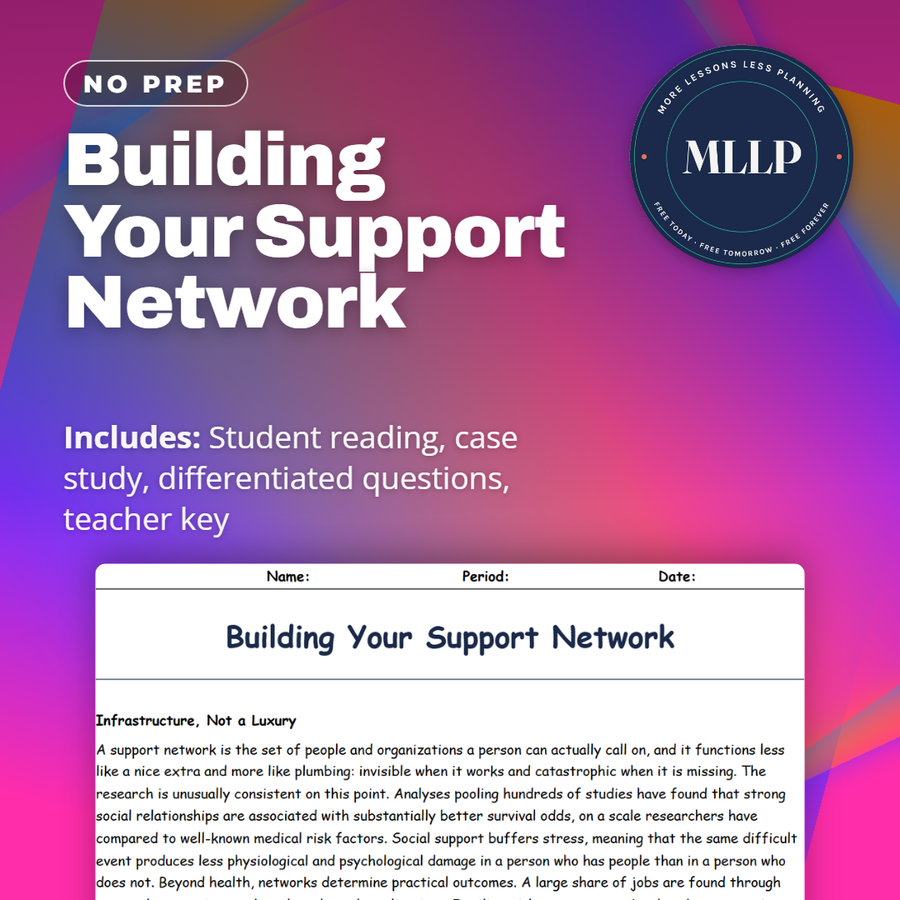
Infrastructure, Not a Luxury
A support network is the set of people and organizations a person can actually call on, and it functions less like a nice extra and more like plumbing: invisible when it works and catastrophic when it is missing. The research is unusually consistent on this point. Analyses pooling hundreds of studies have found that strong social relationships are associated with substantially better survival odds, on a scale researchers have compared to well-known medical risk factors. Social support buffers stress, meaning that the same difficult event produces less physiological and psychological damage in a person who has people than in a person who does not. Beyond health, networks determine practical outcomes. A large share of jobs are found through personal connections rather than through applications. Families with strong networks absorb emergencies, a broken-down car or a sick child on a workday, as inconveniences rather than crises. What makes this a family and consumer science topic rather than a feel-good one is that a network can be built deliberately, and the building is a skill with steps. Most people assume support either exists or does not, the way weather exists. It is closer to a garden. It responds to attention, it decays without it, and the best time to work on it is well before it is needed, because a network assembled during an emergency is not a network. It is a series of awkward phone calls.
Four Different Things People Need
Researchers distinguish several types of social support, and the distinction is genuinely useful because most people are strong in one type and assume they are covered. Emotional support is listening, empathy, and reassurance, the sense that someone is on your side. Informational support is advice, guidance, and knowledge, such as a person who has already navigated a lease, a diagnosis, or a financial aid form. Instrumental support, sometimes called tangible support, is concrete help: a ride, money, a place to stay, childcare, a meal after a hospital stay. Appraisal support is feedback that helps a person evaluate themselves, the friend who says honestly that a plan is bad or that a fear is overblown. The practical value of the list is diagnostic. A person can have five close friends who provide excellent emotional support and no one at all who could give them a ride at six in the morning, and that person has a gap they have never noticed because the network feels full. Different people also supply different types, and expecting one person to provide all four is a reliable way to strain a relationship. Romantic partners in particular are frequently asked to be the entire network, which is a large part of why relationship researchers recommend maintaining outside friendships. Auditing by type turns a vague feeling about support into a specific list of what is missing.
Mapping What You Already Have
The standard exercise for assessing a network is a map drawn in rings. In the center is the person. The inner ring holds the two to five people who could be called at any hour without hesitation. The second ring holds close friends and family contacted regularly, perhaps five to fifteen people. The third ring holds the wider circle of friends, coworkers, classmates, and neighbors, which for most people runs to dozens. The outer ring holds formal and institutional supports, which people consistently forget to include: a doctor, a school counselor, a coach, a case worker, a faith community, a library, a food bank, a community center, the 211 information line. Two findings emerge almost every time someone does this honestly. The first is that people underestimate their third ring badly, because they count only close friends and forget the coworker who would absolutely help move a couch. Sociologist Mark Granovetter's research on weak ties showed that these looser connections are disproportionately valuable for finding jobs and new information, precisely because they move in different circles and know things the inner ring does not. The second finding is that a full-looking map often has a specific hole, most commonly instrumental support or geographic proximity. Nearly everyone discovers that their entire inner ring lives somewhere else, which is a real problem at two in the morning and a solvable one if it is noticed in advance.
Like what you read? The full reading, the case study, and every question set are in the free download below, along with the answer key.
Why this matters
A phone full of contacts is not the same thing as a network, and most teenagers have never been asked to check the difference before an emergency forces it. The reading's point about specific offers over vague ones is worth taking seriously at any age, since I am bringing dinner Tuesday gets a response while let me know if you need anything rarely does. Building a network is described as a habit rather than a project finished once, which matters for students who are about to spend the next several years moving through new schools, jobs, and cities where the automatic proximity of childhood disappears. Learning to notice a gap on paper, the way Trevon did, is a lot cheaper than discovering it during a crisis.
From one teacher to another
Trevon considered himself well connected until his family life class asked one question, who could pick you up at six in the morning if your car did not start. His ring map looked full, but his entire inner ring lived three hours away. The reading treats a support network as something closer to plumbing than a personality trait, backing that claim with research tying strong social ties to sharply better survival odds. It walks through the four types of support people need, emotional, informational, instrumental, and appraisal, and shows how a person can be strong in one and quietly missing another for years. Students read through Trevon's case study and the specific research on weak ties, the loose connections that turn out to matter most for jobs and emergencies.
What you get
Download
Where should I send the next one?
Everything here is free and it stays that way. Leave your email and I'll send you the new lessons as they go up. You can unsubscribe from any one of them.
Related resources
Aging Parents and the Sandwich Generation
Communication Skills That Actually Work
Dating, Boundaries, and Consent
Divorce, Blended Families, and Change
Family Roles and Shared Responsibilities
Friendships and Peer Relationships
Every lesson on this site is free to download and use. If one of them saved you a prep period, you can chip in a few bucks toward my three kids' daycare fund. That's genuinely where tips go.