Divorce, Blended Families, and Change
Quality reviewed September 2026
Facts verified September 23, 2026
- Subject
- Career & Life Skills
- Grades
- Grades 9-12
- Length
- 9-page student worksheet
- Time
- About one 50-minute class period
- Great for
- Sub plans and independent work
- Includes
- Reading passage, comprehension questions + full answer key
- Format
- Print-and-go PDF
What students do
- Naomi's case study names the exact moment she realized she had become the messenger
- The real divorce rate gets checked against the widely repeated fifty percent claim
- Trace why researchers rank ongoing conflict above the divorce itself as a predictor
- Compare legal custody and physical custody using the reading's own definitions
What it covers
- Divorce statistics, custody terms, and how children actually adjust afterward
- The difference between co-parenting and parallel parenting in high and low conflict households
- Naomi's case study on being asked to carry messages between two households
Start reading this worksheet
The Numbers, Handled Carefully
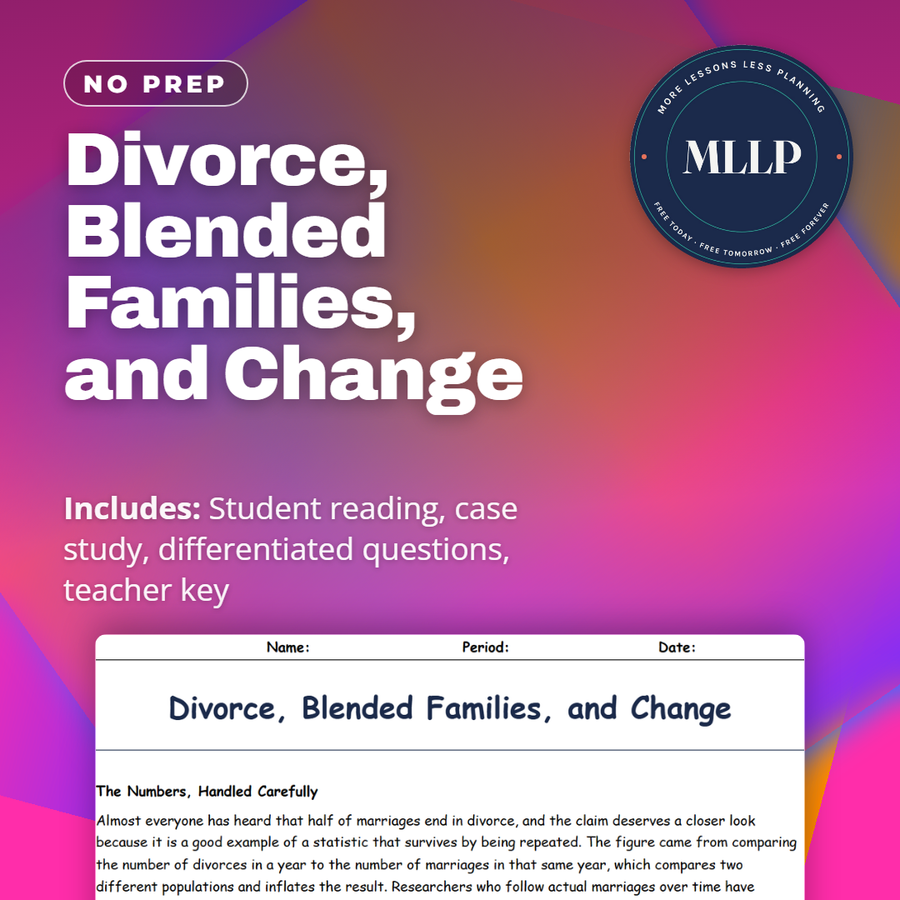
Almost everyone has heard that half of marriages end in divorce, and the claim deserves a closer look because it is a good example of a statistic that survives by being repeated. The figure came from comparing the number of divorces in a year to the number of marriages in that same year, which compares two different populations and inflates the result. Researchers who follow actual marriages over time have generally estimated that somewhere between forty and forty-five percent of first marriages in the United States end in divorce, with the risk considerably higher for second and third marriages. More interesting is the direction of travel. The divorce rate peaked around 1980 and has declined substantially since, and the decline is concentrated among younger adults. People marrying today marry later, are more likely to have finished more education, and are more likely to have lived together first, all of which are associated with lower divorce risk. At the same time, researchers found that the divorce rate among adults over fifty had roughly doubled since the 1990s, a pattern researchers call gray divorce. Several factors are consistently linked to divorce risk: marrying very young, low income, low education, a parental divorce, and cohabiting with multiple partners before marriage. None of these are destinies. They are patterns in populations, and knowing them is useful mainly because it makes the decision to marry a decision rather than a default.
What the Process Involves
Divorce is a legal process, and understanding its parts removes some of the fog around it. All states now allow no-fault divorce, meaning neither spouse must prove wrongdoing, though the specific grounds and waiting periods vary. Legal separation is a distinct status in some states, allowing a couple to live apart with a court-ordered arrangement while remaining married. Custody has two separate components that get confused constantly. Legal custody is the authority to make major decisions about a child's education, health care, and religion. Physical custody is where the child actually lives. Either can be sole or joint, and joint legal custody paired with one primary residence is a common arrangement. Courts across the country decide custody using the best interests of the child standard, which weighs factors such as each parent's relationship with the child, stability, the child's needs, and in many states the preferences of an older child. Child support is calculated by state formula, generally based on both parents' incomes and the amount of parenting time, and it is a right belonging to the child rather than to the receiving parent. Property division follows one of two systems: community property states split marital property roughly equally, while equitable distribution states divide it fairly, which is not always evenly. Many families use mediation, in which a neutral third party helps reach agreement outside court, and it is typically faster, cheaper, and less damaging to the ongoing relationship than litigation.
How Children Actually Do
The research on children and divorce is more nuanced than either of the popular versions. Divorce is genuinely hard on children in the short term, and most show distress in the first year or two: sleep disruption, declining grades, anger, anxiety, or acting out. The important finding is what happens after that window. Long-term studies find that the substantial majority of children adjust well within roughly two years and show no lasting differences from peers on most measures. A minority experience longer-lasting effects, and researchers have worked hard to identify what separates the two groups. The clearest finding is that ongoing conflict between parents predicts child outcomes better than the divorce itself. Children in high-conflict marriages that end frequently do better than they were doing before, while children whose parents divorce and then continue fighting through them do worse than children in stable low-conflict marriages. Other protective factors include economic stability, which often drops sharply after divorce, maintaining a relationship with both parents when both are safe, consistent routines, and a single transition rather than repeated ones. Two specific harms are worth naming because parents cause them unintentionally: loyalty binds, where a child feels that loving one parent betrays the other, and using a child as a messenger, confidant, or source of information about the other household. Children are remarkably resilient about structure and remarkably vulnerable to being placed in the middle.
Like what you read? The full reading, the case study, and every question set are in the free download below, along with the answer key.
Why this matters
A large share of students in any classroom are already living some version of what this reading describes, and very few of them have seen the actual research instead of the folk statistics. I think the custody vocabulary alone is worth the class period, since legal custody and physical custody get confused constantly by adults who are living through the process themselves. The finding about ongoing conflict mattering more than the divorce itself reframes a question a lot of teenagers are quietly carrying, whether their family's version of this counts as the bad kind. Naming loyalty binds and the messenger role directly gives students language for a position many of them have been placed in without anyone calling it that.
From one teacher to another
The claim that half of all marriages end in divorce turns out to be a statistic built from comparing two different groups, and the reading walks through why researchers put the real first marriage figure closer to forty to forty five percent instead. From there it moves into the parts of a divorce that actually affect a family, the difference between legal custody and physical custody, how child support gets calculated, and why mediation tends to work better than a courtroom for most families. A full passage is devoted to how children actually do afterward, and the finding that carries the most weight is that ongoing conflict between parents predicts outcomes better than the divorce itself. The case study follows Naomi, who is fourteen and realizes the real problem in her two household schedule was never the schedule, it was being asked to carry messages between her parents. A final passage covers blended families and the four to seven year timeline researchers use for a stepfamily to feel settled, which runs considerably longer than most adults expect going in.
What you get
Download
Where should I send the next one?
Everything here is free and it stays that way. Leave your email and I'll send you the new lessons as they go up. You can unsubscribe from any one of them.
Related resources
Aging Parents and the Sandwich Generation
Building Your Support Network
Communication Skills That Actually Work
Dating, Boundaries, and Consent
Family Roles and Shared Responsibilities
Friendships and Peer Relationships
Every lesson on this site is free to download and use. If one of them saved you a prep period, you can chip in a few bucks toward my three kids' daycare fund. That's genuinely where tips go.