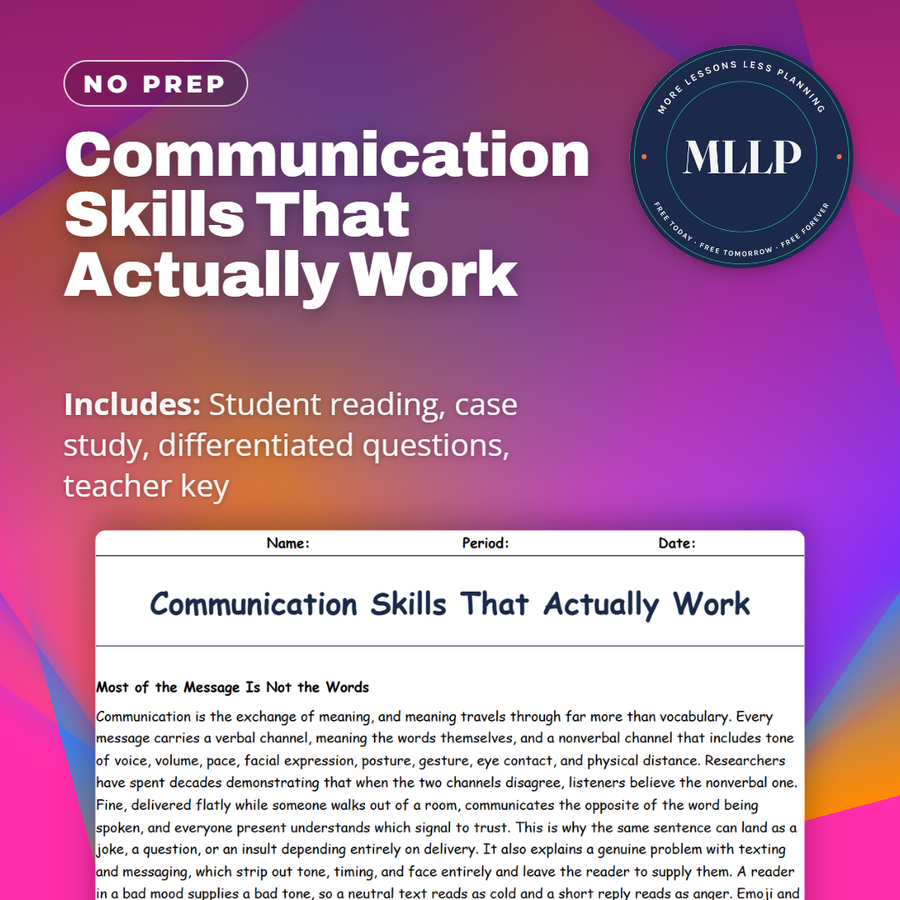
Communication Skills That Actually Work
Quality reviewed September 2026
Facts verified September 23, 2026
- Subject
- Career & Life Skills
- Grades
- Grades 9-12
- Length
- 8-page student worksheet
- Time
- About one 50-minute class period
- Great for
- Sub plans and independent work
- Includes
- Reading passage, comprehension questions + full answer key
- Format
- Print-and-go PDF
What students do
- Explain why the four-part I-statement structure gave Rohan something he could actually do
- Priya's bathroom case study shows what changed when she rewrote one accusing sentence
- Active listening gets broken into specific behaviors instead of a vague personality trait
- Identify which communication style, passive, aggressive, passive-aggressive, or assertive, fits an example
What it covers
- Nonverbal signals, active listening, and the four-part I-statement structure
- The specific habits that damage a conversation, including stonewalling and kitchen-sinking
- Priya and Rohan's bathroom case study, tested against the I-statement structure
Start reading this worksheet
Most of the Message Is Not the Words
Communication is the exchange of meaning, and meaning travels through far more than vocabulary. Every message carries a verbal channel, meaning the words themselves, and a nonverbal channel that includes tone of voice, volume, pace, facial expression, posture, gesture, eye contact, and physical distance. Researchers have spent decades demonstrating that when the two channels disagree, listeners believe the nonverbal one. Fine, delivered flatly while someone walks out of a room, communicates the opposite of the word being spoken, and everyone present understands which signal to trust. This is why the same sentence can land as a joke, a question, or an insult depending entirely on delivery. It also explains a genuine problem with texting and messaging, which strip out tone, timing, and face entirely and leave the reader to supply them. A reader in a bad mood supplies a bad tone, so a neutral text reads as cold and a short reply reads as anger. Emoji and punctuation are attempts to patch the missing channel, and they only partly work. The practical rules follow directly. Deliver anything emotionally loaded in person or by voice, where the nonverbal channel is available. Assume a text can be read three ways and reread it once before sending. And when someone's words and delivery do not match, ask about the mismatch out loud rather than guessing, because a guess about what a face meant is still only a guess.
Listening Is a Skill, Not a Pause
Most people describe themselves as good listeners, and most people are actually doing something else, which is waiting. In ordinary conversation the listener spends the other person's talking time composing a reply, which means the last third of what was said is never really processed. Active listening is the deliberate alternative, and it is a set of behaviors rather than an attitude. It starts with attention: put the phone down, turn toward the speaker, and let there be a short silence after they stop instead of jumping in. It continues with reflecting, meaning you say back what you understood in your own words. So you are saying the schedule change is the part that bothers you, not the extra shift itself. Reflecting does two jobs at once, since it checks your accuracy and it proves you were listening. Clarifying questions come next, and open questions that begin with what or how pull far more than questions answerable with yes or no. Finally, resist the three most common derailments: giving advice nobody asked for, one-upping with your own story, and rushing to reassure. Reassurance in particular feels supportive and usually ends the conversation, because it tells the speaker the topic is closed. The most useful thing a listener can say is often nothing more than that sounds hard, tell me more, which requires no wisdom whatsoever and works nearly every time.
I-Statements and Owning the Message
The single most portable communication tool is the I-statement, and it survives outside the classroom because it changes the listener's response rather than merely sounding polite. A you-statement assigns a motive and invites defense. You never help around here has a built-in accusation, and the listener's next sentence is almost always evidence of a time they helped, which means the actual problem is never discussed. An I-statement describes the speaker's own experience, which is not arguable. The standard structure has four parts: I feel, then a specific emotion; when, then a specific behavior rather than a character judgment; because, then the concrete effect on you; and I need, then a clear and doable request. Assembled, it sounds like this. I feel frustrated when the dishes are still in the sink at bedtime, because I end up doing them before school and it makes me late. I need us to split them by nine. Notice what the structure prevents. It bans always and never, which are almost never accurate and which reliably start arguments about the exception. It replaces a personality accusation with an observable behavior. It ends with a request instead of a complaint, which gives the other person something they can actually do. The tool is not magic and it does not guarantee agreement. What it guarantees is that the conversation stays about the dishes.
Like what you read? The full reading, the case study, and every question set are in the free download below, along with the answer key.
Why this matters
Every household runs disagreements through words, tone, and timing whether anyone plans it or not, and the gap between a fight that resolves and one that repeats for months usually comes down to a handful of learnable habits. I like this reading because it treats communication as a set of specific, testable moves rather than a trait some people simply have and others do not. The I-statement structure in particular travels well outside a family life classroom, since a roommate, a coworker, or a coach responds to a clear behavior and a doable request far better than to an accusation. Students who can name the difference between reassurance and being heard, or between an assertive sentence and an aggressive one, carry that skill into arguments this reading never had to mention by name.
From one teacher to another
Priya had said the same accusing sentence to her brother roughly forty times before anything changed. The reading opens with the finding that when a person's words and their tone disagree, listeners believe the tone, which explains why the same sentence can land as a joke or an insult depending on delivery. From there it breaks active listening into specific behaviors, reflecting back what you heard, asking open questions, resisting the urge to reassure, rather than treating listening as a passive trait. Students work through the four-part I-statement structure Priya eventually used on her brother, and the case study questions ask them to name exactly which part of her new sentence gave Rohan something concrete to respond to. A separate section sorts passive, aggressive, passive-aggressive, and assertive communication, since most people default to one style under pressure without ever noticing which one.
What you get
Download
Where should I send the next one?
Everything here is free and it stays that way. Leave your email and I'll send you the new lessons as they go up. You can unsubscribe from any one of them.
Related resources

Aging Parents and the Sandwich Generation
Building Your Support Network
Dating, Boundaries, and Consent
Divorce, Blended Families, and Change
Family Roles and Shared Responsibilities
Friendships and Peer Relationships
Every lesson on this site is free to download and use. If one of them saved you a prep period, you can chip in a few bucks toward my three kids' daycare fund. That's genuinely where tips go.