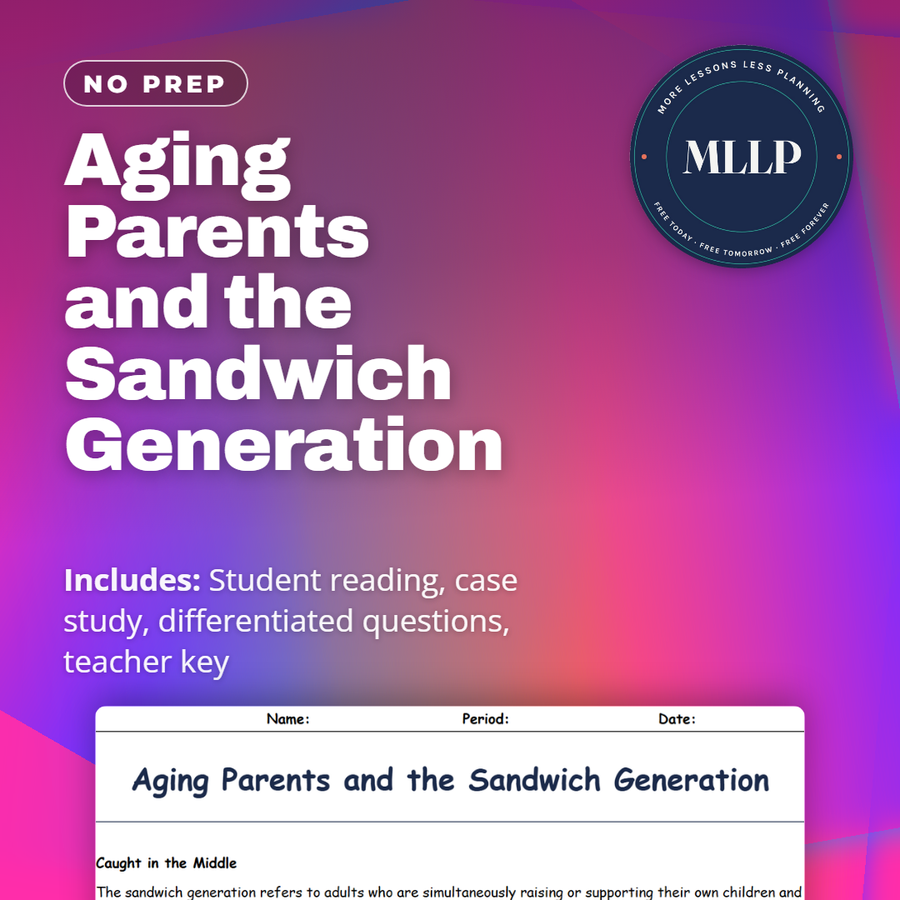
Aging Parents and the Sandwich Generation
Quality reviewed September 2026
Facts verified September 23, 2026
- Subject
- Career & Life Skills
- Grades
- Grades 9-12
- Length
- 9-page student worksheet
- Time
- About one 50-minute class period
- Great for
- Sub plans and independent work
- Includes
- Reading passage, comprehension questions + full answer key
- Format
- Print-and-go PDF
What students do
- The sandwich generation squeeze falls hardest on adults in their forties and fifties, mostly women
- Renata's kitchen table meeting turns two overlooked documents into an actual plan
- Identify the difference between ADLs and IADLs and why the second kind fades first
- Explain why having the conversation before a crisis still mattered even though it solved no immediate problem
What it covers
- Caregiving demands, real costs, and the planning documents that head off a crisis
- The difference between activities of daily living and instrumental activities of daily living
- Free resources like the Area Agency on Aging, the Eldercare Locator, and the 211 line
Start reading this worksheet
Caught in the Middle
The sandwich generation refers to adults who are simultaneously raising or supporting their own children and providing care for an aging parent. The term was coined by a social worker in the 1980s and has become steadily more accurate since. Research from the Pew Research Center has found that roughly a quarter of American adults are sandwiched in this way, meaning they have a parent aged sixty-five or older while also raising a minor child or providing financial support to an adult child. The squeeze is not evenly distributed. It falls most heavily on adults in their forties and fifties, and within that group it falls disproportionately on women, who provide the majority of unpaid family caregiving in nearly every country where it has been measured. The pressure is simultaneous rather than sequential, which is the defining feature. A person in this position may be helping with college applications in the same week they are arranging a neurologist appointment, and the two obligations do not take turns. What makes the topic appropriate for a high school course is that today's students will be the sandwich generation, and most people arrive at it with no preparation at all. The families who handle it best are not the wealthiest ones. They are the ones who had the conversations early, which is an advantage available to anyone willing to be slightly uncomfortable ahead of schedule.
Why This Is Happening Now
This particular squeeze is a recent invention, produced by several demographic changes arriving together. Life expectancy rose dramatically across the twentieth century, so far more people now live into their eighties and nineties, and the years gained are frequently years that involve some level of assistance. The population aged sixty-five and older is growing rapidly as the baby boom generation moves through it. At the same time, the average age at first birth has risen substantially, which compresses the gap between raising children and caring for parents until the two overlap. Families are smaller than they used to be, so there are fewer adult siblings available to divide the work, and geographic mobility means those siblings often live in different states. Meanwhile the cost of formal care has climbed steeply. National surveys of long-term care costs have regularly put a private room in a nursing home above one hundred thousand dollars a year, with assisted living and home health aides costing tens of thousands annually. Medicare, contrary to widespread belief, does not pay for long-term custodial care, meaning ordinary help with daily living; it covers medical care and only short, limited post-hospital stays. Medicaid does cover long-term care but only after a person has spent down most of their assets. That gap between what people assume is covered and what actually is explains an enormous amount of family financial stress.
What Caregiving Actually Involves
Family caregiving is often imagined as medical work, and it is mostly not. Professionals divide the tasks into two categories. Activities of daily living, abbreviated ADLs, are the basic self-care functions: bathing, dressing, eating, using the toilet, transferring in and out of a bed or chair, and walking. Instrumental activities of daily living, or IADLs, are the tasks required to live independently: managing medications, cooking, cleaning, shopping, transportation, using a phone, and handling finances. Decline usually shows up in the IADLs first, which is why the earliest warning signs a family notices are unopened mail, missed bills, an empty refrigerator, or a series of small unexplained car scrapes rather than anything dramatic. National surveys estimate that tens of millions of Americans provide unpaid care to an adult, with average commitments in the range of twenty to twenty-five hours a week, which is effectively a part-time job layered on top of everything else. The work also includes a substantial administrative component that people rarely anticipate: coordinating appointments, arguing with insurance companies, tracking medications, and managing paperwork. And it includes emotional labor that is genuinely difficult, since a role reversal in which an adult child begins making decisions for a parent is disorienting for both people and is frequently resisted by the parent for reasons that have nothing to do with stubbornness and everything to do with losing independence.
Like what you read? The full reading, the case study, and every question set are in the free download below, along with the answer key.
Why this matters
Today's students will very likely become part of the sandwich generation themselves, and the reading is blunt that most people arrive at it with no preparation at all. The families who handle it best are not the wealthiest ones, they are the ones who had the uncomfortable conversation early, while everyone involved could still choose the terms of it. That is worth naming directly to a sixteen year old, since the difference between a durable power of attorney and a health care proxy takes ten minutes to learn and can save a family a court process later. Knowing that Medicare does not cover long term custodial care changes how a family saves. None of that costs money, and all of it is easier to absorb now than during a bad week.
From one teacher to another
Renata almost missed the signs before two missed heart medication doses forced the issue, unopened mail, a scraped car door, the same story told twice. I use this one because the reading treats the sandwich generation as infrastructure rather than a mood, tracing it to real demographic causes like longer lifespans, later childbearing, and the gap between what Medicare covers and what families assume it covers. Students read through the difference between ADLs and IADLs, why the second kind of decline shows up first, and what a health care proxy actually does that a will does not. The case study follows Renata calling one kitchen table meeting instead of waiting for an emergency, and the questions ask students to explain why the conversation still mattered even though it solved no immediate problem. It closes with the free resources most families never look for until they need them, including the Area Agency on Aging and the Eldercare Locator.
What you get
Download
Where should I send the next one?
Everything here is free and it stays that way. Leave your email and I'll send you the new lessons as they go up. You can unsubscribe from any one of them.
Related resources

Building Your Support Network
Communication Skills That Actually Work

Dating, Boundaries, and Consent

Divorce, Blended Families, and Change
Family Roles and Shared Responsibilities
Friendships and Peer Relationships
Every lesson on this site is free to download and use. If one of them saved you a prep period, you can chip in a few bucks toward my three kids' daycare fund. That's genuinely where tips go.