Family Roles and Shared Responsibilities
Quality reviewed September 2026
Facts verified September 23, 2026
- Subject
- Career & Life Skills
- Grades
- Grades 9-12
- Length
- 9-page student worksheet
- Time
- About one 50-minute class period
- Great for
- Sub plans and independent work
- Includes
- Reading passage, comprehension questions + full answer key
- Format
- Print-and-go PDF
What students do
- Identify the difference between role overload, role conflict, and role ambiguity
- The Whitaker family's sixty eight item inventory shows the gap between helping and owning a task
- Instrumental roles and expressive roles get separated from the informal roles families never name
- Explain why reassigning work by whole domain fixes the mental load and a task list does not
What it covers
- Family roles, the mental load, and the specific ways a household's roles break down
- Parentification and role overload as two recognizable problems tied to how work gets split
- The Whitaker family's household inventory, from sixty eight tasks down to who owns each one
Start reading this worksheet
Every Household Runs on Unwritten Job Descriptions
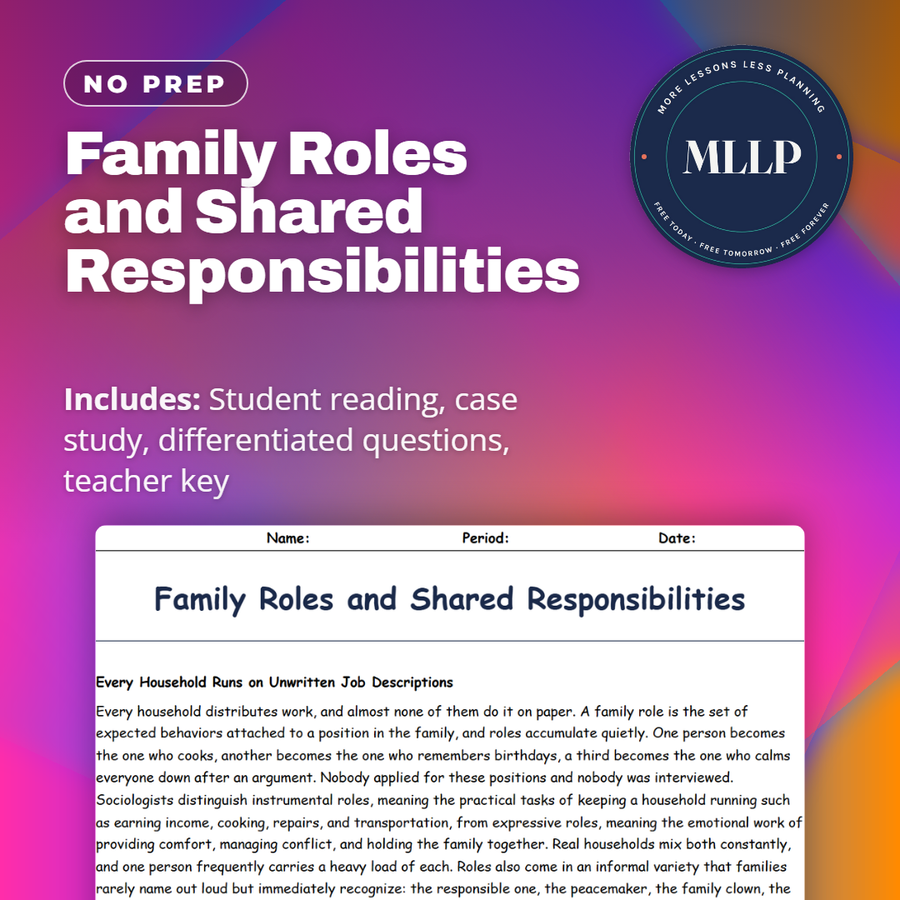
Every household distributes work, and almost none of them do it on paper. A family role is the set of expected behaviors attached to a position in the family, and roles accumulate quietly. One person becomes the one who cooks, another becomes the one who remembers birthdays, a third becomes the one who calms everyone down after an argument. Nobody applied for these positions and nobody was interviewed. Sociologists distinguish instrumental roles, meaning the practical tasks of keeping a household running such as earning income, cooking, repairs, and transportation, from expressive roles, meaning the emotional work of providing comfort, managing conflict, and holding the family together. Real households mix both constantly, and one person frequently carries a heavy load of each. Roles also come in an informal variety that families rarely name out loud but immediately recognize: the responsible one, the peacemaker, the family clown, the scapegoat who gets blamed when things go wrong, the caretaker. These informal roles are sticky, meaning a person keeps performing them for decades and often reverts to a childhood role the moment they walk into a parent's house at thirty-five. Naming a role is the first step to changing it, because an unnamed role feels like a personality trait. The question worth asking about any household is not whether roles exist. It is whether the people in them ever agreed to them.
Where Roles Come From
Roles are assigned by several forces working at once, and very few of them involve a conversation. Culture supplies a set of default expectations about who does what, and these vary enormously across families and communities. Gender norms remain one of the strongest influences, even in households that describe themselves as egalitarian. Time-use data collected by the Bureau of Labor Statistics has consistently shown women spending more time per day on household activities and on caring for household members than men, and the gap narrowed only slowly across recent decades. Birth order contributes, since oldest children are often assigned responsibility early and youngest children frequently keep a less demanding role long after they could handle more. Modeling is powerful, because people tend to reproduce the division of labor they watched growing up unless they deliberately decide otherwise, and that decision usually requires noticing the pattern first. Necessity assigns plenty of roles too. A parent working nights creates a sibling who supervises homework. A family with one car assigns a driver. Personality plays a real but smaller part than people assume, since the person who is good at organizing often became good at it by being assigned it repeatedly at eleven. The practical value of understanding origins is that a role produced by habit or necessity can be renegotiated, while a role mistaken for an unchangeable trait cannot even be discussed.
The Work Nobody Sees
The most contested household labor is the kind that produces no visible evidence. Researchers call it cognitive labor or the mental load, and it means the noticing, planning, remembering, and coordinating that keeps a household functioning. It is knowing that the permission slip is due Friday, that the youngest outgrew their shoes, that the car needs an oil change, that the grandparents' anniversary is next week, and that the dentist only answers before four. None of that shows up as a completed task. It is invisible to everyone except the person carrying it, and it does not stop when the workday does. Sociologist Arlie Hochschild popularized a related idea in describing the second shift, meaning the household and caregiving work that a person performs after finishing paid employment. The mental load causes disproportionate conflict for a specific reason: the person carrying it feels overloaded while the other people genuinely believe the work is shared, because they do complete tasks when asked. Being asked is precisely the issue. Delegating a task while retaining the responsibility for remembering it is not sharing the load; it is adding a management job. The practical fix is transferring ownership of whole domains rather than assigning individual tasks. One person owning all of laundry, including noticing when it needs doing and buying detergent, is genuinely shared work. One person doing a load when told is help, and help is not the same thing.
Like what you read? The full reading, the case study, and every question set are in the free download below, along with the answer key.
Why this matters
Plenty of students already occupy a specific role in their own household, whether that is the one who translates for a parent, the one who watches a younger sibling, or the one everyone calls when something breaks, and very few of them have ever been asked whether they agreed to it. The reading's distinction between doing a task and owning it names something that causes real friction in a lot of homes, including some of theirs. Learning that a role produced by habit or necessity can be renegotiated, while a role mistaken for a personality trait cannot even be discussed, gives students a concrete way to raise something at home instead of just feeling it. It also previews a conversation a lot of them will have again as adults, in a different kitchen, about who owns the laundry.
From one teacher to another
Ray thought he was helping with plenty around the house until his family's inventory assignment stopped at sixty eight recurring tasks and his wife owned fifty one of them. The reading opens by naming something most households never put into words, that roles like the cook, the peacemaker, or the one who remembers birthdays get assigned without anyone applying for them. It separates instrumental roles, the practical tasks of running a household, from expressive roles, the emotional work of holding it together, and then names the specific work nobody sees, the mental load of noticing and remembering that keeps happening even after a task gets delegated. A full passage covers what goes wrong when roles are distributed badly, role overload, role conflict, role ambiguity, and the heavier problem of parentification. The Whitaker case study follows one family's inventory from a guess of twenty tasks to an actual list of sixty eight, and the questions ask students to explain what the ownership column revealed that the task column did not.
What you get
Download
Where should I send the next one?
Everything here is free and it stays that way. Leave your email and I'll send you the new lessons as they go up. You can unsubscribe from any one of them.
Related resources

Aging Parents and the Sandwich Generation
Building Your Support Network
Communication Skills That Actually Work

Dating, Boundaries, and Consent
Divorce, Blended Families, and Change
Friendships and Peer Relationships
Every lesson on this site is free to download and use. If one of them saved you a prep period, you can chip in a few bucks toward my three kids' daycare fund. That's genuinely where tips go.