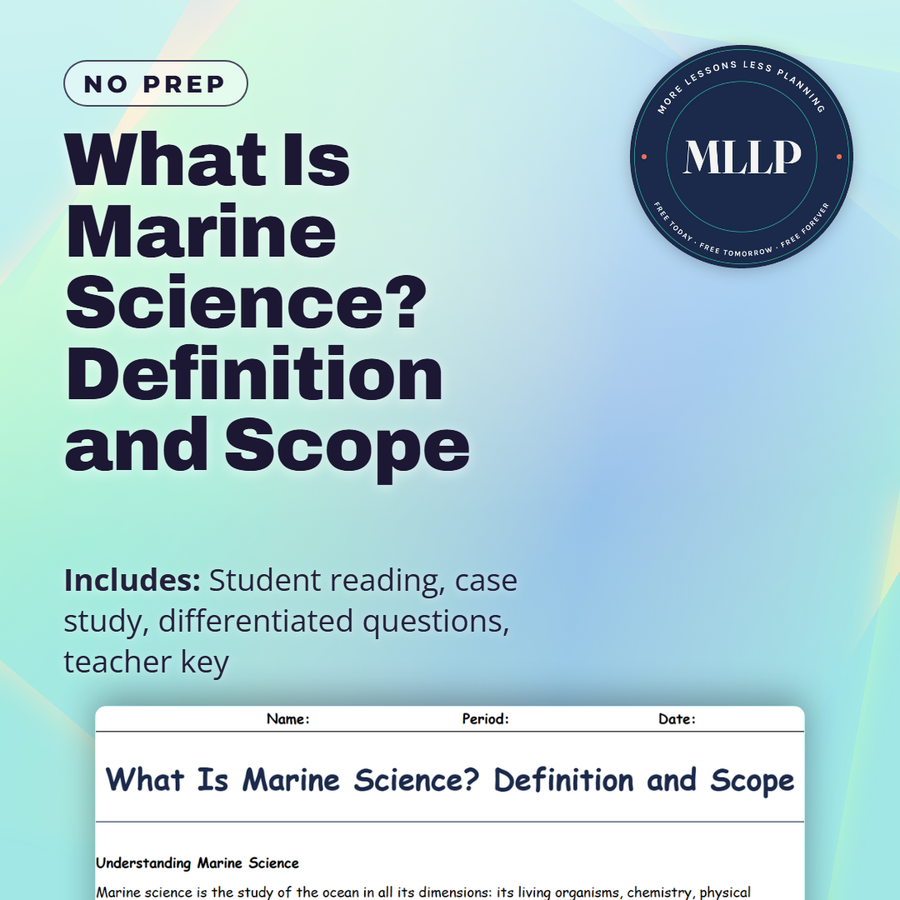
What Is Marine Science? Definition and Scope
Quality reviewed September 2026
Facts verified September 14, 2026
- Subject
- Science
- Grades
- Grades 9-12
- Length
- 6-page student worksheet
- Time
- About one 50-minute class period
- Great for
- Sub plans and independent work
- Includes
- Reading passage, comprehension questions + full answer key
- Format
- Print-and-go PDF
What students do
- Match terms like Marine Biology, Chemical Oceanography, Marine Geology, and Computer Models to their correct definitions
- Fill in the blank sentences on the Secchi disk, interdisciplinary science, and dinoflagellates
- Answer multiple choice questions on the definition of marine science, what a CTD measures, and which factor did not cause the algal bloom in the case study
- Write short answers on why marine science requires collaboration across disciplines, one way marine science benefits society, and one method to prevent nutrient-driven blooms
What it covers
- The definition of marine science as an interdisciplinary study of ocean biology, chemistry, geology, and physics
- Tools marine scientists use, including CTDs and computer models, and how the branches work together in a coastal estuary
- A case study on a coastal algal bloom investigated through chemistry, biology, physics, and geology data
Start reading this worksheet
Understanding Marine Science
Marine science is the study of the ocean in all its dimensions: its living organisms, chemistry, physical properties, and geology. Oceans cover over 70% of Earth’s surface, making them central to the planet’s climate system, weather patterns, and life support systems. To study the ocean properly, marine science blends many disciplines—biology to understand organisms, chemistry to analyze water composition, geology to map the seafloor, and physics to study currents, waves, and tides. Unlike subjects that deal with a single branch of science, marine science thrives on interdisciplinary thinking. For example, studying a coral reef requires analyzing how chemical nutrients influence growth, how geologic formations provide habitat, how biological interactions maintain balance, and how wave energy affects reef stability. By combining perspectives, marine science allows students and scientists to see the ocean as a living, connected system rather than isolated parts.
How the Branches Work Together
To understand the power of marine science, imagine a coastal estuary. A physical oceanographer measures how fresh river water and salty seawater layer and mix. A chemical oceanographer tests nutrient levels and pollutants in that estuary. A marine biologist studies how fish populations respond to these conditions, and a marine geologist examines the sediments that shape the estuary’s floor. Each scientist has a specialty, but the full picture only appears when their work comes together. This cooperation is not optional—it is essential. Currents affect nutrient distribution, which in turn shapes plankton blooms that feed larger animals. Sediment layers hold historical records of pollution and past climate shifts. By integrating all of these fields, marine science provides knowledge for managing fisheries, protecting coasts, and understanding global climate change.
Skills in Marine Science
Marine scientists need strong observation skills, the ability to work with data, and the creativity to design experiments. They may use CTDs (conductivity, temperature, depth instruments), current meters, and remote sensors to collect information. Increasingly, they also use computer models to simulate conditions and predict changes. These models help communities prepare for storms, anticipate fisheries’ productivity, or evaluate the effects of climate change on coastal environments. But tools alone don’t make a marine scientist. Teamwork and systems thinking are crucial. Each branch supplies part of the puzzle, but understanding the whole ocean requires collaboration. Marine science is about both careful detail and big-picture synthesis.
Like what you read? The full reading, the case study, and every question set are in the free download below, along with the answer key.
Why this matters
Fish, or maybe coral, is what most students guess when asked what marine science studies. Marine science actually pulls together biology, chemistry, geology, and physics to study one connected system, using tools as different as a Secchi disk that measures how far light travels through water and a CTD that records salinity and temperature at once.
I use the coastal algal bloom case study to show why that combination matters instead of just listing four branches of science. Students have to weigh biology, chemistry, physics, and geology data together to explain a single bloom in one bay, and that exercise does more to define the field than any definition I could give them up front.
From one teacher to another
Marine science pulls together biology, chemistry, geology, and physics to study one connected system, and this worksheet lays out how. Students read about the tools scientists use, from Secchi disks that measure water clarity to CTDs that record salinity and temperature. The case study on a coastal algal bloom asks students to weigh evidence from four different branches of science to explain what happened in the bay. Questions cover the definition of marine science, its tools, and ways to prevent future blooms.
What you get
Download
Where should I send the next one?
Everything here is free and it stays that way. Leave your email and I'll send you the new lessons as they go up. You can unsubscribe from any one of them.
Related resources
Ancient Ocean Explorers: Polynesians, Phoenicians, and Beyond
Branches of Marine Science: Biology, Chemistry, Geology, and Physical Oceanography
Careers in Marine Science and Oceanography
Famous Expeditions: HMS Challenger, Alvin, and Beyond
Marine Science Contributions to Society: Medicine, Climate, and Food
Modern Tools of Ocean Exploration: ROVs, AUVs, and Sonar
Every lesson on this site is free to download and use. If one of them saved you a prep period, you can chip in a few bucks toward my three kids' daycare fund. That's genuinely where tips go.