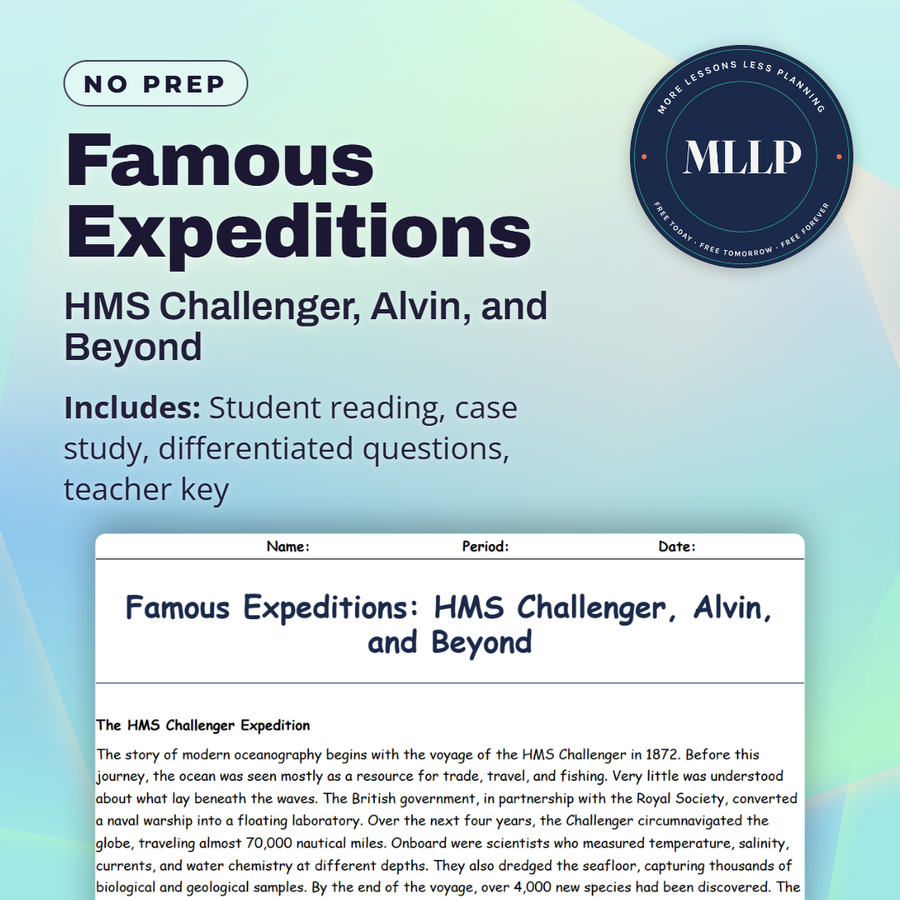
Famous Expeditions: HMS Challenger, Alvin, and Beyond
Quality reviewed September 2026
Facts verified September 14, 2026
- Subject
- Science
- Grades
- Grades 9-12
- Length
- 6-page student worksheet
- Time
- About one 50-minute class period
- Great for
- Sub plans and independent work
- Includes
- Reading passage, comprehension questions + full answer key
- Format
- Print-and-go PDF
What students do
- Match terms like HMS Challenger, Alvin, Deepsea Challenger, and Hydrothermal Vents to their correct definitions
- Fill in the blank sentences on the Challenger expedition, chemosynthesis, and the Deepsea Challenger dive
- Answer multiple choice questions on the Challenger's biggest achievement, Alvin's most famous discovery, and what made the Deepsea Challenger dive unique
- Write short answers on how the Challenger expedition shaped modern oceanography, why Alvin matters to scientists and historians, and what makes the Mariana Trench so hard to explore
What it covers
- The HMS Challenger expedition (1872-1876) and the birth of modern oceanography
- Alvin's discovery of hydrothermal vent ecosystems and its survey of the Titanic wreck
- A case study on James Cameron's 2012 solo dive to the Mariana Trench in the Deepsea Challenger
Start reading this worksheet
The HMS Challenger Expedition
The story of modern oceanography begins with the voyage of the HMS Challenger in 1872. Before this journey, the ocean was seen mostly as a resource for trade, travel, and fishing. Very little was understood about what lay beneath the waves. The British government, in partnership with the Royal Society, converted a naval warship into a floating laboratory. Over the next four years, the Challenger circumnavigated the globe, traveling almost 70,000 nautical miles. Onboard were scientists who measured temperature, salinity, currents, and water chemistry at different depths. They also dredged the seafloor, capturing thousands of biological and geological samples. By the end of the voyage, over 4,000 new species had been discovered. The Challenger also documented the existence of deep-sea trenches, disproving the belief that life could not exist below 500 meters. Its published findings filled 50 volumes and remain one of the most important collections in ocean science. The Challenger expedition transformed curiosity into systematic study and is often called the birth of modern oceanography.
Alvin and the Rise of Submersibles
Nearly a century later, marine exploration took another leap forward with the development of manned submersibles. One of the most famous is Alvin, operated by the Woods Hole Oceanographic Institution. First launched in 1964, Alvin is a small submersible that carries a crew of three. Unlike earlier vessels, Alvin could dive to depths of over 4,000 meters, enabling scientists to directly observe the deep sea. Alvin is best remembered for two major achievements. In 1977, it carried scientists to the Galápagos Rift, where they discovered hydrothermal vents and entire ecosystems based on chemosynthesis. Later, in 1986, Alvin helped survey the wreck of the Titanic, providing valuable historical and scientific insights. Alvin proved that direct human observation, combined with technology, could reveal discoveries that remote tools alone might miss. The submersible continues to operate today, with upgrades that allow even deeper and safer dives.
Like what you read? The full reading, the case study, and every question set are in the free download below, along with the answer key.
Why this matters
A four-year voyage in the 1870s mapped ocean depths and turned up thousands of undocumented species, and that expedition, the HMS Challenger, is why oceanography exists at all. That thread continues with Alvin, the submersible that found hydrothermal vent life and surveyed the Titanic wreck, and ends with James Cameron's solo 2012 dive to the bottom of the Mariana Trench.
Lining up all three expeditions is what makes the progress visible, since a ship's survey, a submersible, and a solo dive to the Mariana Trench represent three different eras of what counted as possible. Each one went deeper than the last, and the trench is still hard enough to explore that a student who assumes the ocean has been fully mapped has the story backwards.
From one teacher to another
Deep-sea exploration has its own history of milestone voyages, starting with the HMS Challenger's four-year global survey in the 1870s. Students read about how that expedition mapped ocean depths and discovered thousands of new species, then move to Alvin's role in finding hydrothermal vent life and surveying the Titanic wreck. The case study covers James Cameron's solo 2012 dive to the bottom of the Mariana Trench in the Deepsea Challenger submersible. Questions ask students to compare what each expedition contributed to marine science.
What you get
Download
Where should I send the next one?
Everything here is free and it stays that way. Leave your email and I'll send you the new lessons as they go up. You can unsubscribe from any one of them.
Related resources
Ancient Ocean Explorers: Polynesians, Phoenicians, and Beyond
Branches of Marine Science: Biology, Chemistry, Geology, and Physical Oceanography
Careers in Marine Science and Oceanography
Marine Science Contributions to Society: Medicine, Climate, and Food
Modern Tools of Ocean Exploration: ROVs, AUVs, and Sonar
The Ocean’s Role in Earth’s Climate System
Every lesson on this site is free to download and use. If one of them saved you a prep period, you can chip in a few bucks toward my three kids' daycare fund. That's genuinely where tips go.