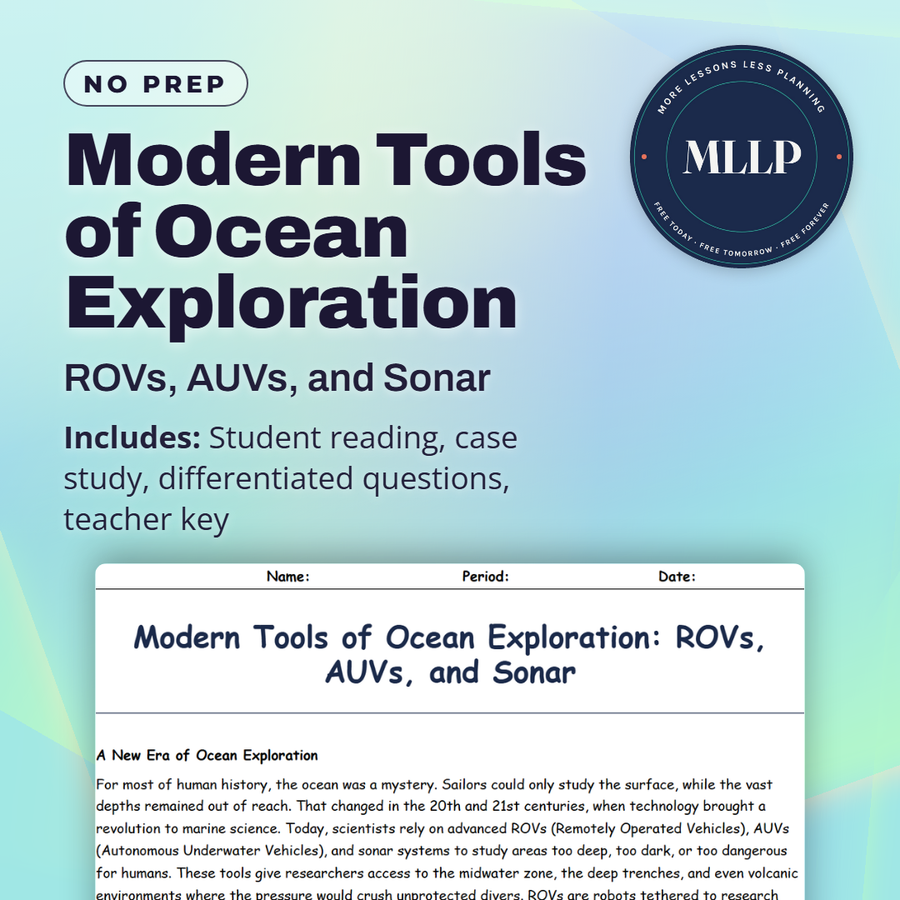
Modern Tools of Ocean Exploration: ROVs, AUVs, and Sonar
Quality reviewed September 2026
Facts verified September 14, 2026
- Subject
- Science
- Grades
- Grades 9-12
- Length
- 7-page student worksheet
- Time
- About one 50-minute class period
- Great for
- Sub plans and independent work
- Includes
- Reading passage, comprehension questions + full answer key
- Format
- Print-and-go PDF
What students do
- Match terms like ROV, AUV, Sonar, and Black Smokers to their correct definitions
- Fill in the blank sentences on what sonar stands for, chemosynthesis, and AUVs
- Answer multiple choice questions on the difference between AUVs and ROVs, what sonar uses to map the seafloor, and what powers hydrothermal vent ecosystems
- Write short answers on why ROVs suit dangerous environments, how the Galápagos vent discovery changed ideas about life, and one way sonar benefits both science and society
What it covers
- How ROVs, AUVs, and sonar let scientists explore the deep ocean without diving there themselves
- The tools' different roles, from tethered ROV arms to autonomous AUV surveys to sonar seafloor mapping
- A case study on the 1977 Galápagos Rift discovery of hydrothermal vents using the submersible Alvin
Start reading this worksheet
A New Era of Ocean Exploration
For most of human history, the ocean was a mystery. Sailors could only study the surface, while the vast depths remained out of reach. That changed in the 20th and 21st centuries, when technology brought a revolution to marine science. Today, scientists rely on advanced ROVs (Remotely Operated Vehicles), AUVs (Autonomous Underwater Vehicles), and sonar systems to study areas too deep, too dark, or too dangerous for humans. These tools give researchers access to the midwater zone, the deep trenches, and even volcanic environments where the pressure would crush unprotected divers. ROVs are robots tethered to research vessels by cables, which transmit power and data. Pilots onboard ships can guide them, manipulate robotic arms, and stream video in real time. AUVs, in contrast, are untethered and programmed before launch. They operate like underwater drones, carrying instruments across wide areas and returning data after surfacing. Sonar, short for Sound Navigation and Ranging, sends sound waves through water to detect objects and map the seafloor. Together, these three technologies have reshaped our understanding of the deep sea. They allow us not only to observe marine life but also to document geological processes, locate shipwrecks, and monitor climate change indicators such as melting ice or ocean currents.
ROVs: The Eyes and Hands of the Deep Sea
ROVs are among the most versatile tools in marine science. Connected to ships with fiber-optic cables, they can transmit high-definition video, capture still images, and carry lights that illuminate the total darkness of the deep. Many ROVs are equipped with manipulator arms that can grab samples of rocks, corals, or even living organisms. Some ROVs are small and portable, while others, like the Jason operated by the Woods Hole Oceanographic Institution, can dive several kilometers beneath the surface. ROVs are particularly valuable in dangerous environments. For example, they allow scientists to study hydrothermal vents, where superheated water and toxic chemicals make human dives nearly impossible. They can also explore shipwrecks, such as the Titanic, without risking human lives. Because ROVs are controlled from the surface, scientists can make immediate decisions about what to observe or collect. This flexibility makes them one of the most important tools in marine research today.
AUVs: The Autonomous Surveyors
While ROVs depend on direct human control, AUVs are programmed to carry out missions on their own. Launched from a ship, they travel along pre-determined paths, recording temperature, salinity, currents, and chemical concentrations. After completing their route, they resurface to upload their data. Because AUVs are not limited by cables, they can cover large distances efficiently and are often used for seafloor mapping, pollution monitoring, and under-ice surveys in the Arctic and Antarctic. Some AUVs are designed to dive to extreme depths, while others specialize in shallow coastal studies. One major advantage of AUVs is that they free scientists to monitor multiple sites at once, or to conduct long-term surveys without needing constant human oversight. They are particularly useful for collecting baseline data: the kind of information needed to understand long-term changes in the ocean. By using fleets of AUVs, scientists can piece together a big-picture view of how currents transport heat and nutrients around the globe.
Like what you read? The full reading, the case study, and every question set are in the free download below, along with the answer key.
Why this matters
In 1977, scientists piloting the submersible Alvin along the Galápagos Rift found an ecosystem that broke a rule biology had treated as universal: life with no sunlight anywhere near it. The vents ran on chemosynthesis instead, turning chemicals pouring out of the seafloor into food for animals no one had documented before.
A tethered ROV and an independent AUV solve different problems, and this reading asks students to sort out which one fits which job before adding sonar as a third layer that maps the ground these vehicles explore. It turns a list of acronyms into a set of actual trade-offs.
From one teacher to another
Deep-sea exploration today relies on machines rather than human divers alone, and this reading covers three of them. Students read about tethered ROVs with camera arms, autonomous AUVs that survey wide areas on their own, and sonar systems that map the seafloor using sound. The case study walks through the 1977 discovery of hydrothermal vents at the Galápagos Rift, where scientists found ecosystems running on chemosynthesis instead of sunlight. Questions ask students to compare what each technology contributes to ocean research.
What you get
Download
Where should I send the next one?
Everything here is free and it stays that way. Leave your email and I'll send you the new lessons as they go up. You can unsubscribe from any one of them.
Related resources
Ancient Ocean Explorers: Polynesians, Phoenicians, and Beyond
Branches of Marine Science: Biology, Chemistry, Geology, and Physical Oceanography
Careers in Marine Science and Oceanography
Famous Expeditions: HMS Challenger, Alvin, and Beyond
Marine Science Contributions to Society: Medicine, Climate, and Food
The Ocean’s Role in Earth’s Climate System
Every lesson on this site is free to download and use. If one of them saved you a prep period, you can chip in a few bucks toward my three kids' daycare fund. That's genuinely where tips go.