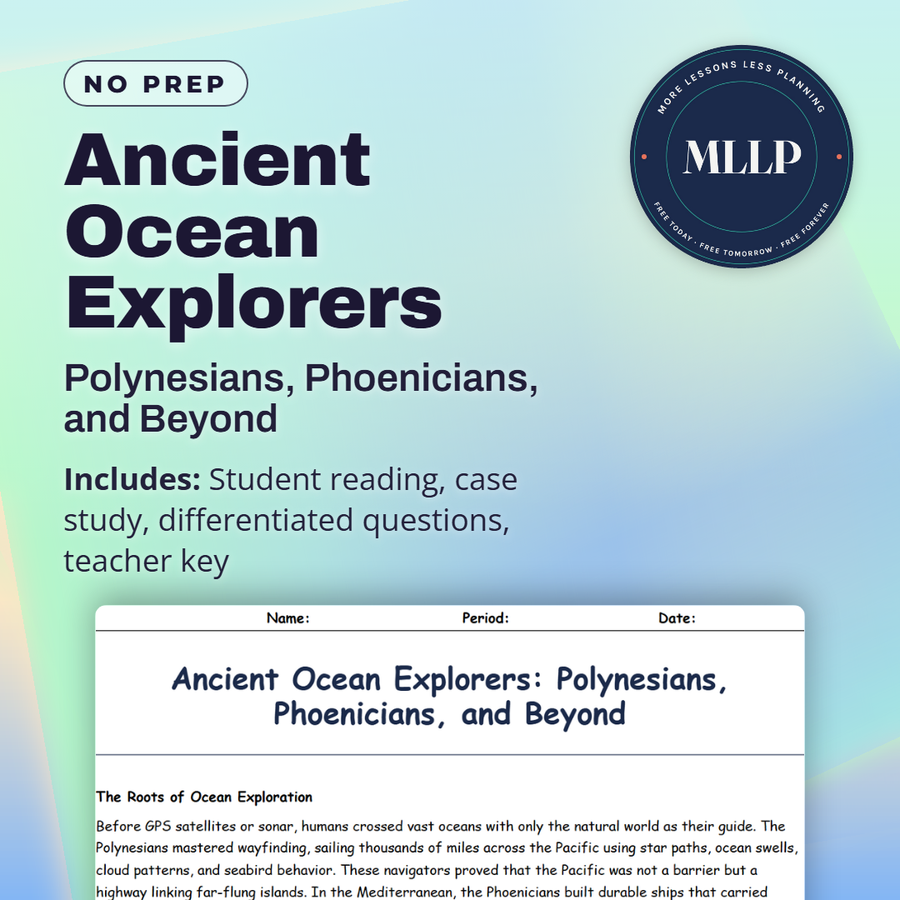
Ancient Ocean Explorers: Polynesians, Phoenicians, and Beyond
Quality reviewed September 2026
Facts verified September 14, 2026
- Subject
- Science
- Grades
- Grades 9-12
- Length
- 6-page student worksheet
- Time
- About one 50-minute class period
- Great for
- Sub plans and independent work
- Includes
- Reading passage, comprehension questions + full answer key
- Format
- Print-and-go PDF
What students do
- Match terms like Polynesians, Phoenicians, Greeks, and Oral Traditions to their correct definitions
- Fill in the blank sentences on the sidereal compass, Phoenician trade networks, and the North Star
- Answer multiple choice questions on Polynesian navigation tools, Phoenician sailing strategies, and the signs that signaled a nearby island
- Write short answers on how Polynesian wayfinding blended science and culture, what Phoenician ships carried besides goods, and what lesson modern scientists can take from ancient navigators
What it covers
- Polynesian wayfinding across the Pacific using stars, swells, and seabirds
- Phoenician maritime trade networks in the Mediterranean and their navigation methods
- A case study on an apprentice navigator using stars, swells, and bird flight to find an island
Start reading this worksheet
The Roots of Ocean Exploration
Before GPS satellites or sonar, humans crossed vast oceans with only the natural world as their guide. The Polynesians mastered wayfinding, sailing thousands of miles across the Pacific using star paths, ocean swells, cloud patterns, and seabird behavior. These navigators proved that the Pacific was not a barrier but a highway linking far-flung islands. In the Mediterranean, the Phoenicians built durable ships that carried goods, ideas, and cultural influence. They charted coastal routes, relied on the North Star, and developed some of the earliest maritime trade networks. Both groups show how early ocean explorers used scientific observation, though not called that at the time, to survive and thrive at sea.
Navigation Without Technology
The Polynesians relied on a sidereal compass, a mental map of how stars rose and set along the horizon. They also distinguished between primary swells (long waves generated by distant storms) and local chop caused by nearby winds. Phoenicians, meanwhile, studied the rhythm of seasonal winds, coastal landmarks, and early celestial navigation. What both cultures shared was careful observation, passed through oral traditions and hands-on training. These methods were not written textbooks but lived experiences, repeated until they became second nature. Their success demonstrates a universal truth: patterns in nature are reliable guides if you study them carefully. This same principle underlies modern oceanography.
Like what you read? The full reading, the case study, and every question set are in the free download below, along with the answer key.
Why this matters
Ask a student how someone finds a small island in the Pacific with no instruments, and most guess luck. Polynesian navigators read the sidereal compass, ocean swells, and seabird flight paths, while Phoenician sailors built Mediterranean trade networks guided by the North Star and generations of accumulated knowledge.
The case study puts students in the seat of an apprentice navigator piecing together those same signs to find land, changing how they talk about ancient peoples for the rest of the unit. Wayfinding starts to look like a system of observation rather than guesswork, the same reliance modern oceanography still depends on.
From one teacher to another
Long before satellites, Polynesian and Phoenician sailors used the sky and sea itself to cross open water. Students read about the sidereal compass, wave patterns, and seasonal winds that guided these voyages across the Pacific and the Mediterranean. A case study puts students in the seat of an apprentice navigator, piecing together star positions, swells, and bird flight to find land. The vocabulary and questions tie ancient methods to the observation-based thinking that still drives oceanography today.
What you get
Download
Where should I send the next one?
Everything here is free and it stays that way. Leave your email and I'll send you the new lessons as they go up. You can unsubscribe from any one of them.
Related resources
Branches of Marine Science: Biology, Chemistry, Geology, and Physical Oceanography
Careers in Marine Science and Oceanography
Famous Expeditions: HMS Challenger, Alvin, and Beyond
Marine Science Contributions to Society: Medicine, Climate, and Food
Modern Tools of Ocean Exploration: ROVs, AUVs, and Sonar
The Ocean’s Role in Earth’s Climate System
Every lesson on this site is free to download and use. If one of them saved you a prep period, you can chip in a few bucks toward my three kids' daycare fund. That's genuinely where tips go.