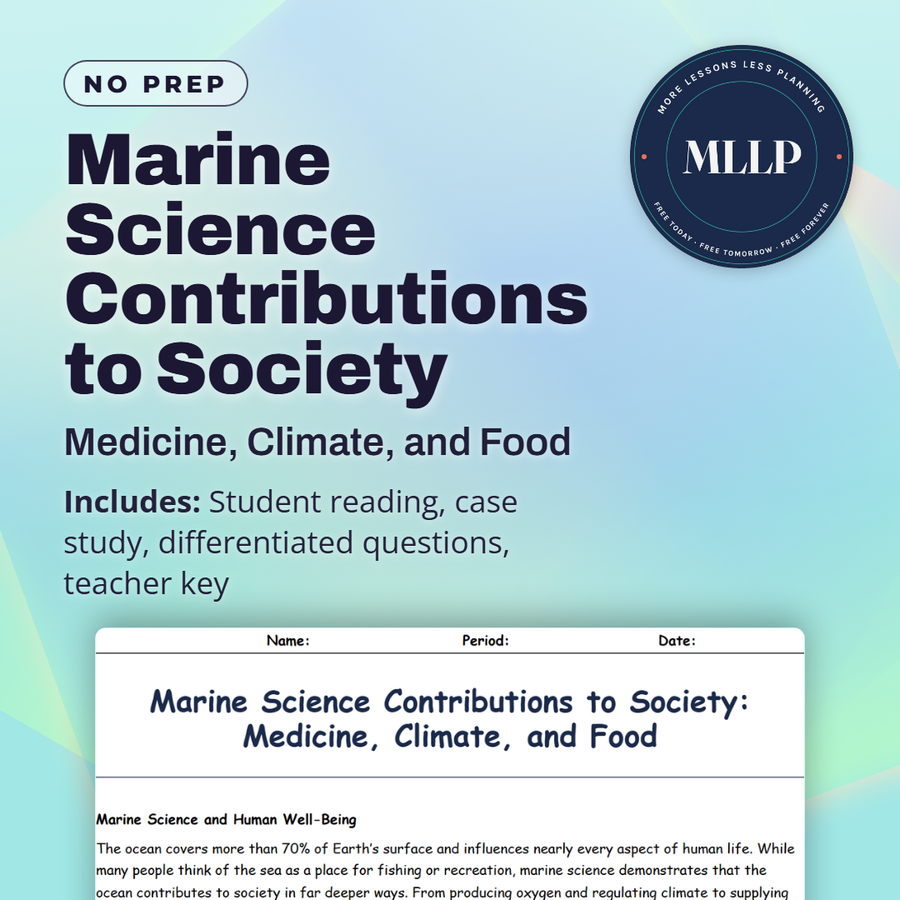
Marine Science Contributions to Society: Medicine, Climate, and Food
Quality reviewed September 2026
Facts verified September 14, 2026
- Subject
- Science
- Grades
- Grades 9-12
- Length
- 7-page student worksheet
- Time
- About one 50-minute class period
- Great for
- Sub plans and independent work
- Includes
- Reading passage, comprehension questions + full answer key
- Format
- Print-and-go PDF
What students do
- Match terms like Carbon Sink, Aquaculture, Phytoplankton, and Cone Snail to their correct definitions
- Fill in the blank sentences on carbon dioxide absorption, phytoplankton, and the drug AZT
- Answer multiple choice questions on which drug came from a Caribbean sponge, the ocean's role in climate, and why aquaculture matters for food security
- Write short answers on why conserving marine biodiversity matters for future medicine, how ocean currents stabilize climate, and one way marine science supports food security
What it covers
- How the ocean's carbon sink and phytoplankton support climate regulation and oxygen production
- Sustainable fisheries and aquaculture as sources of food security
- A case study on how a Caribbean sponge compound led to the development of AZT, an early HIV treatment
Start reading this worksheet
Marine Science and Human Well-Being
The ocean covers more than 70% of Earth’s surface and influences nearly every aspect of human life. While many people think of the sea as a place for fishing or recreation, marine science demonstrates that the ocean contributes to society in far deeper ways. From producing oxygen and regulating climate to supplying food and new medicines, the ocean’s value is immense. Scientists who study marine systems uncover knowledge that not only improves human health and security but also helps preserve ecosystems for future generations. Understanding these contributions allows us to appreciate why marine science is not just about discovery—it is about sustaining human civilization.
Medicine from the Sea
One of the most exciting contributions of marine science is the development of pharmaceuticals derived from marine organisms. Sponges, corals, mollusks, and even bacteria living in extreme environments produce unique bioactive compounds to defend themselves or communicate. These compounds can be adapted into medicines for humans. For example, chemicals from a Caribbean sea sponge led to the development of AZT, one of the first drugs used to treat HIV/AIDS. Compounds from cone snails have been used to create painkillers more powerful than morphine but without addictive side effects. Research on marine microbes near hydrothermal vents has also uncovered enzymes capable of functioning under extreme pressure and temperature. These enzymes are valuable in biotechnology and medical research, where traditional enzymes would fail. Marine organisms continue to inspire cancer treatments, antibiotics, and anti-inflammatory drugs. The search for new medicines highlights why conserving marine biodiversity is essential—species we have not yet discovered could hold cures to diseases that remain untreatable today.
Climate Regulation and the Ocean
Beyond medicine, the ocean is central to regulating Earth’s climate system. The sea absorbs about 25% of the carbon dioxide released by human activity, acting as a carbon sink. Microscopic phytoplankton, which drift near the surface, conduct photosynthesis and produce much of the world’s oxygen. Ocean currents transport heat across the globe, stabilizing weather patterns and preventing extreme temperature differences between the equator and poles. Marine science helps us understand critical processes like El Niño and La Niña, which shift weather worldwide. It also tracks the effects of climate change on the ocean, such as warming waters, acidification, and melting sea ice. Without this knowledge, society would be less prepared for rising sea levels, stronger storms, and changing fisheries. Marine scientists therefore play a vital role in both predicting future climate conditions and advising governments on how to respond.
Like what you read? The full reading, the case study, and every question set are in the free download below, along with the answer key.
Why this matters
One of the drugs used to treat HIV traces back to a compound found in a Caribbean sponge, a connection most people never make between the ocean and their own medicine cabinet. This reading follows that discovery alongside two other roles the ocean plays: absorbing roughly a quarter of human carbon dioxide, and feeding billions of people through fisheries and aquaculture.
I use this reading to push back on the idea that marine science only matters to people near a coast. A student who has never seen the ocean is still breathing air it helped regulate and likely eating food it helped produce, and tracing AZT back to a reef closes that distance fast.
From one teacher to another
The ocean touches human life far beyond the beach, through medicine, climate regulation, and food. Students read about how a sponge compound led to the HIV drug AZT, how the ocean absorbs a quarter of human carbon dioxide emissions, and how fisheries and aquaculture feed billions of people. The case study follows the discovery of that sponge compound from a Caribbean coral reef to a life-saving medication. Questions ask students to connect biodiversity, climate stability, and food security to marine science research.
What you get
Download
Where should I send the next one?
Everything here is free and it stays that way. Leave your email and I'll send you the new lessons as they go up. You can unsubscribe from any one of them.
Related resources
Ancient Ocean Explorers: Polynesians, Phoenicians, and Beyond
Branches of Marine Science: Biology, Chemistry, Geology, and Physical Oceanography
Careers in Marine Science and Oceanography
Famous Expeditions: HMS Challenger, Alvin, and Beyond
Modern Tools of Ocean Exploration: ROVs, AUVs, and Sonar
The Ocean’s Role in Earth’s Climate System
Every lesson on this site is free to download and use. If one of them saved you a prep period, you can chip in a few bucks toward my three kids' daycare fund. That's genuinely where tips go.