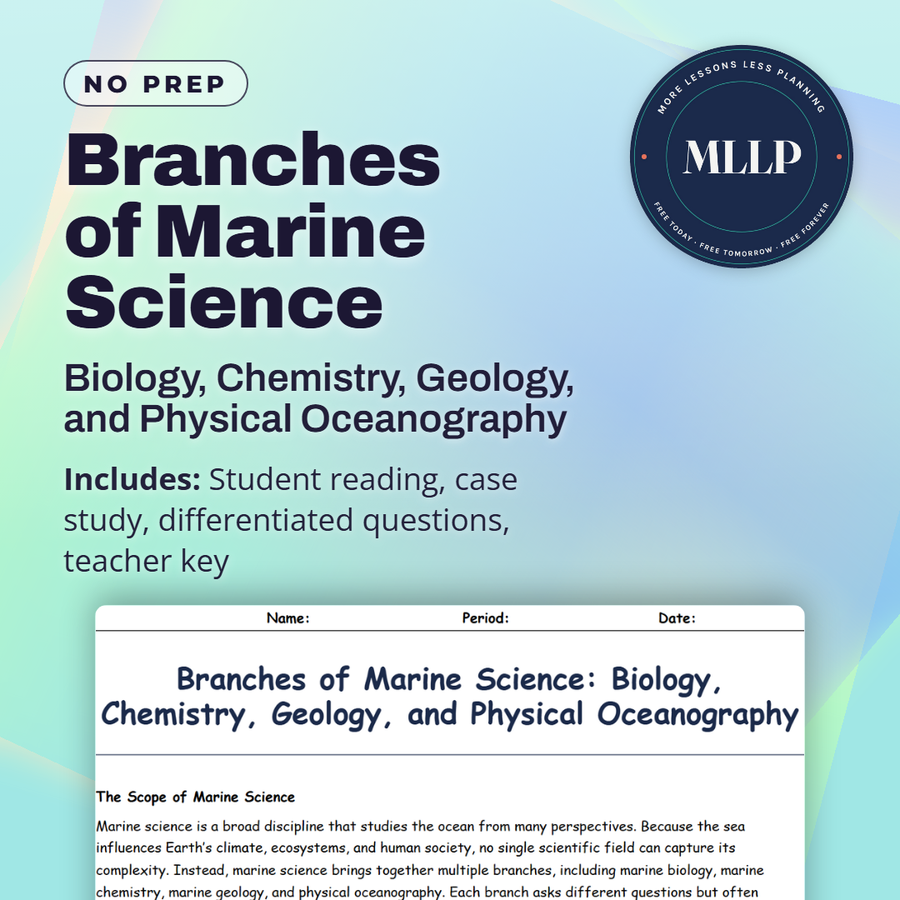
Branches of Marine Science: Biology, Chemistry, Geology, and Physical Oceanography
Quality reviewed September 2026
Facts verified September 14, 2026
- Subject
- Science
- Grades
- Grades 9-12
- Length
- 7-page student worksheet
- Time
- About one 50-minute class period
- Great for
- Sub plans and independent work
- Includes
- Reading passage, comprehension questions + full answer key
- Format
- Print-and-go PDF
What students do
- Match terms like Marine Biology, Marine Chemistry, Marine Geology, and Coral Bleaching to their correct definitions
- Fill in the blank sentences on physical oceanography, ocean acidification, and marine biology
- Answer multiple choice questions on which branch studies seawater chemistry, which branch reads sediment layers, and which branch studies tides and currents
- Write short answers on why sediment layers matter for climate history, how upwelling links biology and physical oceanography, and why coral reef research needs every branch of marine science
What it covers
- The four branches of marine science, from studying ocean organisms to mapping the seafloor and tracking currents
- How marine chemistry tracks ocean acidification and nutrient cycles in seawater
- A case study on the Great Barrier Reef, where all four branches worked together during the 2016 and 2017 bleaching events
Start reading this worksheet
The Scope of Marine Science
Marine science is a broad discipline that studies the ocean from many perspectives. Because the sea influences Earth’s climate, ecosystems, and human society, no single scientific field can capture its complexity. Instead, marine science brings together multiple branches, including marine biology, marine chemistry, marine geology, and physical oceanography. Each branch asks different questions but often overlaps with the others. Together, they create a complete picture of how the ocean works and why it matters. Understanding these branches is essential for appreciating both the diversity of ocean life and the physical forces that shape it. A marine biologist studying coral reefs may collaborate with a chemist tracking changes in water pH, while a geologist examines volcanic activity beneath the seafloor, and a physical oceanographer analyzes the currents that deliver nutrients to the reef. Marine science thrives on this interconnectedness, showing how life, chemistry, rocks, and water all form part of the same dynamic system.
Marine Biology: Life in the Ocean
Marine biology focuses on the study of organisms that live in the sea, from microscopic plankton to giant whales. Biologists classify species, study ecosystems, and analyze how organisms interact with their environment. Topics range from coral reef symbiosis to deep-sea adaptations that allow fish to survive at crushing depths. Marine biology also plays a central role in conservation, as scientists work to protect endangered species like sea turtles or manatees. A key focus of marine biology today is understanding how climate change affects ecosystems. Rising sea temperatures cause coral bleaching, while acidification threatens shell-building organisms. By studying these effects, marine biologists provide evidence for conservation policies and international agreements aimed at protecting biodiversity. Their work underscores that the health of marine life is directly tied to human well-being, as billions of people rely on ocean ecosystems for food, jobs, and medicine.
Marine Chemistry: The Ocean as a Laboratory
Marine chemistry examines the chemical properties of seawater and how they change over time. The ocean is not just salt water; it is a complex mixture of minerals, gases, and nutrients that sustain life. Chemists analyze salinity, oxygen, nitrogen, carbon dioxide, and trace elements. They also study how pollutants such as plastics, oil, and heavy metals affect marine systems. One of the most urgent areas of marine chemistry is ocean acidification. As the ocean absorbs carbon dioxide from the atmosphere, its pH decreases, harming organisms that build shells or skeletons. Chemists also study nutrient cycles, tracking how nitrogen and phosphorus move through ecosystems and influence productivity. Marine chemistry provides the foundation for understanding both natural cycles and human impacts, making it crucial for predicting future changes in ocean health.
Like what you read? The full reading, the case study, and every question set are in the free download below, along with the answer key.
Why this matters
Marine biology gets all the public attention, but it is only one quarter of what marine science actually studies. Chemists track seawater composition and ocean acidification, geologists read sediment layers on the seafloor, and physical oceanographers follow currents and tides, each one asking a different question about the same body of water.
That is exactly what the Great Barrier Reef case study shows: the 2016 and 2017 bleaching events needed sediment records, upwelling data, and reef biology examined together, not one branch at a time. I use it to prove that a real ocean problem rarely stays inside a single branch's boundaries.
From one teacher to another
Marine science splits into four connected branches, each asking different questions about the same ocean. Students read about how biologists study organisms, chemists track seawater composition, geologists read the seafloor, and physical oceanographers follow currents and tides. The case study on the Great Barrier Reef shows all four branches working on one problem, the 2016 and 2017 coral bleaching events. The questions ask students to connect sediment records, upwelling, and reef biology into one bigger picture.
What you get
Download
Where should I send the next one?
Everything here is free and it stays that way. Leave your email and I'll send you the new lessons as they go up. You can unsubscribe from any one of them.
Related resources
Ancient Ocean Explorers: Polynesians, Phoenicians, and Beyond
Careers in Marine Science and Oceanography
Famous Expeditions: HMS Challenger, Alvin, and Beyond
Marine Science Contributions to Society: Medicine, Climate, and Food
Modern Tools of Ocean Exploration: ROVs, AUVs, and Sonar
The Ocean’s Role in Earth’s Climate System
Every lesson on this site is free to download and use. If one of them saved you a prep period, you can chip in a few bucks toward my three kids' daycare fund. That's genuinely where tips go.