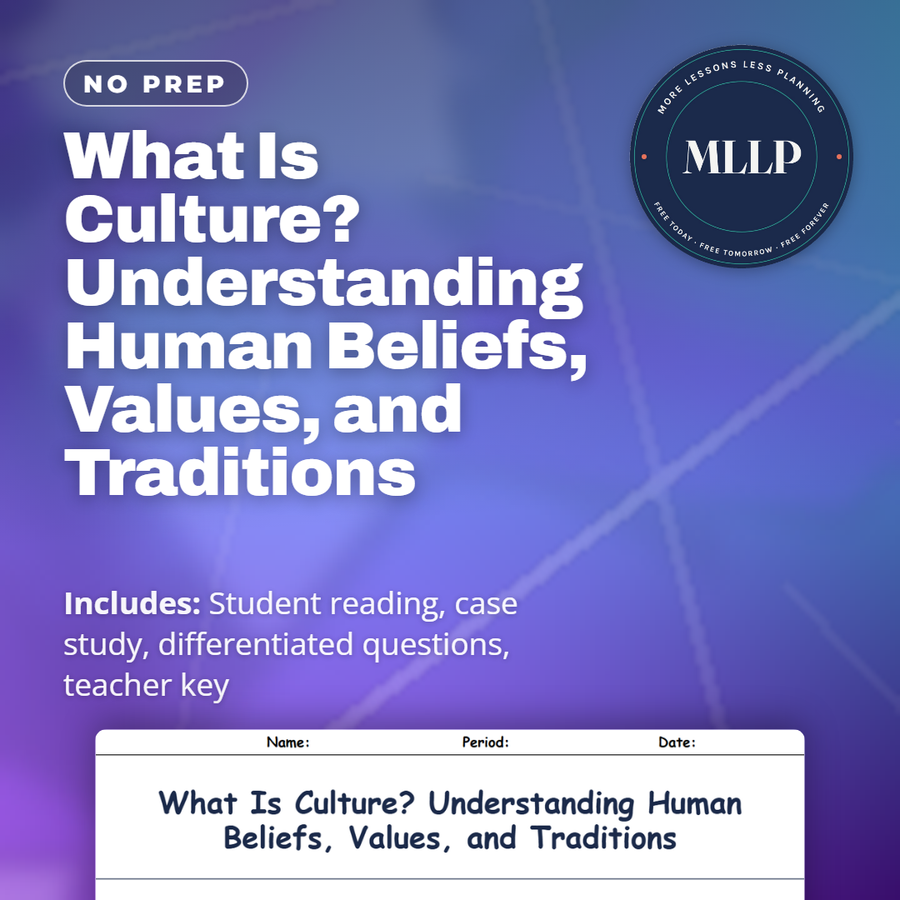
What Is Culture? Understanding Human Beliefs, Values, and Traditions
Quality reviewed September 2026
Facts verified September 14, 2026
- Subject
- Social Studies
- Grades
- Grades 9-12
- Length
- 9-page student worksheet
- Time
- About one 50-minute class period
- Great for
- Sub plans and independent work
- Includes
- Reading passage, comprehension questions + full answer key
- Format
- Print-and-go PDF
What students do
- Match terms like Norm, Taboo, and Adaptation to their correct definitions
- Fill in the blank sentences on norms, material culture, and taboos
- Answer multiple choice questions on what counts as material culture, what non-material culture includes, and how a taboo is defined
- Write short answers on why geographers study both material and non-material culture, how technology changes cultural norms, and how values guide decision-making
What it covers
- Culture as a shared system of values and beliefs, and how it shapes identity and social organization
- The difference between material culture, like tools and architecture, and non-material culture, like language and belief
- A case study on a mountain community's harvest festival, blending centuries-old traditions with music brought back by younger generations
Start reading this worksheet
The Shared System of Values and Beliefs
Culture can be thought of as a shared system of values, beliefs, and practices that ties groups of people together, shaping how they see the world and interact with one another. While individuals within a culture may express unique perspectives, certain core values and behaviors are widely accepted. These shared elements can include anything from how people greet each other to the type of government they support. In many cases, cultural norms develop over generations; they become so deeply ingrained that people follow them without consciously realizing it. Understanding culture means recognizing that the same gesture, custom, or phrase can hold very different meanings depending on one’s cultural background. For instance, a small hand gesture used in one country to signal approval might be misunderstood or even offensive in another. Because of such variations, learning about culture helps students avoid misunderstandings in our increasingly global society. In schools, for example, teachers create an environment that reflects cultural values about respect, punctuality, and academic achievement. These values do not arise out of thin air; they are passed down from the surrounding society. Over time, both informal interactions and formal rules teach students the expectations for behavior. As students grow, they may retain these values or challenge them, contributing to the continuous evolution of culture. Culture is never static. It responds to technology, migrations, trade, and political shifts, consistently adapting while still retaining a cultural core. Even everyday objects, such as clothing styles or smartphones, can highlight evolving social values, like the notion of individuality and convenience. The resulting weave of cultural practices gives each community its unique flavor and sense of identity while also contributing to a shared human heritage.
Material vs. Non-Material Culture
To better understand the complexity of culture, geographers often divide it into material and non-material components. Material culture consists of tangible, physical objects: buildings, tools, clothing, technology, and artwork (anything humans create or modify in the world around them). These items reflect the ingenuity and resources available to a specific group, and they can also symbolize deeper values. For example, monumental architecture like pyramids or cathedrals tells us not only about construction techniques but also about the cultural importance of religion or leadership in that society. On the other hand, non-material culture includes ideas, traditions, languages, social norms, taboos, and moral beliefs: elements that cannot be touched but have a profound influence on the way people behave. Language is a prime example: it helps transmit knowledge, values, and shared stories across generations. Another form of non-material culture is a sense of humor. Jokes that are funny in one cultural group may fall flat or be considered rude in another, revealing that humor is shaped by context and collective experiences. Religious beliefs, ethical standards, and artistic styles are also categorized as non-material culture, illustrating how people interpret the world around them and find meaning in their daily lives. Sometimes, material and non-material culture blend in fascinating ways. A national flag (material) often stands for a series of historical ideals (non-material), such as freedom or unity. A music genre like jazz can begin in a localized subculture and spread worldwide, mixing elements of material production (instruments, recordings) with intangible creative expression. Studying both types of culture side by side allows geographers and anthropologists to see how societies grow and change, and why certain customs persist while others die out.
How Culture Shapes Identity and Social Organization
Because culture informs group behaviors and traditions, it plays a major role in shaping individual identities and determining how societies are organized. Think of identity as a patchwork quilt, where each piece represents an influence from one’s background: family values, language, neighborhood, religious beliefs, nationality, and more. These pieces come together to form a single coherent sense of self. Culture is the thread that holds the quilt together, offering shared understandings and consistent rules that help people function in large, complex groups. In many societies, identity is closely tied to religious or ethnic traditions, which dictate major life events like weddings, holidays, and rites of passage. Social organization itself often reflects cultural values about hierarchy, gender roles, and communal responsibilities. In some cultures, a patriarchal model has historically placed men in leadership positions, while other cultures emphasize egalitarian structures or matriarchal lineages. These organizational patterns also show up in political systems. Monarchies, democracies, and even tribal councils reveal how groups respond to questions of power, authority, and decision-making. Over time, as societies encounter new ideas, these frameworks can shift. For instance, once a single religion might have dominated a region, but changing values can lead to acceptance of diverse faiths and secular viewpoints. Technology can also speed up cultural adaptation by introducing different lifestyles and beliefs from across the globe through digital platforms. As people adopt elements from other cultures, new forms of cultural identity emerge, highlighting the fluid nature of social organization.
Like what you read? The full reading, the case study, and every question set are in the free download below, along with the answer key.
Why this matters
A festival that has run for centuries can still change from one generation to the next without losing what makes it matter. A mountain community's harvest festival makes that case, with younger residents bringing back new music while keeping traditions their grandparents would still recognize.
I use this reading to split culture into material pieces students can point to, tools, buildings, and non-material pieces they have to infer, values, language, norms, taboos. Sorting the festival's music and rituals into those two buckets is what makes the vocabulary stick for the rest of the unit instead of staying a list to memorize.
From one teacher to another
This one gives students a working definition of culture, then breaks it into material and non-material pieces so they can sort examples for themselves. I like that the harvest festival case study shows tradition and change happening at the same time, with young people bringing new music into an old ritual without losing its meaning. It works well as an opening reading for a culture unit, since it sets up vocabulary students will use all the way through the unit.
What you get
Download
Where should I send the next one?
Everything here is free and it stays that way. Leave your email and I'll send you the new lessons as they go up. You can unsubscribe from any one of them.
Related resources
Cultural Diffusion and Exchange: How Ideas Spread Around the World
Cultural Landscapes: How Humans Shape and Reflect Culture on Land
Culture and Identity: How Geography Shapes Who We Are
Ethnicity and Race: Identity, Diversity, and Social Geography
Exploring the Elements of Culture: Language, Religion, and Customs
Folk Culture vs. Popular Culture: Local Traditions and Global Trends
Every lesson on this site is free to download and use. If one of them saved you a prep period, you can chip in a few bucks toward my three kids' daycare fund. That's genuinely where tips go.