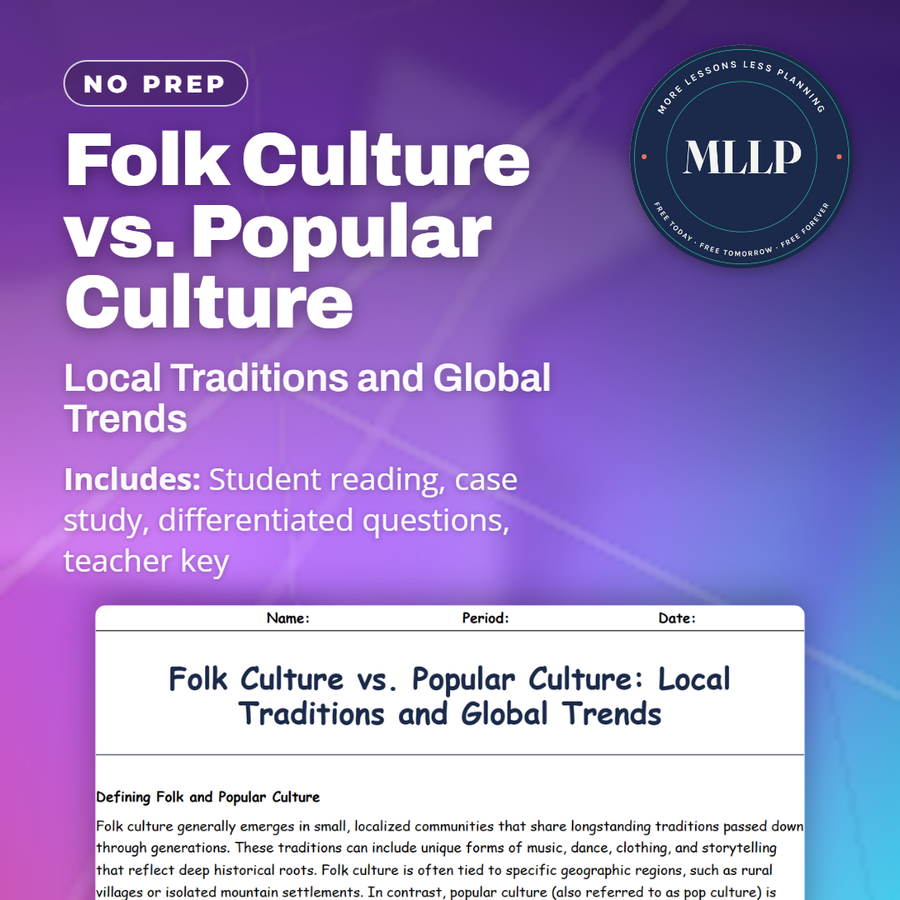
Folk Culture vs. Popular Culture: Local Traditions and Global Trends
Quality reviewed September 2026
Facts verified September 14, 2026
- Subject
- Social Studies
- Grades
- Grades 9-12
- Length
- 7-page student worksheet
- Time
- About one 50-minute class period
- Great for
- Sub plans and independent work
- Includes
- Reading passage, comprehension questions + full answer key
- Format
- Print-and-go PDF
What students do
- Match terms like Folk Culture, Popular Culture, and Adaptation to their correct definitions
- Fill in the blank sentences on folk culture, globalization, and mass-produced goods
- Answer multiple choice questions on what defines folk culture, how popular culture spreads, and how folk culture stays relevant today
- Write short answers on how digital platforms help artisans market folk traditions, how popular culture can benefit local communities, and why folk cultures are worth protecting
What it covers
- The differences between folk culture and popular culture, including origin, distribution, and how each changes over time
- Examples like folk music versus mass-produced pop music, and handmade crafts versus fast fashion
- A case study on a village's traditional weaving technique that nearly disappeared before reviving through online exposure
Start reading this worksheet
Defining Folk and Popular Culture
Folk culture generally emerges in small, localized communities that share longstanding traditions passed down through generations. These traditions can include unique forms of music, dance, clothing, and storytelling that reflect deep historical roots. Folk culture is often tied to specific geographic regions, such as rural villages or isolated mountain settlements. In contrast, popular culture (also referred to as pop culture) is widespread, mass-produced, and heavily influenced by mass media and consumer trends. This type of culture transcends geographic boundaries; think of global pop music hits or blockbuster movies that millions around the world watch.
Origins, Distribution, and Preservation
Folk culture typically has anonymous origins, evolving slowly and organically over time. Preservation of folk culture often depends on localized memory and oral traditions, which can be lost if younger generations migrate or adopt popular culture elements. In contrast, popular culture often has identifiable creators and arises from urban centers or influential media hubs. It spreads rapidly through television, radio, the internet, and international marketing, leading to global familiarity in a short span. The distribution of folk culture is usually limited by physical barriers or social factors (such as the lack of mass media access). Consequently, folk songs, dances, or crafts might remain unique to a region, rarely known outside it. Popular culture, however, can appear simultaneously in distant parts of the world. Fast-food chains, for example, have become near-ubiquitous in many countries. While these chains offer convenience and familiarity, they also signal a shift away from traditional local culinary practices.
Examples and Cultural Impact
A classic example of folk culture is folk music, characterized by acoustic instruments and storytelling lyrics that capture the daily lives and struggles of a community. Contrastingly, global pop music often involves large-scale production, electronic beats, and marketing campaigns. While folk tunes may remain within a local community, pop songs can dominate charts in multiple countries at once. This represents the broader tension: folk traditions can be overshadowed by the sheer reach and economic power of popular culture. A similar dynamic is observed in craftwork versus mass production. Handmade goods reflect the local environment, resources, and cultural identity, often requiring specialized skills developed over generations. In pop culture, trends lean toward fast fashion and factory-produced items. Both forms of culture have value: folk culture preserves heritage, while pop culture fosters a sense of global connectivity. The question is how to find balance, ensuring that local diversity survives even as the world becomes increasingly interconnected.
Like what you read? The full reading, the case study, and every question set are in the free download below, along with the answer key.
Why this matters
A weaving technique nearly disappeared before artisans revived it by selling online. That is not the story students expect from folk culture, since most picture something frozen in the past rather than a craft that can adapt and find new customers.
The twist most students miss is that folk culture adapts. Digital platforms let artisans market their traditions directly, turning an old technique into new income instead of losing out to mass-produced goods.
From one teacher to another
This one sets up a clean comparison between folk culture and popular culture, then lets students see the tension play out in a case study about a weaving tradition that almost died out. I like that the story does not end with folk culture simply losing to mass media. It shows artisans adapting and finding a new market instead. This is a good fit for a unit on globalization or cultural diffusion, since it builds directly on those ideas.
What you get
Download
Where should I send the next one?
Everything here is free and it stays that way. Leave your email and I'll send you the new lessons as they go up. You can unsubscribe from any one of them.
Related resources
Cultural Diffusion and Exchange: How Ideas Spread Around the World
Cultural Landscapes: How Humans Shape and Reflect Culture on Land
Culture and Identity: How Geography Shapes Who We Are
Ethnicity and Race: Identity, Diversity, and Social Geography
Exploring the Elements of Culture: Language, Religion, and Customs
Indigenous Cultures and Globalization: Change, Resilience, and Survival
Every lesson on this site is free to download and use. If one of them saved you a prep period, you can chip in a few bucks toward my three kids' daycare fund. That's genuinely where tips go.