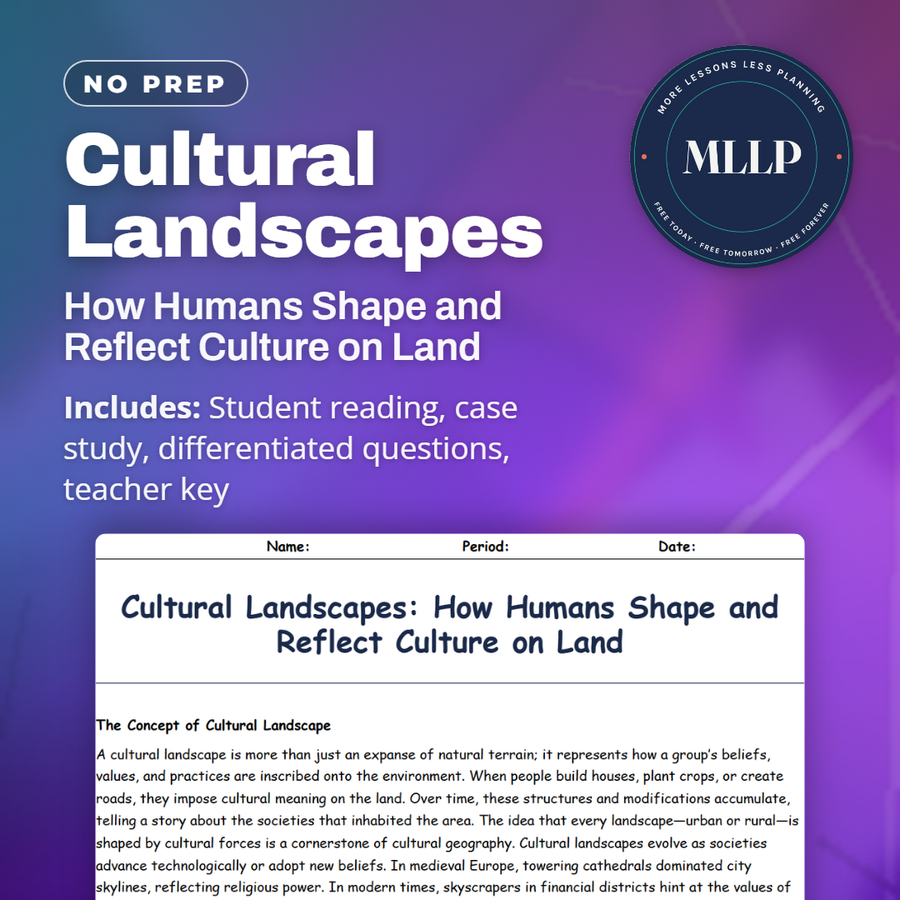
Cultural Landscapes: How Humans Shape and Reflect Culture on Land
Quality reviewed September 2026
Facts verified September 14, 2026
- Subject
- Social Studies
- Grades
- Grades 9-12
- Length
- 8-page student worksheet
- Time
- About one 50-minute class period
- Great for
- Sub plans and independent work
- Includes
- Reading passage, comprehension questions + full answer key
- Format
- Print-and-go PDF
What students do
- Match terms like Cultural Landscape, Monuments, and Environmental Adaptation to their correct definitions
- Fill in the blank sentences on cultural landscape, adaptation to steep terrain, and architectural heritage
- Answer multiple choice questions on what a cultural landscape is, the purpose of monuments, and how agricultural practices reflect local knowledge
- Write short answers on how tourism reshapes architecture, why cultural values matter in urban design, and how climate change affects coastal landscapes
What it covers
- How architecture, land use, and monuments reflect a society's values, from cathedrals and government buildings to terraced fields
- Human-environment interaction, including irrigation, seawalls, and other adaptations to local conditions
- A case study on a lakeside fishing town transformed by tourism, and the tradeoffs between economic growth and cultural preservation
Start reading this worksheet
The Concept of Cultural Landscape
A cultural landscape is more than just an expanse of natural terrain; it represents how a group’s beliefs, values, and practices are inscribed onto the environment. When people build houses, plant crops, or create roads, they impose cultural meaning on the land. Over time, these structures and modifications accumulate, telling a story about the societies that inhabited the area. The idea that every landscape, urban or rural, is shaped by cultural forces is a cornerstone of cultural geography. Cultural landscapes evolve as societies advance technologically or adopt new beliefs. In medieval Europe, towering cathedrals dominated city skylines, reflecting religious power. In modern times, skyscrapers in financial districts hint at the values of commerce and economic growth. Observing a landscape can thus offer clues into a community’s history, identity, and priorities.
Architecture, Land Use, and Monuments
Architecture embodies cultural values in physical form. Traditional homes might be built from local materials adapted to the climate, such as adobe dwellings in hot, dry regions or stilt houses in flood-prone areas. Sacred structures (like temples, churches, mosques) often occupy prominent spots, reflecting a society’s religious devotion. Government buildings can highlight political power, with grand facades that invoke authority and permanence. Land use patterns are similarly revealing. Agricultural landscapes might show terraced fields in mountainous regions, or large-scale industrial farming in flat plains. Urban zoning divides space for housing, commerce, and recreation, each choice reflecting cultural and economic priorities. Monuments (statues, memorials, historical markers) also imprint cultural identity onto a place. They commemorate heroes, events, or ideologies that the community values. The presence (or absence) of monuments tied to certain groups can reflect broader social attitudes and historical narratives.
Human-Environment Interaction
Cultural landscapes also underscore the interaction between humans and the environment. Where water is scarce, societies develop irrigation systems or water-conservation methods, reshaping natural waterways. Coastal communities might erect seawalls or build houses on stilts to adapt to tidal surges. These adaptations often become woven into local culture, from architectural styles to the festivals celebrating a successful harvest season. Meanwhile, environmental factors like climate change force communities to adjust old patterns. Agriculture might shift, and historic buildings might be retrofitted for new conditions. Studying these changes reveals humanity’s capacity for both resilience and mismanagement. Overdevelopment or poorly planned tourism can damage natural habitats and disrupt local cultural practices.
Like what you read? The full reading, the case study, and every question set are in the free download below, along with the answer key.
Why this matters
A seawall and a cathedral do the same basic job: they show what a community values enough to build permanently. This reading covers both sides of that, from irrigation and terraced fields that show adaptation to steep terrain, to monuments that carry symbolic weight long after their builders are gone.
The case study on a lakeside fishing town remade by tourism gets the most reaction, because students have to weigh economic growth against what a community loses when its landscape gets built for visitors instead of residents. That tradeoff does not resolve neatly, which is why it holds their attention.
From one teacher to another
This one walks students through how everyday landscapes, from city skylines to farm terraces, carry cultural meaning. I like that it covers monuments and religious sites alongside practical things like irrigation and seawalls, so students see both the symbolic and survival sides of human-environment interaction. The case study on the lakeside town hit by a tourism boom gives a concrete example of that tension between growth and tradition. It works well alongside a unit on urban geography or land use.
What you get
Download
Where should I send the next one?
Everything here is free and it stays that way. Leave your email and I'll send you the new lessons as they go up. You can unsubscribe from any one of them.
Related resources
Cultural Diffusion and Exchange: How Ideas Spread Around the World
Culture and Identity: How Geography Shapes Who We Are
Ethnicity and Race: Identity, Diversity, and Social Geography
Exploring the Elements of Culture: Language, Religion, and Customs
Folk Culture vs. Popular Culture: Local Traditions and Global Trends
Indigenous Cultures and Globalization: Change, Resilience, and Survival
Every lesson on this site is free to download and use. If one of them saved you a prep period, you can chip in a few bucks toward my three kids' daycare fund. That's genuinely where tips go.