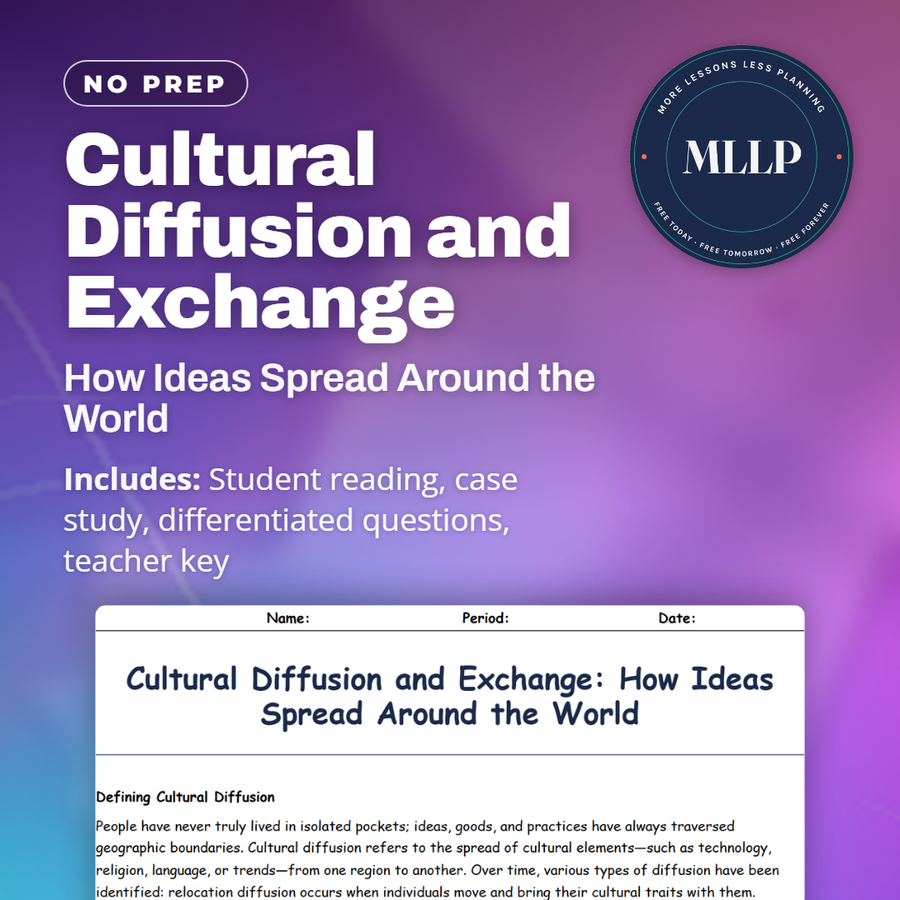
Cultural Diffusion and Exchange: How Ideas Spread Around the World
Quality reviewed September 2026
Facts verified September 14, 2026
- Subject
- Social Studies
- Grades
- Grades 9-12
- Length
- 8-page student worksheet
- Time
- About one 50-minute class period
- Great for
- Sub plans and independent work
- Includes
- Reading passage, comprehension questions + full answer key
- Format
- Print-and-go PDF
What students do
- Match terms like Cultural Appropriation, Syncretism, and Contagious Diffusion to their correct definitions
- Fill in the blank sentences on hierarchical diffusion, syncretism, and cultural homogenization
- Answer multiple choice questions on relocation diffusion, hierarchical diffusion, and stimulus diffusion
- Write short answers on how fast food chains affect local traditions, how technology speeds up cultural exchange, and why some communities resist outside influence
What it covers
- Types of cultural diffusion, including relocation, contagious, hierarchical, and stimulus diffusion, with real-world examples
- Historical and modern cases of diffusion, from the Silk Road to fast food chains and global pop music
- A case study tracing how a folk tune spread and changed as it traveled across regions and cultures
Start reading this worksheet
Defining Cultural Diffusion
People have never truly lived in isolated pockets; ideas, goods, and practices have always traversed geographic boundaries. Cultural diffusion refers to the spread of cultural elements (such as technology, religion, language, or trends) from one region to another. Over time, various types of diffusion have been identified: relocation diffusion occurs when individuals move and bring their cultural traits with them. Contagious diffusion follows a pattern where an idea or practice rapidly spreads through a population, much like a virus, often facilitated by close contact or mass media. Finally, hierarchical diffusion moves from places or people of power or influence to other areas. A fashion trend, for example, may emerge in a global city, then trickle down to smaller towns.
Historical and Modern Examples
Throughout history, cultural diffusion shaped civilizations. The Silk Road connected China, Central Asia, and Europe, enabling the exchange of goods like silk and spices but also the transfer of ideas like Buddhism, Islam, and advanced mathematics. Similarly, the spread of fast food franchises is a modern form of diffusion, as global chains introduce uniform menus worldwide. Another contemporary example is the rapid spread of pop music across continents through the internet, television, and social media. Religions also demonstrate how ideas travel far from their points of origin: Christianity, Islam, Buddhism, and others began in specific regions but spread across the world through trade routes, conquests, and missionaries. This global exchange can be positive, fostering empathy and collaboration. Yet it can also lead to cultural homogenization, where local traditions risk being overshadowed by dominant global influences.
Impacts of Cultural Exchange and Globalization
Cultural diffusion can spark creativity and innovation by merging ideas from different sources. Syncretism, the blending of two or more cultural elements into a new form, can be seen in music genres that combine traditional melodies with modern rhythms, or culinary fusions where local recipes incorporate new spices and techniques. Globalization accelerates this process, as technology allows information to spread almost instantaneously. A teenager in Brazil can learn a dance move from a Korean pop music video within minutes of its release. Similarly, fashion trends that once took years to travel can now become global hits in weeks. However, not all impacts are positive. Critics argue that the overwhelming influence of certain cultures (often linked to powerful economies) can erode indigenous customs, languages, and lifestyles. Local artisans might struggle to compete with mass-produced goods marketed by international brands. There is also the concern of cultural appropriation, where elements of a minority culture are adopted by a dominant culture without proper understanding or respect. Balancing the benefits of cultural exchange with the need to preserve diversity is a pressing issue in an interconnected world.
Like what you read? The full reading, the case study, and every question set are in the free download below, along with the answer key.
Why this matters
Most students assume culture spreads the same way everywhere, but this reading splits that into four mechanisms: relocation, contagious, hierarchical, and stimulus diffusion. A folk tune that changes shape as it travels from region to region makes the idea concrete.
I assign this before a globalization unit because it gives students a vocabulary for something they already notice, like a trend that reached them through a different path than it reached a friend overseas. Naming the mechanism turns a vague sense of change into something they can trace.
From one teacher to another
This one gives students a clear framework for understanding how ideas move around the world, from the four types of diffusion to real examples like the Silk Road and global pop music. I like that the case study follows a single folk tune as it changes shape across regions, which makes an abstract concept feel concrete. It pairs well with a unit on globalization or world history, since it ties directly into migration and trade routes.
What you get
Download
Where should I send the next one?
Everything here is free and it stays that way. Leave your email and I'll send you the new lessons as they go up. You can unsubscribe from any one of them.
Related resources
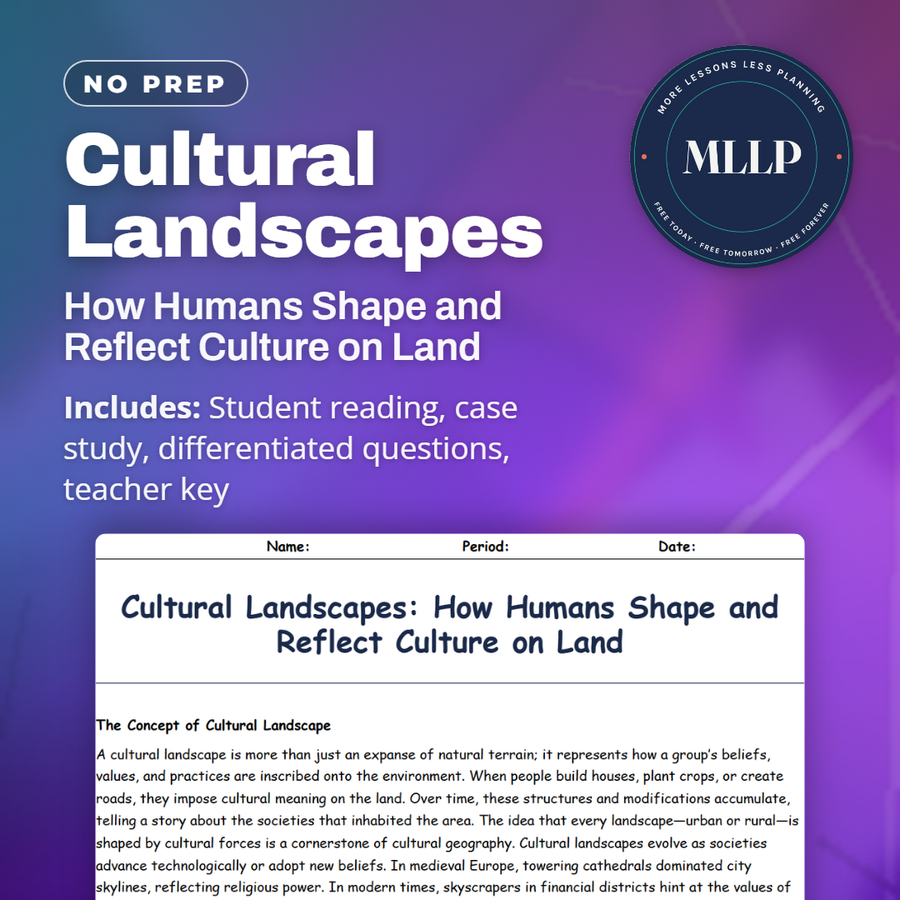
Cultural Landscapes: How Humans Shape and Reflect Culture on Land
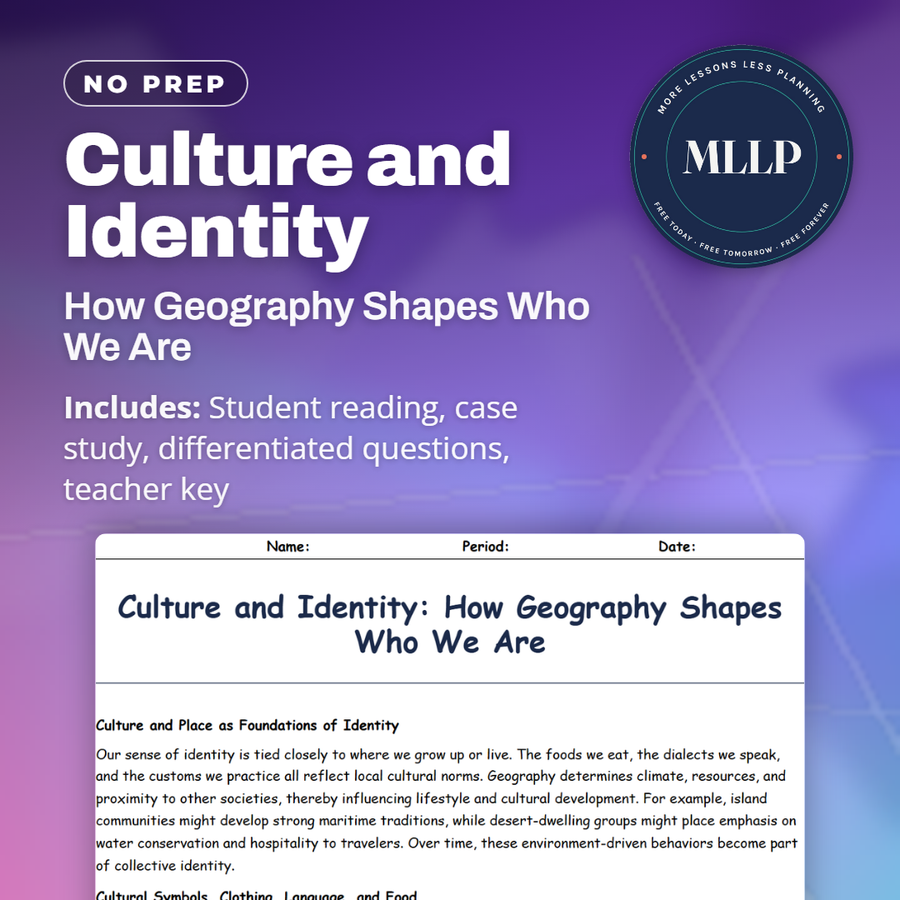
Culture and Identity: How Geography Shapes Who We Are
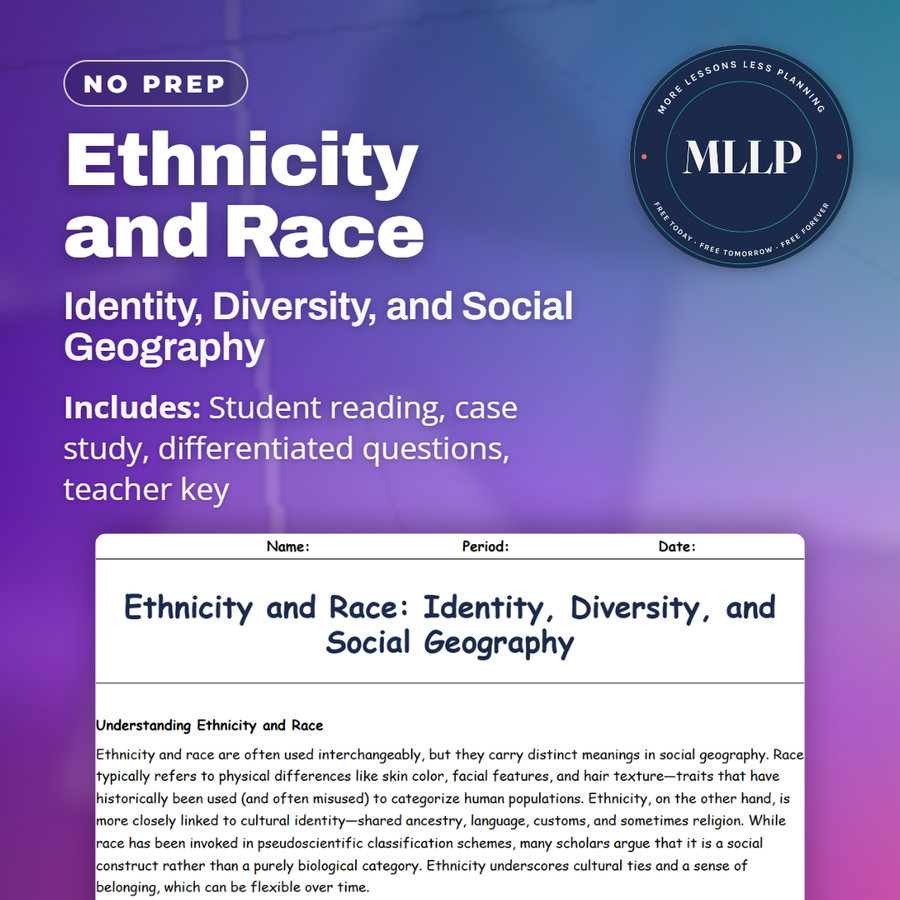
Ethnicity and Race: Identity, Diversity, and Social Geography
Exploring the Elements of Culture: Language, Religion, and Customs
Folk Culture vs. Popular Culture: Local Traditions and Global Trends
Indigenous Cultures and Globalization: Change, Resilience, and Survival
Every lesson on this site is free to download and use. If one of them saved you a prep period, you can chip in a few bucks toward my three kids' daycare fund. That's genuinely where tips go.