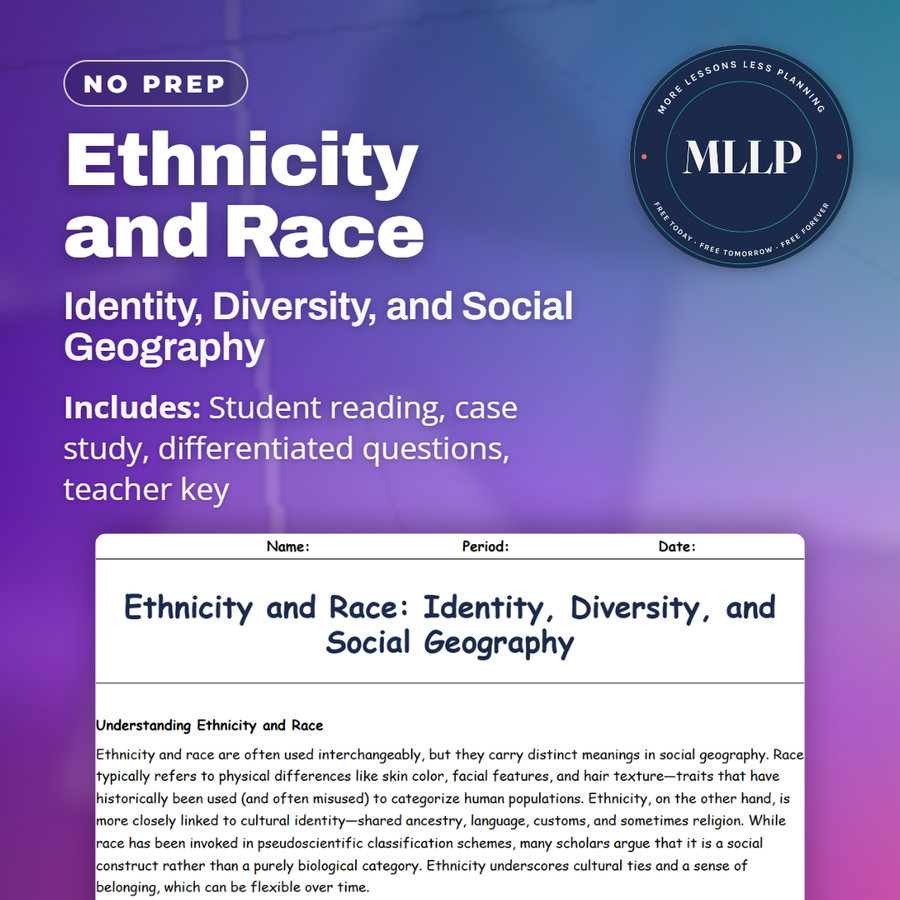
Ethnicity and Race: Identity, Diversity, and Social Geography
Quality reviewed September 2026
Facts verified September 14, 2026
- Subject
- Social Studies
- Grades
- Grades 9-12
- Length
- 8-page student worksheet
- Time
- About one 50-minute class period
- Great for
- Sub plans and independent work
- Includes
- Reading passage, comprehension questions + full answer key
- Format
- Print-and-go PDF
What students do
- Match terms like Ethnicity, Race, and Segregation to their correct definitions
- Fill in the blank sentences on ethnic enclaves, segregation, and multiculturalism
- Answer multiple choice questions on how race differs from ethnicity, why ethnic enclaves form, and what multiculturalism means
- Write short answers on why ethnic enclaves can both support and limit newcomers, how social geography explains educational disparities, and what reduces discrimination in schools
What it covers
- The distinction between race and ethnicity, and how social categorization shapes opportunity and social structure
- Ethnic enclaves and migration patterns, including how neighborhoods like Little Havana form and evolve
- A case study comparing two high schools shaped by decades of housing policy and unequal school funding
Start reading this worksheet
Understanding Ethnicity and Race
Ethnicity and race are often used interchangeably, but they carry distinct meanings in social geography. Race typically refers to physical differences like skin color, facial features, and hair texture: traits that have historically been used (and often misused) to categorize human populations. Ethnicity, on the other hand, is more closely linked to cultural identity: shared ancestry, language, customs, and sometimes religion. While race has been invoked in pseudoscientific classification schemes, many scholars argue that it is a social construct rather than a purely biological category. Ethnicity underscores cultural ties and a sense of belonging, which can be flexible over time.
Social Categorization and Its Effects
Societies often categorize individuals based on race or ethnicity, which can shape social structures, opportunities, and even laws. For instance, some countries historically implemented legal systems that segregated or discriminated against certain racial or ethnic groups. Understanding how these categories are formed and maintained is crucial to understanding broader social geography: the spatial patterns of how people live, interact, and have access to resources. Areas known as ethnic enclaves (like Chinatown districts or Little Italy neighborhoods) often develop in urban settings, providing community support, cultural familiarity, and economic opportunities for new immigrants. However, racial or ethnic categorization can also contribute to segregation, where marginalized groups are confined to under-resourced neighborhoods. This can create cycles of poverty and social unrest. Recognizing that these patterns are shaped by policies, cultural perceptions, and economic disparities helps us appreciate the complexity of managing diverse societies.
Multicultural Societies and Challenges
In a world characterized by significant migration, many nations are becoming increasingly multicultural, home to people from varied ethnic and racial backgrounds. Ideally, such diversity offers a rich mix of cuisines, languages, and traditions. However, multiculturalism also brings challenges like discrimination, misunderstanding, and conflict. The concept of inclusion refers to efforts to ensure all groups have equal access to opportunities and respect. In schools, inclusive policies might involve multicultural curricula or language support programs to help non-native speakers. In businesses, it can mean diverse hiring practices or creating spaces that are comfortable for employees of various backgrounds. Unfortunately, discrimination, whether overt or subtle, still exists, and it can manifest through stereotypes, hate crimes, or institutional biases. Many societies struggle to strike a balance between honoring cultural identity and promoting national unity. Efforts to encourage dialogue, protect minority rights, and celebrate shared values can foster social cohesion in diverse populations.
Like what you read? The full reading, the case study, and every question set are in the free download below, along with the answer key.
Why this matters
Little Havana did not happen by accident, and this reading uses it to show how ethnic enclaves form and what they do for the people living there. Before that example it lays out the difference between race and ethnicity in plain terms, categories that shape opportunity long after they are assigned.
The two-schools case study earns its place in my classroom because it connects segregation and unequal funding directly to geography instead of leaving them as abstract terms. Students leave with vocabulary they keep running into later, and a sense of why a neighborhood's map can predict a school's resources.
From one teacher to another
This one lays out the difference between race and ethnicity in plain terms, then shows how those categories play out in real neighborhoods and schools. I like that it does not shy away from segregation and unequal funding, using the two-schools case study to make the connection between geography and opportunity concrete. It is a solid fit for a unit on social geography or urban demographics, and it gives students vocabulary they will keep running into elsewhere.
What you get
Download
Where should I send the next one?
Everything here is free and it stays that way. Leave your email and I'll send you the new lessons as they go up. You can unsubscribe from any one of them.
Related resources
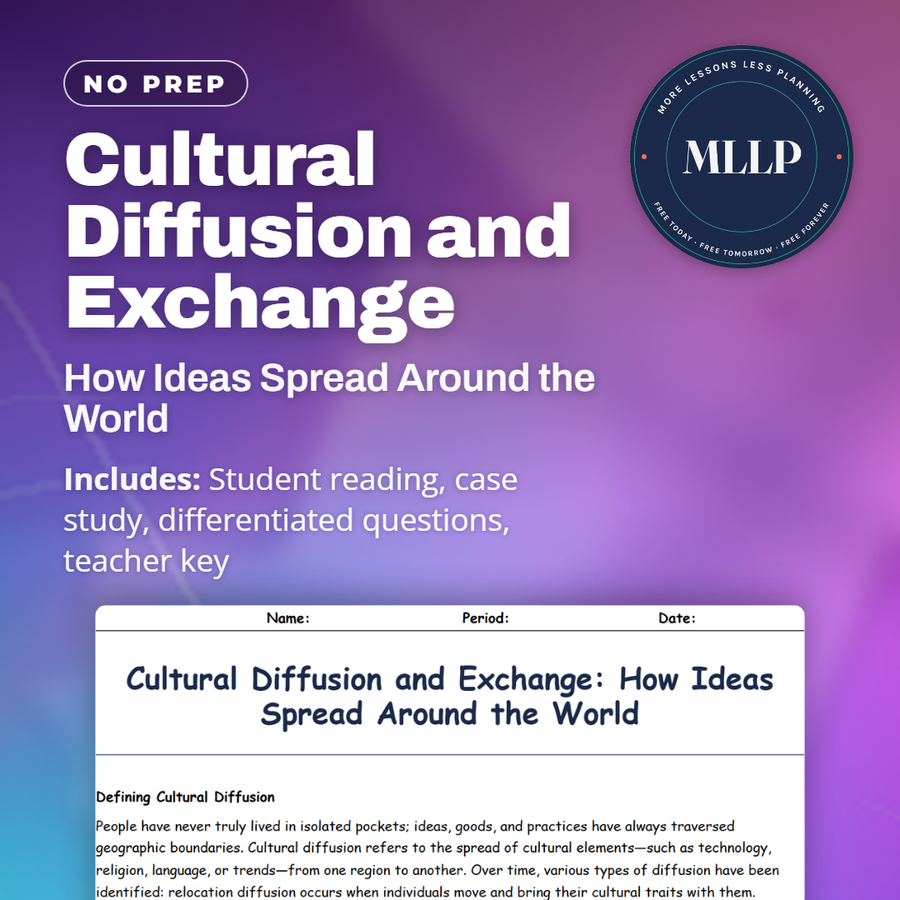
Cultural Diffusion and Exchange: How Ideas Spread Around the World
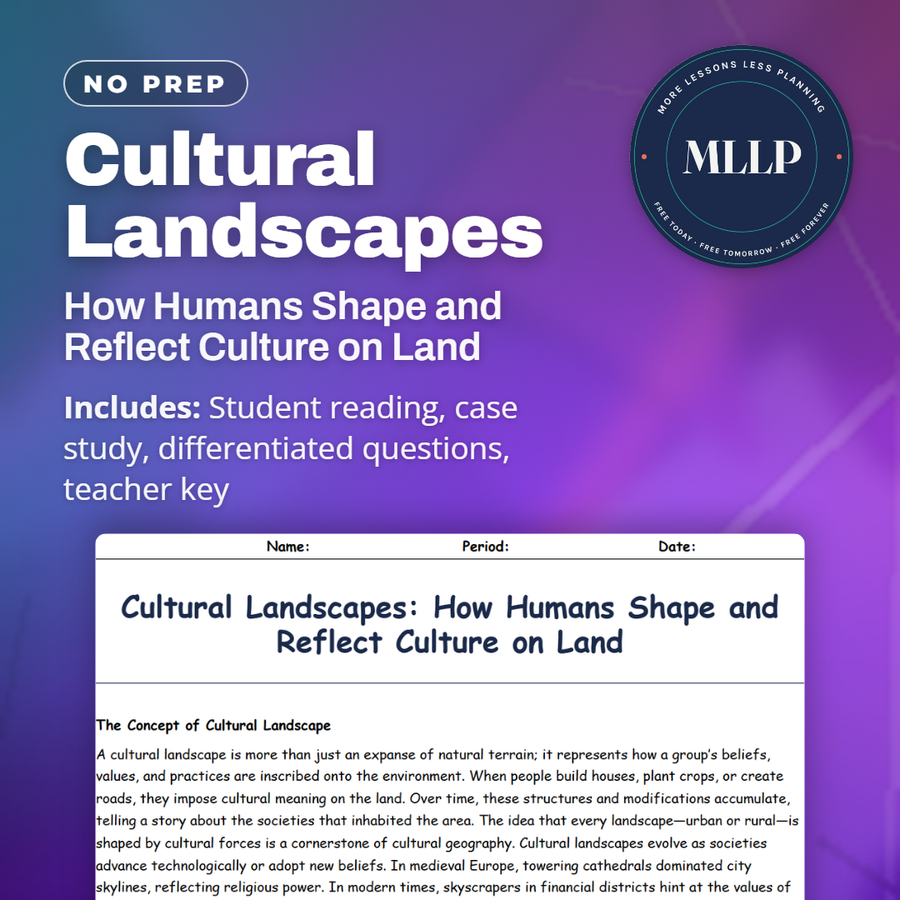
Cultural Landscapes: How Humans Shape and Reflect Culture on Land
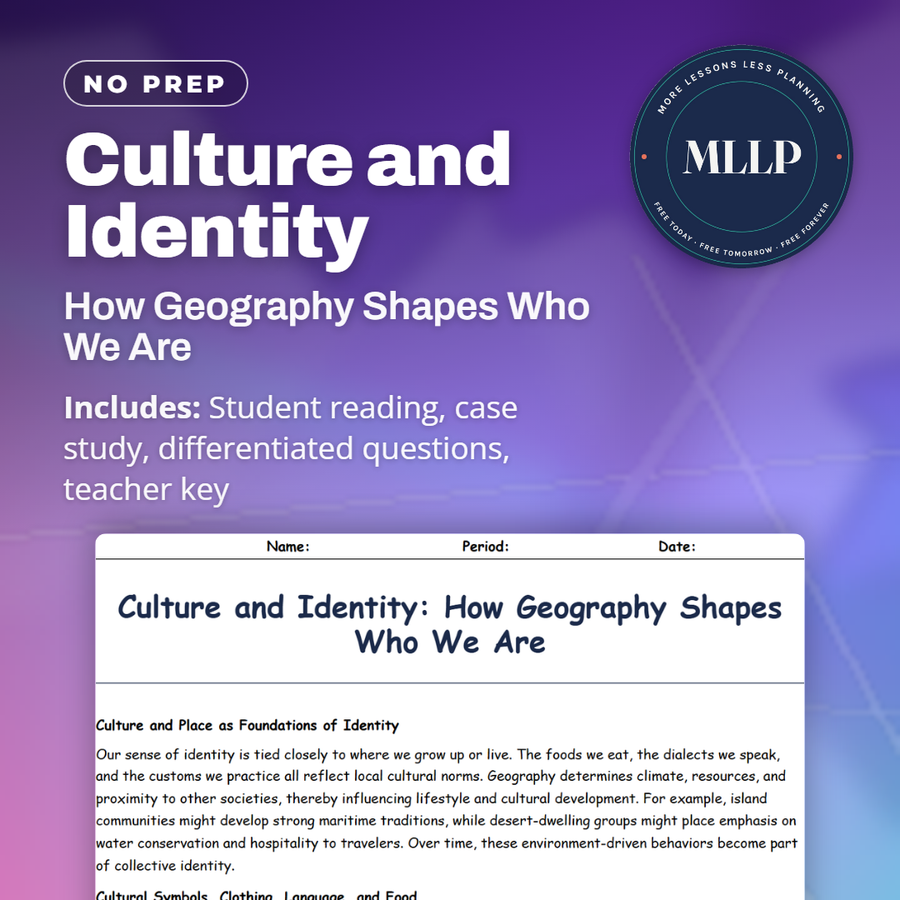
Culture and Identity: How Geography Shapes Who We Are
Exploring the Elements of Culture: Language, Religion, and Customs
Folk Culture vs. Popular Culture: Local Traditions and Global Trends
Indigenous Cultures and Globalization: Change, Resilience, and Survival
Every lesson on this site is free to download and use. If one of them saved you a prep period, you can chip in a few bucks toward my three kids' daycare fund. That's genuinely where tips go.