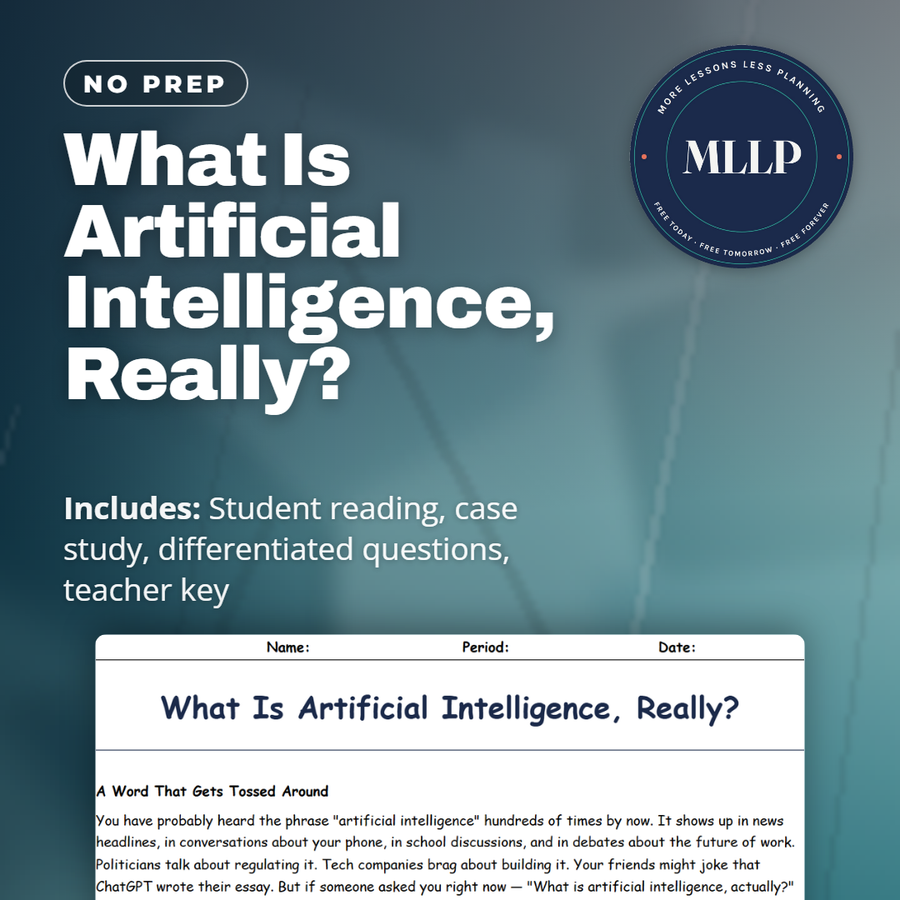
What Is Artificial Intelligence, Really?
Quality reviewed September 2026
Facts verified September 20, 2026
- Subject
- Career & Life Skills
- Grades
- Grades 9-12
- Length
- 9-page student worksheet
- Time
- About one 50-minute class period
- Great for
- Sub plans and independent work
- Includes
- Reading passage, comprehension questions + full answer key
- Format
- Print-and-go PDF
What students do
- Sort the three types of AI, rule-based systems, machine learning, and deep learning, from oldest to newest
- Marcus's uncritical AI summary supplies two case study questions on why he missed his own textbook's errors
- Fill in three blanks naming judgment, narrow, and wrong as the reading's key terms
- AI gets separated from automation and from Hollywood robots through a multiple-choice section on what makes AI genuinely different
What it covers
- The real definition of artificial intelligence and how it differs from both automation and Hollywood robots
- Rule-based systems, machine learning, and deep learning as three distinct types of AI
- A case study on a student who trusted an AI summary and got caught not knowing his own material
Start reading this worksheet
A Word That Gets Tossed Around
You have probably heard the phrase "artificial intelligence" hundreds of times by now. It shows up in news headlines, in conversations about your phone, in school discussions, and in debates about the future of work. Politicians talk about regulating it. Tech companies brag about building it. Your friends might joke that ChatGPT wrote their essay. But if someone asked you right now, "What is artificial intelligence, actually?", could you answer with real confidence? Most people cannot, and that includes most adults. The term gets stretched and squeezed to mean almost anything, which makes it nearly impossible to have an honest conversation about it. That confusion is where this course begins. Artificial intelligence is not magic. It is not a robot with feelings. It is not a digital brain that thinks the way you think. And despite what the movies suggest, it is not plotting to take over the world. What it actually is turns out to be both simpler and more interesting than most people expect, and understanding the real definition gives you a serious advantage in every conversation about AI from this point forward.
The Real Definition, and Why It Matters
At its core, artificial intelligence refers to software (that is, computer programs) that can perform tasks that would normally require human judgment or learning. Notice that phrase: "normally require human judgment." That is the key. For most of computing history, programs could only do exactly what a programmer explicitly told them to do, step by step. If a programmer forgot to include a rule, the program failed. AI changes that. AI programs can learn from examples, recognize patterns, and make decisions even in situations they have never seen before. A more technical way to put it: AI is a field of computer science focused on building systems that can perceive their environment, process information, and take actions to achieve a goal. That definition comes from decades of academic research stretching back to the 1950s. But the practical meaning is simpler: AI is software that gets better at a task the more data it processes, rather than requiring a human to manually update every rule. Why does the definition matter? Because if you think AI is just "smart computers," you will misunderstand what it can and cannot do. AI systems are incredibly powerful within narrow tasks: recognizing a face, translating a sentence, predicting what video you want to watch next. But they have no understanding, no common sense, and no awareness. Knowing that distinction will help you use AI better and avoid being fooled by it.
Not All AI Is the Same
Here is something most people do not realize: there is no single thing called "AI." The phrase covers a huge family of different techniques, each suited to different problems. Some AI systems use rules explicitly programmed by humans, called rule-based systems or expert systems, where engineers write out thousands of "if-then" instructions. If the patient's temperature is above 103 degrees and they have a rash, flag for review. These systems can be effective, but they break down when reality does not match the programmer's assumptions. Other AI systems, the kind you interact with most today, use machine learning, which means the system is trained on massive amounts of data rather than hand-coded rules. A spam filter trained on millions of emails learns to recognize patterns in suspicious messages without anyone explicitly writing the rule "watch out for the phrase 'click here to claim your prize.'" A medical imaging AI trained on a million X-rays learns to spot signs of pneumonia that human radiologists might miss when they are tired. The learning happens through a process of trial and error at enormous scale, which we will dig into in a later unit. Then there is deep learning, a subfield of machine learning that uses structures loosely inspired by the human brain (called neural networks) to tackle incredibly complex tasks like understanding language, generating images, and translating speech in real time. The large language models behind ChatGPT, Claude, and Gemini are all deep learning systems. The differences between these types matter when you are evaluating what a particular AI tool can and cannot do.
Like what you read? The full reading, the case study, and every question set are in the free download below, along with the answer key.
Why this matters
This is the first reading in the AI literacy unit, so it sets the definition every later worksheet builds on, and Marcus's story gives students an immediate, personal reason to care about getting that definition right. A student who cannot say what AI actually is will either trust it blindly or dismiss it reflexively, and both reactions cause real problems, from submitting work with invented facts to missing genuinely useful tools. Marcus's two factual errors, a wrong date and wrong names that sounded completely plausible, are exactly the kind of mistake this whole unit is designed to help students catch before they turn in the assignment.
From one teacher to another
Most people, including most adults, cannot give a clear definition of artificial intelligence even though they use the word constantly, and this opening worksheet in the unit is built to fix that. Students read the real definition, software that learns from data to perform tasks that would normally require human judgment, and see how it differs from both traditional rule-based programs and the science-fiction robots that shape most people's assumptions. A case study follows Marcus, a junior who lets an AI summarize a history chapter for him, sounds confident in class, and later finds two factual errors, a wrong date and wrong names, when he finally checks the summary against his own textbook. By the end, students can separate the actual definition of AI from automation, from Hollywood, and from marketing hype.
What you get
Download
Where should I send the next one?
Everything here is free and it stays that way. Leave your email and I'll send you the new lessons as they go up. You can unsubscribe from any one of them.
Related resources
A Short History of AI: From Turing to ChatGPT
AI Hype vs. AI Reality: Cutting Through the Noise
How AI Got Smart So Fast: The 2022-2026 Boom
Meet the Big AI Tools: ChatGPT, Gemini, Claude, Copilot
Narrow AI vs. General AI: What Today's Tools Can and Can't Do
The Difference Between AI, Machine Learning, and Algorithms
Every lesson on this site is free to download and use. If one of them saved you a prep period, you can chip in a few bucks toward my three kids' daycare fund. That's genuinely where tips go.