What Is a Loan? Principal, Interest & Terms
Quality reviewed September 2026
- Grades
- Grades 9-12
- Time
- About two 50-minute class periods
- Includes
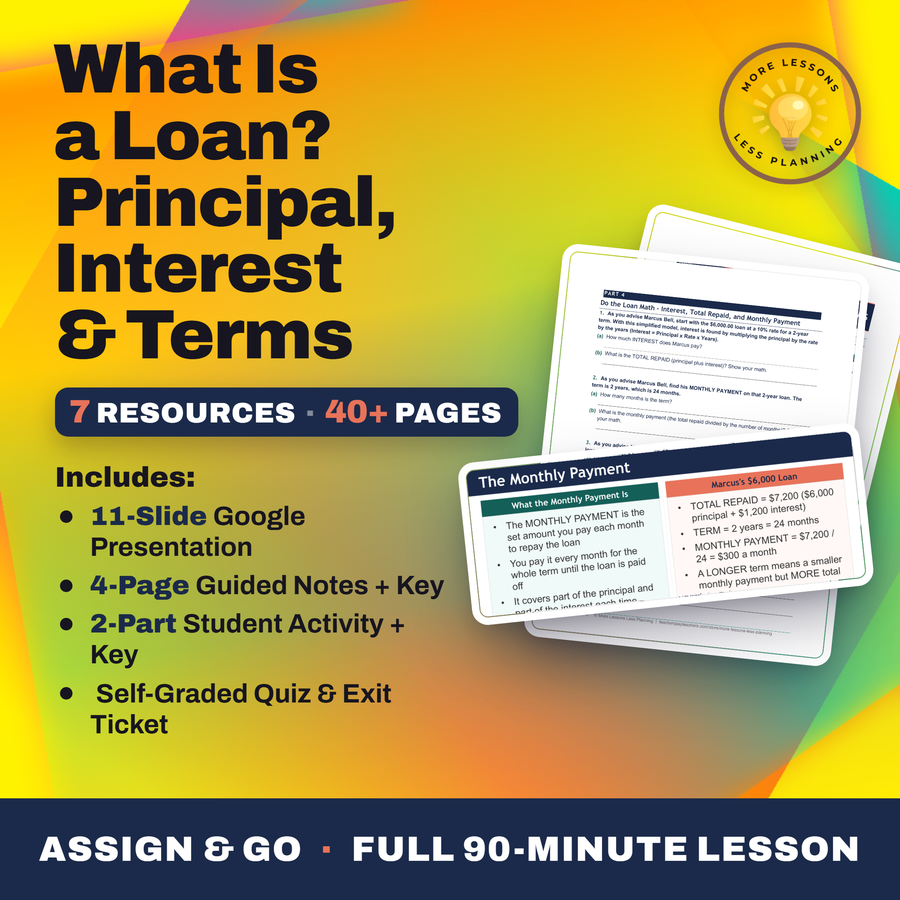
- 11 ready-to-teach files
- Format
- Word (.docx) · PowerPoint (.pptx)
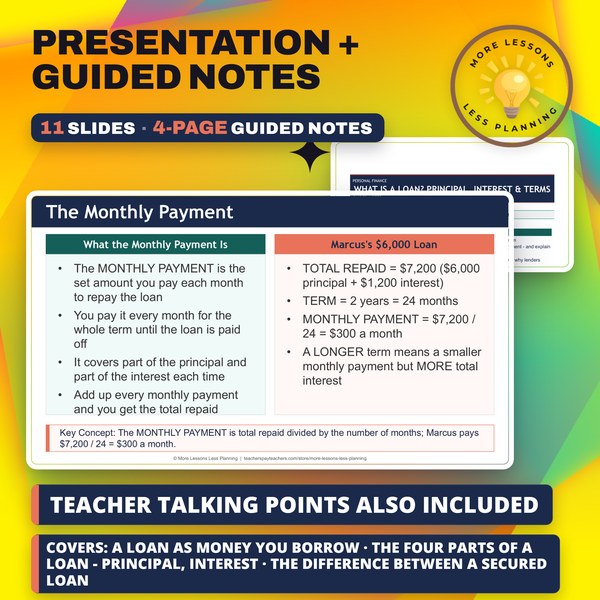
- Slide deck
- Guided notes
- Guided notes teacher key
- Activity + answer key
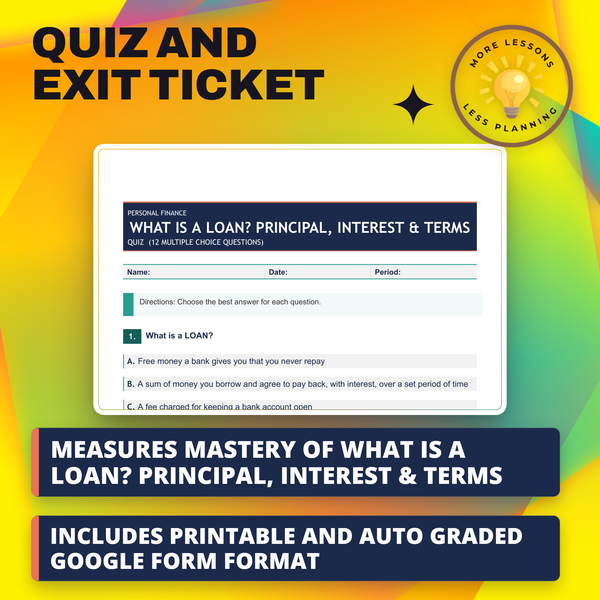
- Quiz + answer key
- Exit ticket + answer key
- Teacher guide
- Teacher presentation notes
What students do
- Read a bar chart comparing a $6,000 amount borrowed to the $7,200 total repaid and explain the gap
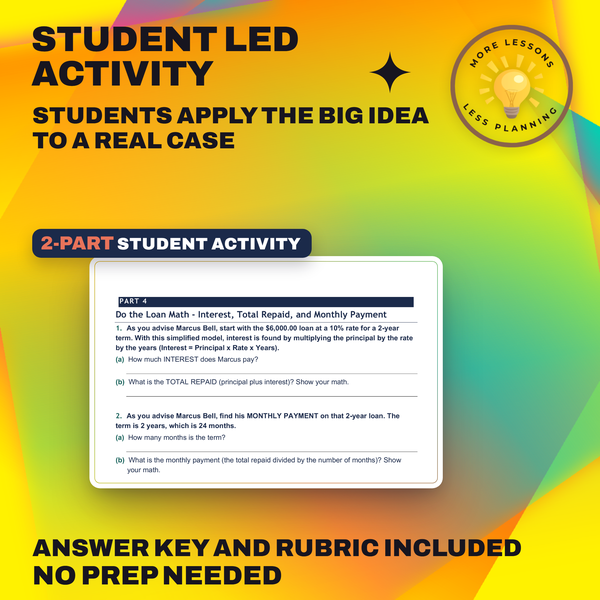
- Calculate interest, total repaid, and monthly payment for a $6,000 loan at three different terms
- Identify Marcus Bell's car loan as secured, explaining what collateral the lender could take if he stopped paying
- Write a recommendation comparing two real loan offers, naming the term trade-off between monthly payment and total interest
What it covers
- Principal, interest, term, and monthly payment, using Marcus Bell's real car-loan numbers
- The term trade-off between a lower monthly payment and a higher total interest cost
- Why a secured loan, backed by collateral like Marcus's car, usually charges less than an unsecured loan
- Comparing two real competing loan offers to make and defend an actual recommendation
Learning targets
- Define a loan as money you borrow and repay, with interest, over a set term
- Identify the four parts of a loan - principal, interest, term, and monthly payment - and explain what each one is
- Explain the difference between a secured loan and an unsecured loan and why lenders charge interest
- Explain that a borrower repays the principal plus interest, so the total repaid is more than the amount borrowed, and that the term affects both the monthly payment and the total interest
Peek inside
A Loan Is Borrowing You Pay Back
A LOAN is a sum of money you borrow and agree to pay back, with interest, over a set period of .
A loan lets you get a car, pay for school, or buy a home now and repay the lender in pieces over time instead of all at .
There Is Always a Lender
The LENDER is the bank, credit union, or company that provides the loan money and is repaid the principal plus .
Marcus Bell needs a $6,000 used to get to his new job; a loan would let him drive it now and repay the lender over the next two years.
Why this matters
Borrow $6,000 and a lender can walk away with $7,200 once it is paid off, a difference most students never expect until Marcus Bell's real car loan spells it out in front of them. Every loan carries that hidden second number, and this lesson makes students calculate it instead of accepting a monthly payment at face value.
The trade-off I push hardest is the one buyers get wrong most: a longer term drops the monthly payment but raises the total interest, so a smaller number on paper stops looking like the better deal once students run it themselves. By the time they compare two competing offers, they're defending a recommendation with math, not a gut feeling about which payment looks easier.
From one teacher to another
I built this around one number students have to sit with before anything else clicks: a $6,000 loan can actually cost $7,200 to pay off, and that gap is the whole lesson. Working through Marcus Bell's real car-loan numbers, students calculate the interest themselves using principal times rate times years, then divide the total repaid by the number of months to find his own monthly payment. The part I push hardest is the term trade-off, because it's the single most useful idea in the unit: they stretch the same $6,000 loan across three different terms and calculate, on their own, how far the monthly payment drops and how much the total interest climbs, so a smaller monthly number stops looking automatically like the better deal. They also work out why Marcus's loan counts as secured, naming the car itself as the collateral the lender could take, and connect that directly to why an unsecured loan like a credit card usually charges more. The closing task hands them two real competing loan offers and asks for an actual recommendation, not a summary, so they have to pick a side and defend it with their own calculated numbers.
Every file in this toolkit
-
Activity (Student)
Marcus Bell borrows $6,000 for a used car, and a bar chart puts that amount against the $7,200 he actually repays, then students stretch the same loan from a 2-year to a 4-year term to see what moves up and what moves down.
-
Activity (Answer Key)
Two years on a $6,000 car loan costs Marcus $7,200 total, $1,200 in interest on top of a $300 monthly bill, and stretching that same loan to four years drops the payment to $175 while pushing total interest up to $2,400.
-
Exit Ticket (Student)
Defining a loan in one line starts the quiz, then one of its four working parts gets named before asking why a borrower always pays back more than what was handed over. Principal, interest, and term drive a brief written response.
-
Exit Ticket (Answer Key)
Naming Marcus's principal, interest, and term correctly earns full credit across four rubric points, with a sample response tying the $1,200 gap directly to the cost of borrowing his $6,000.
-
Guided Notes (Student)
Marcus Bell needs a $6,000 used car, and seven sections define principal, interest, term, and monthly payment before landing on why his loan counts as secured with the car as collateral.
-
Guided Notes (Teacher Key)
$300 is Marcus's monthly payment on the 24-month loan, which also shows the $1,200 gap in total interest between his two loan offers and why an unsecured rate runs higher.
-
Quiz (Student)
A $6,000 car loan tests the four parts of a loan, what Marcus's $1,200 interest gap represents, why unsecured loans like credit cards usually cost more, and what stretching a term does.
-
Quiz (Answer Key)
Principal as the original amount borrowed and the $1,200 gap as interest are marked correct, confirming that a longer term lowers Marcus's payment while raising his total cost.
-
Slides
$6,000 for a used car is what Marcus needs, and these slides show what that costs him: $1,200 in interest for $7,200 repaid over a 2-year term, broken into a $300 monthly payment, then the split between a secured loan backed by his car and an unsecured one.
-
Teacher Guide
A $6,000 used-car loan for Marcus Bell repays $7,200, a $1,200 interest cost this 53-point guide's core model explains. Extensions find a real financing offer's four parts, compare his same loan across three different terms, and sort loan types as secured or unsecured.
-
Teacher Presentation Notes
Borrowing $6,000 for a car and repaying $7,200 leaves Marcus a $1,200 gap that introduces principal, interest, and term before working out his $300-a-month payment over 24 months on a real loan agreement.
Download
Where should I send the next one?
Everything here is free and it stays that way. Leave your email and I'll send you the new lessons as they go up. You can unsubscribe from any one of them.
Related resources
Cosigning and Co-Borrowing - Sharing the Risk
Interest Explained - Simple vs Compound
Loan Default - What Happens When You Can't Pay
Payday Loans - The 400 Percent APR Trap
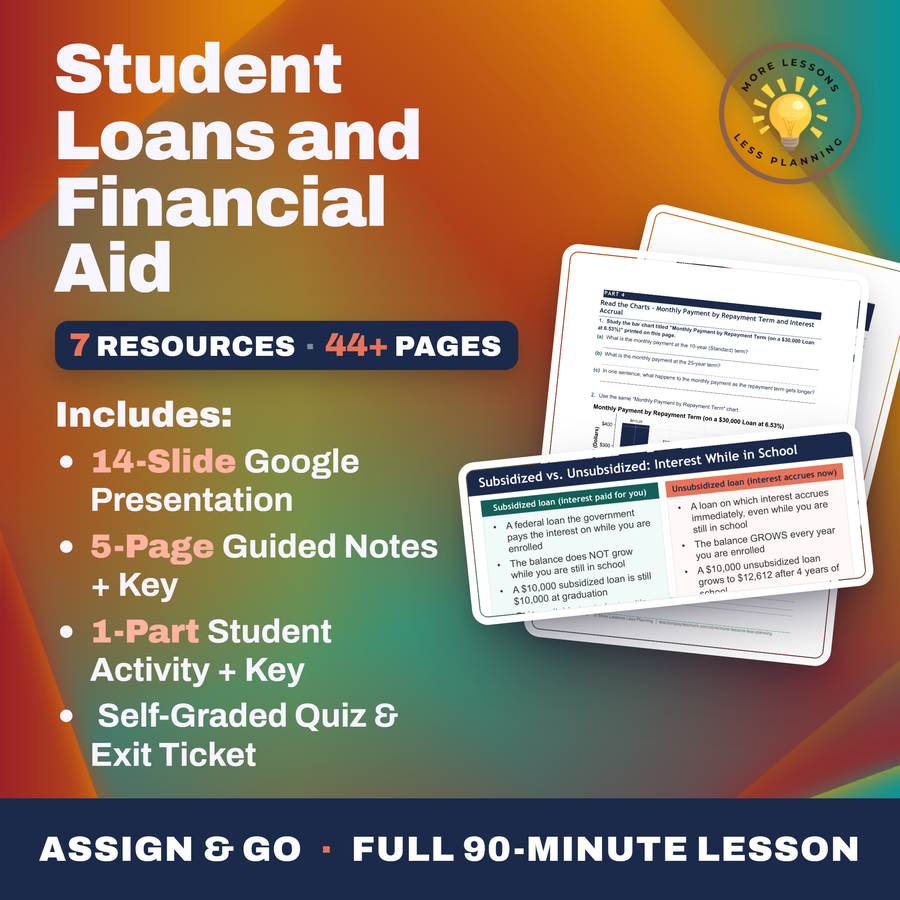
Student Loans and Financial Aid
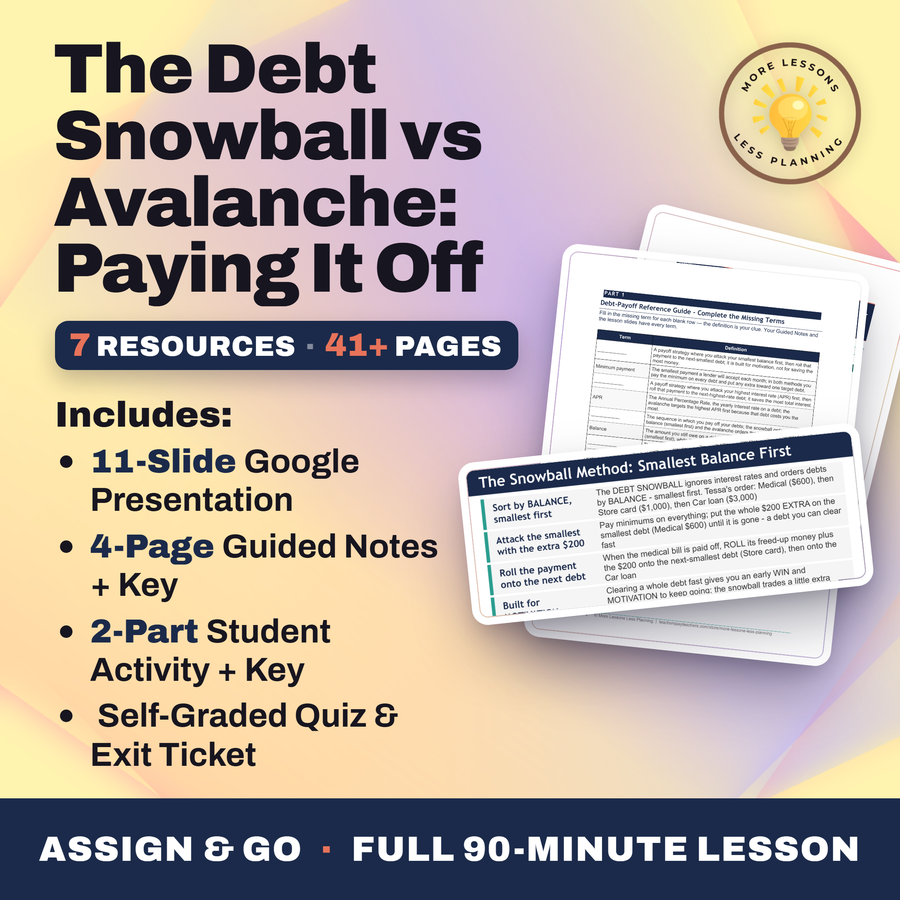
The Debt Snowball vs Avalanche - Paying It Off
Every lesson on this site is free to download and use. If one of them saved you a prep period, you can chip in a few bucks toward my three kids' daycare fund. That's genuinely where tips go.