Payday Loans - The 400 Percent APR Trap
Quality reviewed September 2026
- Grades
- Grades 9-12
- Time
- About two 50-minute class periods
- Includes
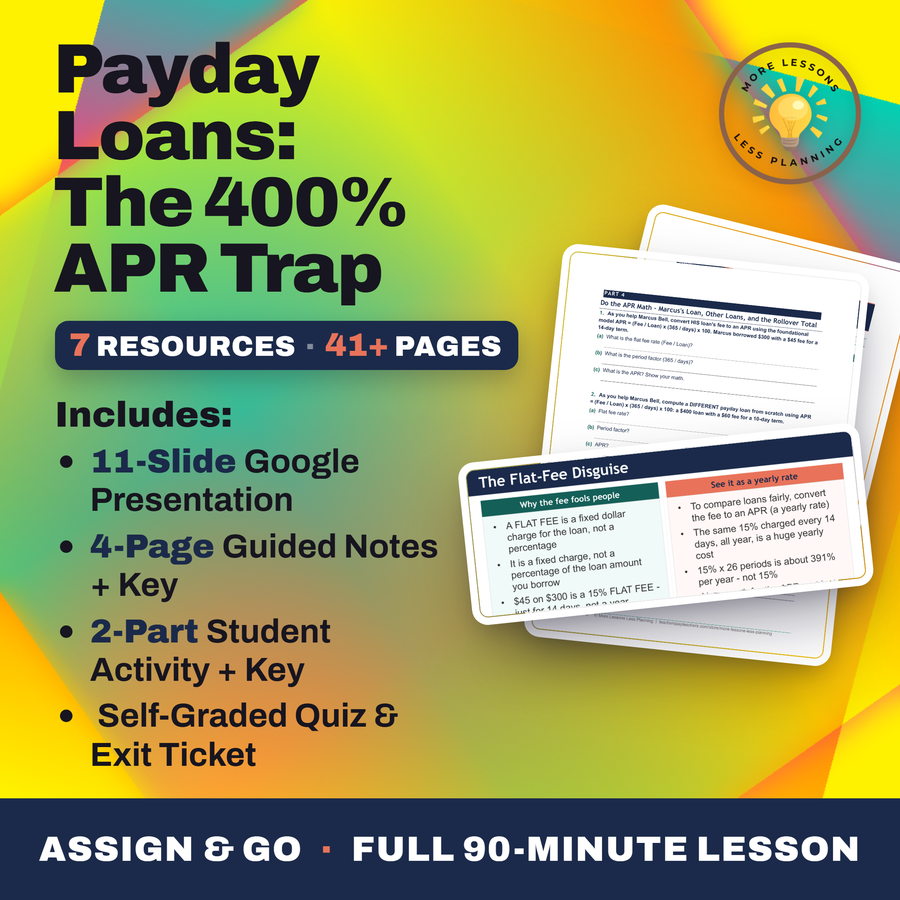
- 11 ready-to-teach files
- Format
- Word (.docx) · PowerPoint (.pptx)
- Slide deck
- Guided notes
- Guided notes teacher key
- Activity + answer key
- Quiz + answer key
- Exit ticket + answer key
- Teacher guide
- Teacher presentation notes
What students do
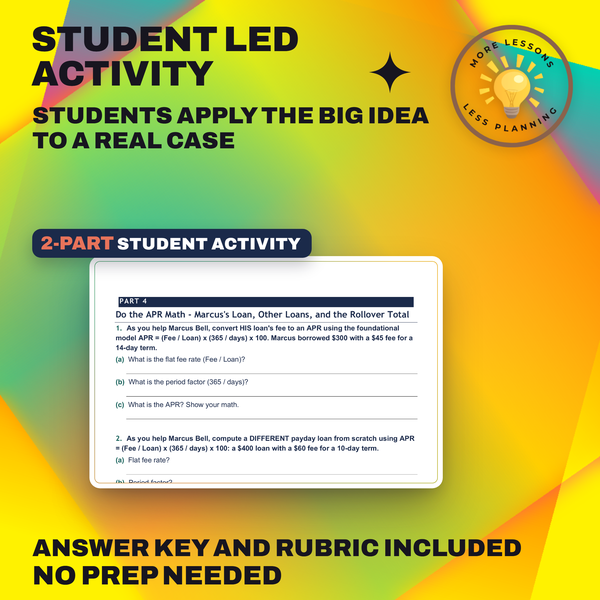
- Convert a $45 flat fee on a $300 payday loan into an APR using APR = (Fee/Loan) x (365/days) x 100
- Compare their calculated APR against a credit card's 24% and a personal loan's 11% on a bar chart
- Calculate the cost of five loan rollovers, where fees pile up while the principal never shrinks
- Recommend a cheaper alternative to a borrower and defend it with a calculated APR
What it covers
- The APR formula, APR = (Fee/Loan) x (365/days) x 100, applied to a real payday loan's flat fee
- How a payday loan's short term is what inflates a modest-looking flat fee into a triple-digit APR
- The rollover trap, where fees keep piling onto a principal that never actually shrinks
- Credit union small-dollar loans and emergency funds as real alternatives to a payday loan
Learning targets
- Define payday loan, title loan, APR, flat fee, and the debt cycle
- Convert a payday loan's flat fee to an APR using APR = (Fee / Loan) x (365 / days) x 100
- Read a bar chart that compares a payday loan's APR to a credit card and a personal loan
- Explain how the rollover debt cycle traps borrowers and name safer alternatives
Peek inside
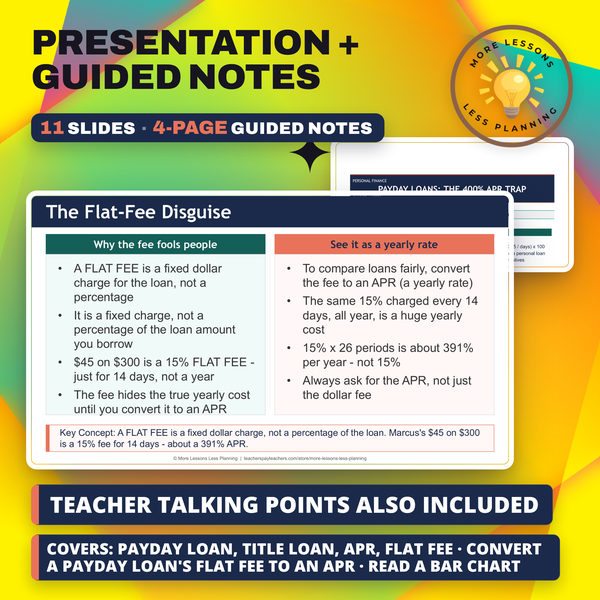
It looks cheap
Marcus borrows $300 and owes $345 in 14 days - 'just a $45 FEE'
The store quotes a FLAT FEE in dollars, never an interest rate
$45 on $300 for two weeks 'feels' small and fast
So borrowers sign without knowing the true yearly cost
It Looks Cheap
Marcus Bell borrows $300 and owes $345 in 14 days - the store calls it "just a $45 ."
The store quotes the cost as a FLAT FEE in dollars, never as an interest , so the loan feels small and fast.
It Is Really ~391% APR
Converted to a yearly rate, Marcus's $45 fee on a $300 loan for 14 days is really about a % APR.
That is about 16 times a credit card (~24%) and 36 times a personal (~11%).
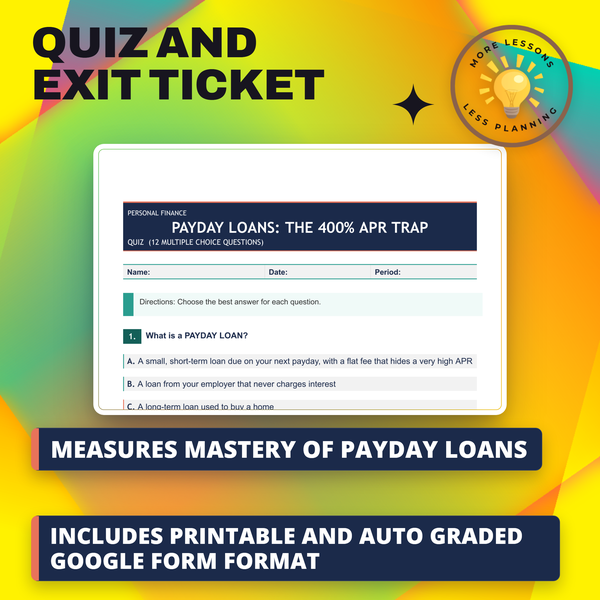
1. A small, short-term loan due on your next payday, with a flat fee that looks small but hides a very high APR, is a .
Why this matters
A $45 fee on a $300 loan sounds like a manageable flat cost, which is the exact assumption this lesson exists to correct before a student ever signs for one. Run that same fee through the real APR formula on its actual 14-day term and it lands close to 400 percent, next to a credit card's 24 and a personal loan's 11 on the same chart.
The number that actually changes minds is what five rollovers do to a $300 loan, since the fees keep stacking while the original principal never moves an inch. I would rather a student do that math on paper in my classroom than learn it by watching a paycheck disappear into a fee that never touches what they actually owe.
From one teacher to another
Every year I get a student who thinks a "$45 fee" sounds like a fair price for borrowing $300, and this lesson exists to correct that math before they sign anything. We walk through the actual formula, APR = (Fee/Loan) x (365/days) x 100, on a real $300 loan with a 14-day term, and students work the fee into an annualized rate themselves before checking it against a credit card and a personal loan on the comparison chart. Then we track what happens when the same loan gets rolled over five times, with students totaling the fees paid against the principal that never actually shrinks, which is usually the calculation that makes the lesson land, followed by a look at credit union small-dollar loans and emergency funds as the way out.
Every file in this toolkit
-
Activity (Student)
A $45 fee on Marcus Bell's $300 payday loan looks small until students convert it into a 391 percent APR, stack it against a credit card and a personal loan, then price out five rollovers on the same unpaid balance.
-
Activity (Answer Key)
Marcus's $300 payday loan carries a $45 fee that converts to roughly a 391% APR, a rate the chart puts at about 16 times a credit card and 36 times a personal loan, while five rollovers at that same fee pile up $225 in charges without ever touching the $300 owed.
-
Exit Ticket (Student)
Turning a flat dollar fee into a yearly rate is the opening calculation, before asking what a rollover does to Marcus's $300 principal and what a 391 percent APR on a two-week loan actually reveals. Payday loan, APR, and rollover get folded into the closing lines.
-
Exit Ticket (Answer Key)
A 391 percent APR, not the small $45 fee itself, is the answer this rubric rewards, plus recognizing that a rollover restarts the clock on Marcus's loan without shrinking the $300 he actually owes.
-
Guided Notes (Student)
Marcus Bell's $45 fee on a $300 two-week loan opens the page, walking the flat-fee math step by step until the 365-over-14 conversion turns it into an annual rate near 391 percent.
-
Guided Notes (Teacher Key)
391 percent is the APR for Marcus's $45 fee on his $300, 14-day loan, the number you get once the 365-over-14 period factor gets applied to that flat rate instead of the dollar amount.
-
Quiz (Student)
$400 with a $60 fee over 10 days closes out the quiz with a fresh APR calculation, after Marcus's $45 fee and his 391 percent APR set up most of the math on his repeatedly rolled-over $300 principal.
-
Quiz (Answer Key)
391 percent is the APR marked correct on Marcus's $45 fee for a 14-day loan, and the rollover math confirming he still owes the full $300 after five extensions closes out the set.
-
Slides
$300 borrowed becomes $345 owed in fourteen days for what the lender calls a flat $45 fee, and these slides convert that fee into a 391 percent APR step by step, towering over a credit card's roughly 24 percent before the rollover cycle starts.
-
Teacher Guide
Rolling a $300 payday loan over seven times means Marcus Bell has paid $315 in fees and still owes the original $300, the rollover trap this 60-point guide's extensions track step by step, plus a cheat-sheet comparing his 391% APR against real credit-union alternatives.
-
Teacher Presentation Notes
A $45 fee on a $300, 14-day loan works out to about a 391% APR for Marcus Bell, the formula, fee over loan times 365 over days times 100, that explains why he keeps rolling the loan instead of paying it off.
Download
Where should I send the next one?
Everything here is free and it stays that way. Leave your email and I'll send you the new lessons as they go up. You can unsubscribe from any one of them.
Related resources
Cosigning and Co-Borrowing - Sharing the Risk
Interest Explained - Simple vs Compound
Loan Default - What Happens When You Can't Pay
Student Loans and Financial Aid
The Debt Snowball vs Avalanche - Paying It Off
What Is a Loan? Principal, Interest & Terms
Every lesson on this site is free to download and use. If one of them saved you a prep period, you can chip in a few bucks toward my three kids' daycare fund. That's genuinely where tips go.